Algeria
 Egypt
 Libya
 Morocco
 Sudan
 Tunisia
 Benin
 Burkina Faso
 Cabo Verde
 Côte d'Ivoire
 Ghana
 Guinea
 Guinea-Bissau
 Liberia
 Mali
 Mauritania
 Niger
 Nigeria
 Senegal
 Sierra Leone
 The Gambia
 Togo
 Cameroon
 Central African Republic
 Chad
 DR Congo
 Equatorial Guinea
 Gabon
 Republic of the Congo
 São Tomé and Príncipe
 Burundi
 Comoros
 Djibouti
 Eritrea
 Ethiopia
 Kenya
 Madagascar
 Malawi
 Mauritius
 Mozambique
 Rwanda
 Seychelles
 South Sudan
 Tanzania
 Uganda
 Angola
 Botswana
 Eswatini
 Lesotho
 Namibia
 South Africa
 Zambia
 Zimbabwe
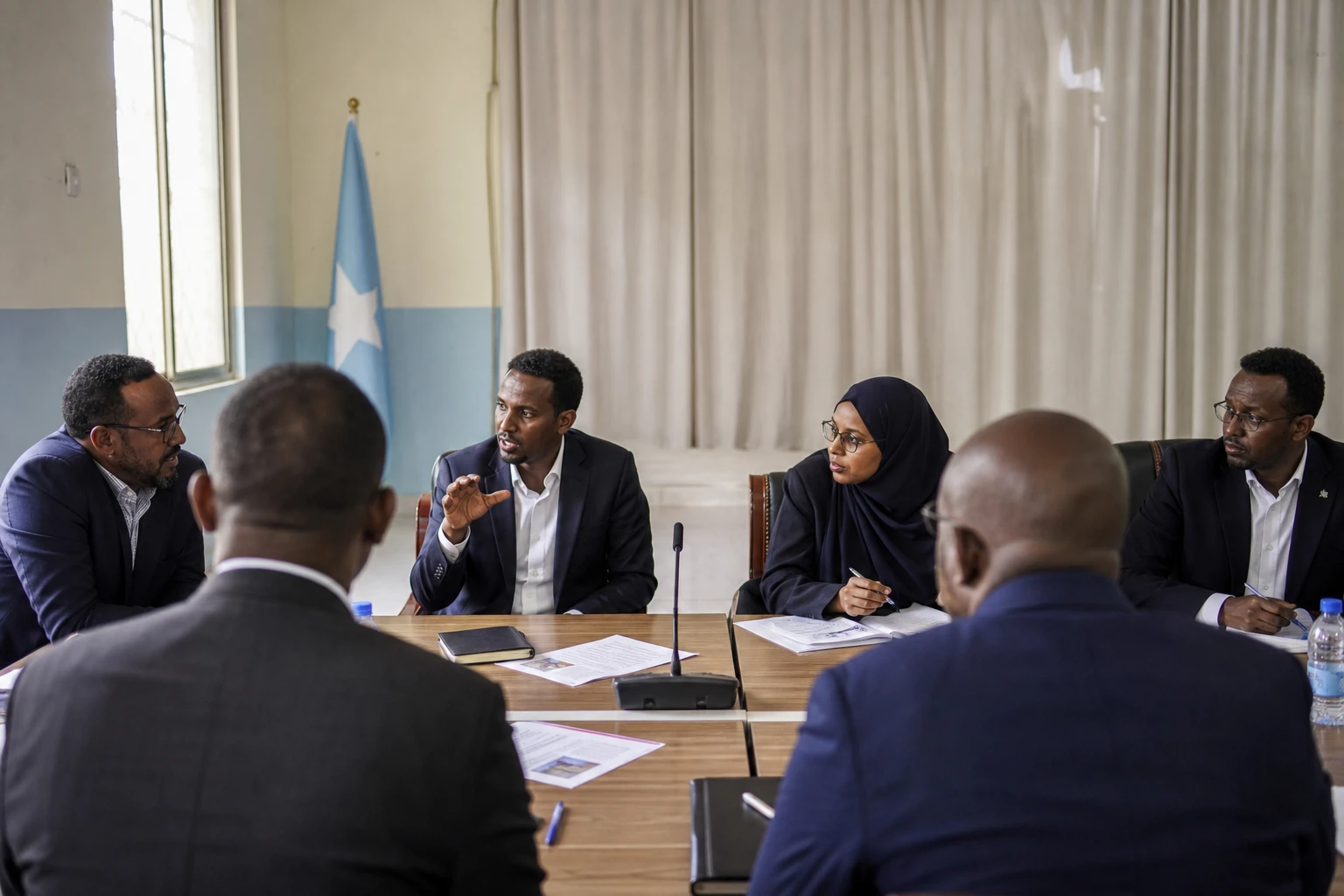
In Mogadishu, land is not just space to build on. It is also a test of power
In the Somali capital, demolitions do more than tear down walls. They revive a broader question: who decides how the city is run, and under what legal authority? In Mogadishu, a city undergoing rapid reconstruction and a place of survival for thousands of displaced families, every eviction operation can become a political flashpoint. Events on 23 August 2026 in the Yaaqshiid district have once again put the issue at the centre of public life in Somalia.
This standoff is rooted in a much longer-running problem. The Banadir region, which includes Mogadishu, has for years accounted for a large share of the forced evictions recorded in the country. The United Nations and UNHCR have long described the capital as an epicentre of land disputes, against a backdrop of no fully operational land registry, demographic pressure and a large population of internally displaced people. Somalia is also working to develop urban and housing policies, with national consultations on housing policy held in Mogadishu in 2026.
What happened in Yaaqshiid
On Sunday 23 August 2026, clashes broke out in the Tookiyo area of Yaaqshiid district, in northern Mogadishu. According to local media, security forces accompanied a house demolition operation involving homes that the authorities said had been built on public land. Residents protested. The clashes left people injured, while reported tolls differ between sources. Hiiraan Online reported on 24 August that one person had been killed and around ten others injured. Goobjoog, for its part, reported nearly ten injuries on 23 August.
The Somali government offers a different interpretation. Local authorities say they want to reclaim public land that has been occupied unlawfully and allocate it to development projects. Mogadishu mayor and Banadir governor Hassan Mohamed Hussein Muungaab backed a policy of reorganising public plots in 2026, while saying that complaints would be handled by administrative committees. This position is part of a broader strategy to reassert control over land in Mogadishu.
The opposition, meanwhile, speaks of land grabbing and a policy pursued at the expense of the most vulnerable households. The criticism is based on a recurring observation: evictions often affect displaced families already living in precarious areas. In 2026, humanitarian actors again raised the alarm over the vulnerability of urban sites in Banadir, where evictions can force people who have already lost their homes once to flee again.
A land crisis, but also a governance crisis
The heart of the problem goes beyond the demolition of houses. In Mogadishu, land lies at the intersection of urbanisation, political rivalries and economic reconstruction. The capital is attracting investment, road projects, infrastructure programmes and development initiatives backed by the state and its partners. But this momentum runs up against a simple rule: without a robust land registry, every plot is open to dispute. In this vacuum, the poorest often pay the heaviest price.
Humanitarian figures convey the scale of the challenge. UNHCR and its partners point out that hundreds of thousands of displaced people live in and around Mogadishu, often on private or disputed plots. UN documents also note that the Banadir region accounts for a major share of evictions recorded in the country. In short, the capital is not only the seat of power: it is also the main point of friction between housing needs, pressure on land and the right to shelter.
The debate took on an even clearer political dimension in 2026. The national consultation on housing policy, which concluded in June in Mogadishu, shows that the Somali state is seeking to develop an institutional response. But as long as compensation, prior notification and dispute-resolution mechanisms remain weak, operations on the ground will continue to generate tensions. Residents of poorer neighbourhoods see above all what they stand to lose immediately: a roof, a business, a nearby school, sometimes the only capital built up over several years.
For their part, the authorities are seeking to show that they govern the city. In a country where the federal government is still trying to harmonise its relations with regional administrations and Banadir, the ability to reclaim illegally occupied land is also seen as a show of authority. This logic explains the intensity of the standoff. But it also explains the public anger, because an urban policy that moves ahead without a social safety net deepens distrust.
What the case says about Somalia and the region
The events in Yaaqshiid resonate beyond Mogadishu. Across the Horn of Africa, cities are absorbing a growing share of internal displacement caused by war, drought and poverty. Somalia, a member of IGAD, faces a challenge shared by other capitals in the region: how to provide housing quickly without allowing the use of state force to become the primary means of displacement?
For Somalia, the stakes are twofold. Domestically, the state must prove that it can renew Mogadishu without further weakening households already at risk. Politically, it must prevent the land issue from becoming a crisis of legitimacy. The protests and security forces’ response show that in the capital, urban development is also an institutional project. As long as land rights remain uncertain, every bulldozer can become a major political event.