Algeria
 Egypt
 Libya
 Morocco
 Sudan
 Tunisia
 Benin
 Burkina Faso
 Cabo Verde
 Côte d'Ivoire
 Ghana
 Guinea
 Guinea-Bissau
 Liberia
 Mali
 Mauritania
 Niger
 Nigeria
 Senegal
 Sierra Leone
 The Gambia
 Togo
 Cameroon
 Central African Republic
 Chad
 DR Congo
 Equatorial Guinea
 Gabon
 São Tomé and Príncipe
 Burundi
 Comoros
 Djibouti
 Eritrea
 Ethiopia
 Kenya
 Madagascar
 Malawi
 Mauritius
 Mozambique
 Rwanda
 Seychelles
 Somalia
 South Sudan
 Tanzania
 Uganda
 Angola
 Botswana
 Eswatini
 Lesotho
 Namibia
 South Africa
 Zambia
 Zimbabwe
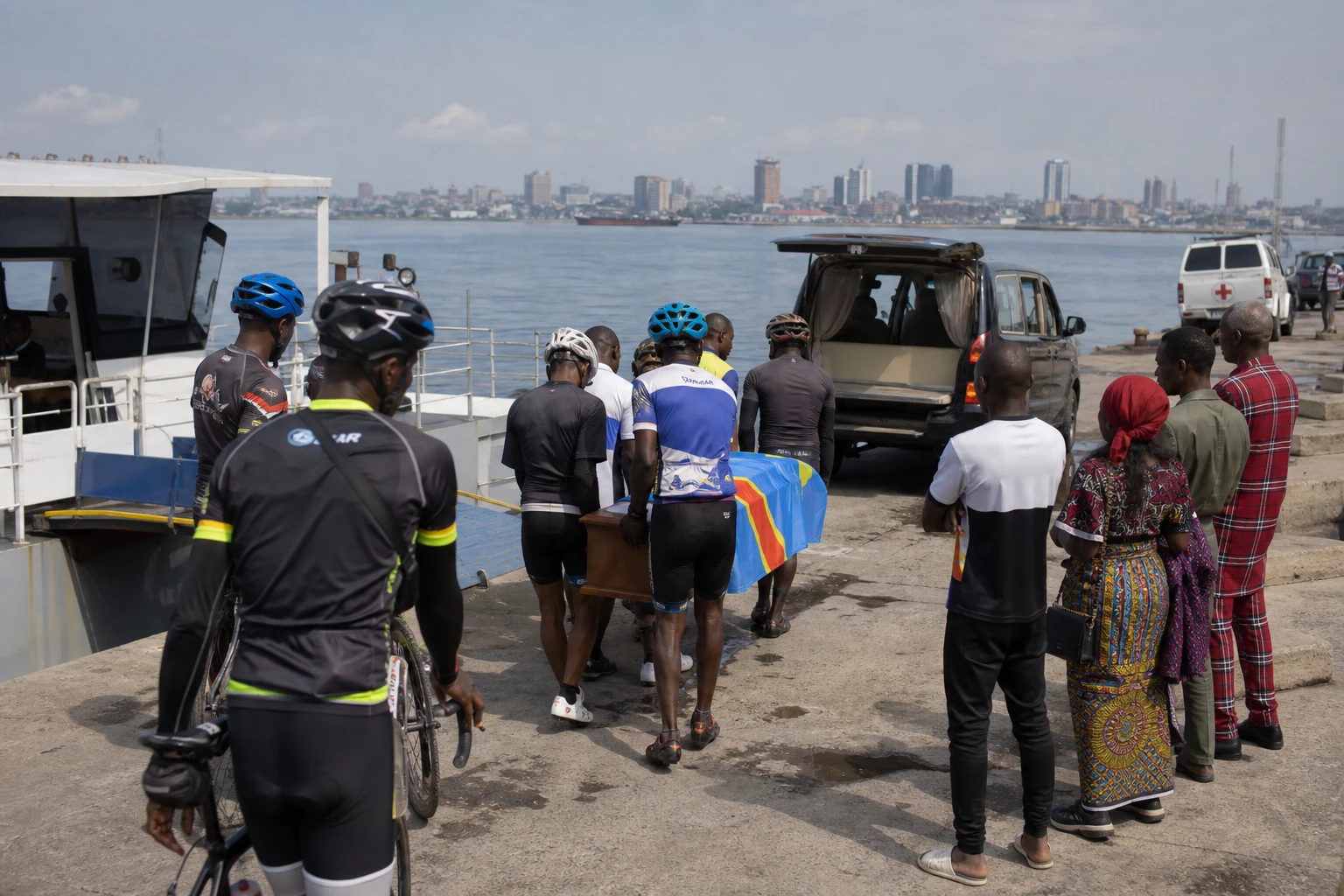
In Kinshasa, Miguel Masaisai’s return took place in the silence of a funeral cortege. The young Congolese cyclist, who had set out from Goma to carry a message of peace to Rabat, was brought back to the Democratic Republic of the Congo after dying on a road in the Republic of the Congo.
His body arrived in Kinshasa on Friday 25 September 2026. It was then taken to the mortuary at Cinquantenaire Hospital. The official funeral programme has not yet been announced by the Congolese authorities.
A journey that began in Goma and reached Kinshasa
Miguel Masaisai, aged 23 according to several corroborating sources, left Goma on 1er May 2026. His aim was to reach Rabat, Morocco, by bicycle, after a journey estimated at nearly 14 000 kilometres.
His initiative, called « Pedals for Peace », was intended to draw attention to the war in eastern DR Congo. It also carried a broader message of unity, solidarity and peace among African peoples.
Before reaching the Republic of the Congo, the cyclist had crossed the Democratic Republic of the Congo from east to west. He arrived in Kinshasa on 5 August, after 67 days on the road and more than 6 500 kilometres travelled, according to information published by Radio Okapi and corroborated by Congolese media.
This leg of the journey prompted a significant welcome in the capital. Young people, cyclists and community leaders praised an individual initiative that had become a focus for collective mobilisation.
A crash on a road in the Republic of the Congo
The journey was cut short on 18 September 2026 in the north of the Republic of the Congo, near Ouesso and the border with Cameroon. Initial reports said a lorry and a vehicle carrying the cyclist had been involved in a road accident.
Available information indicates that Miguel Masaisai had left his bicycle after a mechanical breakdown. He is said to have taken a taxi to reach Ouesso and have his equipment repaired. The vehicle was subsequently involved in the collision. These circumstances were reported by several sources, including Actualité.cd and Congo Inter.
The precise details of the investigation remain the responsibility of the authorities of the Republic of the Congo. The casualty figures and judicial circumstances should therefore not be presented beyond established facts and officially released information.
News of his death initially spread amid confusion on social media. Contradictory messages were posted by relatives and internet users. Cross-checking by Congolese media and fact-checkers subsequently confirmed his death.
Repatriation, a process spanning both banks of the river
The repatriation involved Congolese officials on both sides of the Congo River. A delegation from the Democratic Republic of the Congo had travelled to the Republic of the Congo to follow the administrative procedures and prepare the transfer of the body.
The body eventually crossed the river via Beach Ngobila, the crossing point between Brazzaville and Kinshasa. Relatives, members of the cycling community and representatives of Congolese youth were present on arrival.
The body was then escorted to the mortuary at Cinquantenaire Hospital. For Kinshasa’s cyclists, the journey took on particular significance. They had followed Miguel Masaisai’s progress in the hope of seeing him return on his bicycle. In the end, they accompanied him in a cortege of mourning.
The National Youth Council had supported the request for repatriation and called for a national tribute to be organised. That request will now be considered as part of the official programme the government may announce in the coming days.
A message of peace beyond national borders
Miguel Masaisai’s journey was set against a national backdrop of persistent violence in eastern DR Congo. Originally from Goma, a city in North Kivu regularly affected by armed tensions and population displacement, he chose sport as a way to make his voice heard publicly.
His initiative was not an institutional operation. It relied on his own resources, endurance and the support he encountered along the way. This approach enabled him to form direct ties with people in several Congolese provinces.
The route was also intended to connect several parts of Central Africa. After Kinshasa, Miguel Masaisai had reached Brazzaville, then continued north through the Republic of the Congo. His route was to take him to Cameroon, before further legs towards North Africa.
This regional dimension is a reminder of the human and economic ties between Kinshasa and Brazzaville. The two capitals face each other, but also belong to a shared network of movement in Central Africa. Co-operation between their authorities becomes essential when an accident, death or consular procedure involves nationals of both countries.
What his journey leaves to Congolese youth
Miguel Masaisai’s death brings a journey to an end. It does not erase the meaning his supporters attach to it. Through the kilometres he covered, the young athlete showed that a project driven by one person could reach several cities, communities and generations.
His story also highlights the practical difficulties of long-distance cycling across Central Africa. Breakdowns, varying road conditions, distances between cities and the risks associated with road transport can turn an ordinary leg of a journey into a dangerous situation.
For now, attention is focused on the announcement of the funeral and the next steps in the investigation being conducted in the Republic of the Congo. In Kinshasa, the final tribute is expected to bring together officials, cyclists, relatives and the young people who had followed his initiative.
Miguel Masaisai did not reach Rabat. But his route has already connected Goma, Kinshasa, Brazzaville and the communities he encountered along the way. For Congolese youth, his bicycle will remain associated with a simple idea: peace can also be defended through visible, cross-border civic action.