
 Algeria
 Egypt
 Libya
 Morocco
 Sudan
 Tunisia
 Benin
 Burkina Faso
 Cabo Verde
 Côte d'Ivoire
 Ghana
 Guinea
 Guinea-Bissau
 Liberia
 Mali
 Mauritania
 Niger
 Nigeria
 Senegal
 Sierra Leone
 The Gambia
 Togo
 Cameroon
 Central African Republic
 Chad
 DR Congo
 Equatorial Guinea
 Gabon
 Republic of the Congo
 São Tomé and Príncipe
 Burundi
 Comoros
 Djibouti
 Eritrea
 Kenya
 Madagascar
 Malawi
 Mauritius
 Mozambique
 Rwanda
 Seychelles
 Somalia
 South Sudan
 Tanzania
 Uganda
 Angola
 Botswana
 Eswatini
 Lesotho
 Namibia
 South Africa
 Zambia
 Zimbabwe
In Mekelle, the Ethiopian federal army’s takeover does not resolve the conflict. It shifts the war’s centre of gravity: after losing the Tigray capital, the Tigray People’s Liberation Front (TPLF) may favour rural areas, mobile attacks and clandestine resistance.
A military victory does not mean peace
On 28 November 2020, Ethiopian Prime Minister Abiy Ahmed announced that federal forces had taken full control of Mekelle, the regional capital of Tigray. The army entered the city after officials and fighters linked to the TPLF withdrew, following nearly four weeks of fighting.
The federal government presented the operation as the completion of its military campaign. The head of government also said the final phase of the intervention was over. However, this announcement was not enough to establish that fighting had ended across Tigray.
TPLF officials said their forces would continue the struggle. Several observers at the time believed the withdrawal from Mekelle could represent a change of tactics rather than a surrender. A shift from direct confrontation to guerrilla warfare would allow Tigrayan fighters to draw on the terrain and local networks.
This possibility was reinforced by the TPLF’s history. The movement had itself fought for years as a guerrilla force before helping to bring down Ethiopia’s military regime in 1991. Its political and social roots in Tigray also gave it a greater capacity to mobilise than an armed group without a territorial base.
Mekelle under control, but the city remains tense
After federal troops entered, soldiers patrolled the streets and secured key public buildings. Communications began to be restored after several days of disruption. The restoration was still partial, however, and did not allow information from rural areas to be verified quickly.
Shops remained closed. Residents had moved their stocks to places they considered safer, fearing looting and damage. In a city hit by fighting, the immediate issue was therefore not just military control. It also concerned access to food, healthcare, cash and transport.
The telecommunications blackout severely hampered the work of journalists, humanitarian organisations and families separated by the conflict. A joint investigation by the Ethiopian Human Rights Commission and the Office of the United Nations High Commissioner for Human Rights confirmed that telephone and internet networks had been cut from the start of the crisis, on 4 November 2020.
Under these conditions, casualty figures and accounts of abuses remained difficult to establish independently. Statements by the parties had to be treated with caution, particularly when they concerned military operations, civilian casualties or the state of infrastructure.
The conflict is rooted in a national institutional crisis
The Tigray war arose from a confrontation between the federal government in Addis Ababa and regional authorities dominated by the TPLF. Tensions escalated after the postponement of Ethiopia’s 2020 national elections, officially attributed to the Covid-19 pandemic. Tigrayan leaders rejected the postponement and held their own regional elections in September.
The federal government considered the vote illegal. The TPLF, for its part, challenged the central government’s legitimacy to extend its term beyond the scheduled date. The electoral dispute was added to deeper rivalries over the distribution of power, the structure of federalism and the role of former political elites.
On 3 November 2020, federal authorities accused forces loyal to the TPLF of attacking Ethiopian army installations in the north of the country. The TPLF described the events as a response to an offensive prepared by Addis Ababa. These opposing accounts marked the start of a war whose first weeks were almost impossible to document on the ground.
The conflict quickly spread beyond Tigray’s administrative borders. Fighters and allied forces from the Amhara region took part in operations alongside the federal army. Eritrea, which borders Tigray, was also accused of involvement in the fighting, something the Eritrean and Ethiopian authorities long denied or played down.
The Horn of Africa faces the risk of escalation
The regional dimension of the conflict worried neighbouring countries. Tigray shares a border with Eritrea and Sudan. Tensions between Addis Ababa and Asmara were particularly sensitive, as the TPLF had governed Ethiopia for nearly three decades before Abiy Ahmed came to power in 2018.
The two countries had already fought a border war between 1998 and 2000. Reconciliation between Abiy Ahmed and Eritrean President Isaias Afwerki earned the Ethiopian prime minister the Nobel Peace Prize in 2019. But the Tigray conflict revived suspicions and antagonisms from the previous period.
Sudan, too, had to manage the fallout from the crisis. Thousands of people fled to its territory after fighting began. At the same time, Khartoum and Addis Ababa were locked in a border dispute over Al-Fashaga, a contested agricultural area. The war in Tigray therefore risked adding another source of tension to an already fragile border.
Egypt, Somalia, Sudan and Eritrea called for respect for international law and rejected unilateral measures. Their position reflected regional concerns, but did not yet amount to a mediation mechanism capable of imposing a ceasefire.
The African Union’s expected role
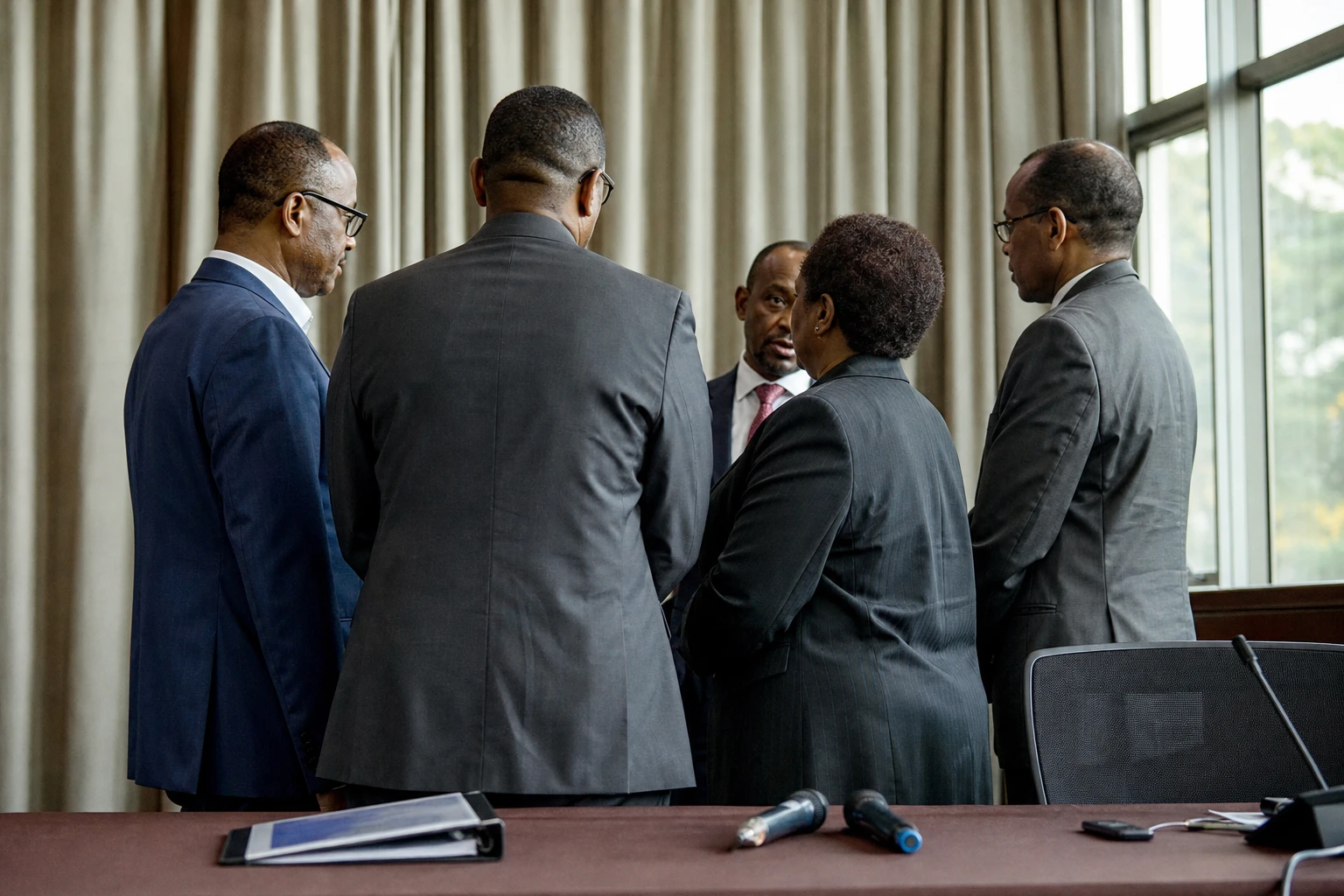
The crisis also tested the African Union, whose headquarters are in Addis Ababa. Three former African heads of state — Joaquim Chissano of Mozambique, Ellen Johnson Sirleaf of Liberia and Kgalema Motlanthe of South Africa — had been appointed special envoys to seek a political solution.
Their mission, however, faced the federal government’s refusal to negotiate with the TPLF before its military operation was over. The Tigrayan movement, for its part, sought to preserve its forces and its ability to resist. Between these two positions, humanitarian access and the protection of civilians remained the most urgent priorities.
The capture of Mekelle was therefore a turning point, but not a resolution. For Addis Ababa, the challenge was to restore federal authority without turning military victory into a lasting occupation. For Tigray’s residents, it was about regaining essential services and security. For neighbouring countries, the priority was to prevent the war from spreading to the Sudanese border or Eritrea.
The course of the conflict depended less on the army’s presence in the regional capital than on the ability to restore communications, ensure humanitarian aid and create a credible political framework. Without these conditions, the fall of Mekelle could mark the beginning of a new phase rather than the end of the war.



