Algeria
 Egypt
 Libya
 Morocco
 Sudan
 Tunisia
 Benin
 Burkina Faso
 Cabo Verde
 Côte d'Ivoire
 Ghana
 Guinea
 Guinea-Bissau
 Liberia
 Mali
 Niger
 Nigeria
 Senegal
 Sierra Leone
 The Gambia
 Togo
 Cameroon
 Central African Republic
 Chad
 DR Congo
 Equatorial Guinea
 Gabon
 Republic of the Congo
 São Tomé and Príncipe
 Burundi
 Comoros
 Djibouti
 Eritrea
 Ethiopia
 Kenya
 Madagascar
 Malawi
 Mauritius
 Mozambique
 Rwanda
 Seychelles
 Somalia
 South Sudan
 Tanzania
 Uganda
 Angola
 Botswana
 Eswatini
 Lesotho
 Namibia
 South Africa
 Zambia
 Zimbabwe
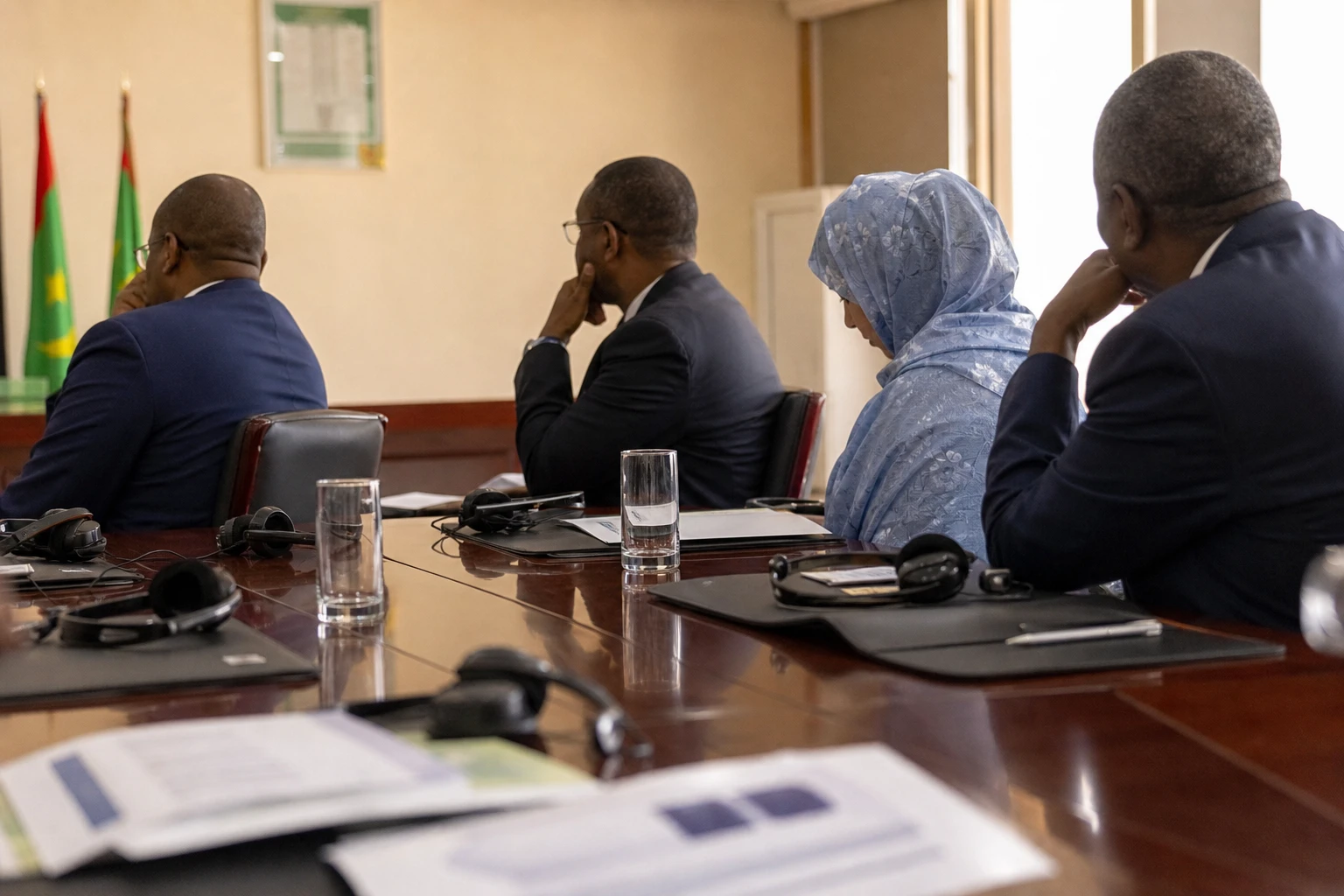
In Nouakchott, an old debate keeps returning to the same point
In Mauritania, major discussions at the end of a second term are never just about one person. They touch on confidence in the rules of the game, the role of the National Assembly and the ability of institutions to withstand pressure in the moment. In Nouakchott and the country’s major inland cities, many know that a single word — “continuity” — can quickly become a battle over the duration of power.
The country is not an isolated case in West Africa, but it has its own trajectory. Mauritania has already experienced sensitive constitutional revisions and a political past marked by ruptures. Today, the debate is taking place within a more tightly regulated framework than in the past, with a fundamental text setting the presidential term at five years, renewable only once.
In other words, the question is not theoretical. It strikes at the heart of the institutional pact. And in a country that presents itself as stable amid a shifting Sahelian environment, the slightest ambiguity over electoral rules quickly takes on national significance.
The legal framework is clear, but the political debate is not
Mauritania’s Constitution is explicit. The president of the Republic is elected for five years and may be re-elected only once. The same Constitution also stipulates that no amendment may undermine the principle of democratic alternation in executive power. This safeguard exists precisely to prevent the rules from being redrawn according to the balance of power.
It is in this context that controversy has resurfaced over a possible third term for Mohamed Ould Cheikh El Ghazouani. The head of state has repeatedly indicated that he does not see this issue as a priority and remains committed to the provisions of the Constitution. At his inauguration for a new five-year term, he even swore not to support any initiative aimed at amending the provisions governing the length and renewal of his term.
This clarification matters because it places the debate in the realm of political signals, not just legal texts. When voices in the majority raise the possibility of future reform, the opposition immediately sees it as a test of constitutional loyalty. It is no longer a discussion about the future, but a question about the government’s real intentions.
Within presidential ranks, some argue that it is too early to rule out any future changes. They cite continuity in public policy, institutional stability and the achievements claimed by the government. This line of defence does not necessarily mean that reform is imminent, but it fuels uncertainty over the timing and method.
The opposition targets not so much one man as the temptation to make rules flexible
The strongest response has come from the opposition, which refuses to let the debate drift towards normalising a third term. Biram Dah Abeid, who came second in the 2024 presidential election with 22.10% of the vote, according to official results, has insisted that the Constitution must be applied without political expediency. His argument is simple: the real issue is not the incumbent president, but the possibility that the rules could be changed tomorrow to remain at the top of the state.
This framing resonates with some of the public, who see term limits as a safeguard, not an inconvenience. In Mauritania, where political life is organised around fluid coalitions, dominant parties and strong personalities, stability does not depend on the text alone. It also depends on the credibility of commitments made to voters. When such a commitment is seen as reversible, the force of public statements diminishes.
The precedent of the 2024 presidential election remains present in people’s minds. Mohamed Ould Cheikh El Ghazouani was re-elected in the first round with 56.12% of the vote, while protests over the results led to tensions and deaths during post-election demonstrations, according to figures reported at the time. That episode left a lasting political mark: it was a reminder that, in Mauritania, acceptance of results and the management of disagreement remain sensitive issues.
In this context, the opposition’s firmness is more than a posture. It also serves to draw a red line before the debate shifts to the National Assembly, public opinion or a hypothetical political dialogue. The earlier the issue takes hold, the harder it becomes to close it down cleanly.
What this standoff says about Mauritania and its African neighbourhood
The issue extends beyond the presidential succession alone. Mauritania sits at the crossroads of several African political spaces. It belongs to the African Union and the Arab Maghreb Union, and is also situated in a West Sahelian environment exposed to security tensions, military transitions and debates over the duration of power. In such a landscape, every institutional signal matters, because it is read far beyond Nouakchott.
The government seeks to highlight stability, public projects and administrative continuity. The opposition, for its part, stresses the most basic democratic guarantee: a term has an end. Between these two narratives, the real challenge is broader. It concerns the ability of Mauritania’s institutions to arbitrate without improvisation, to frame the debate without distorting it, and to prevent a question of succession from undermining political cohesion.
For citizens, the difference is tangible. In the capital, the debate is seen through parties, opinion pieces and official statements. In inland regions, it is measured more by the state’s ability to deliver on its economic promises, maintain order and allow political expression without excessive tension. This is where the government’s credibility is at stake, far more than in slogans of loyalty.
What happens next will depend above all on two things: the progress of the ongoing national dialogue and whether the majority chooses to close this chapter before it grows more entrenched. If the issue persists, it will become a test of institutional maturity. If it clearly fades, it will confirm that Mauritania can still resolve succession debates through law rather than ambiguity.