Algeria
 Egypt
 Libya
 Morocco
 Sudan
 Tunisia
 Benin
 Cabo Verde
 Côte d'Ivoire
 Ghana
 Guinea
 Guinea-Bissau
 Liberia
 Mali
 Mauritania
 Niger
 Nigeria
 Senegal
 Sierra Leone
 The Gambia
 Togo
 Cameroon
 Central African Republic
 Chad
 DR Congo
 Equatorial Guinea
 Gabon
 Republic of the Congo
 São Tomé and Príncipe
 Burundi
 Comoros
 Djibouti
 Eritrea
 Ethiopia
 Kenya
 Madagascar
 Malawi
 Mauritius
 Mozambique
 Rwanda
 Seychelles
 Somalia
 South Sudan
 Tanzania
 Uganda
 Angola
 Botswana
 Eswatini
 Lesotho
 Namibia
 South Africa
 Zambia
 Zimbabwe
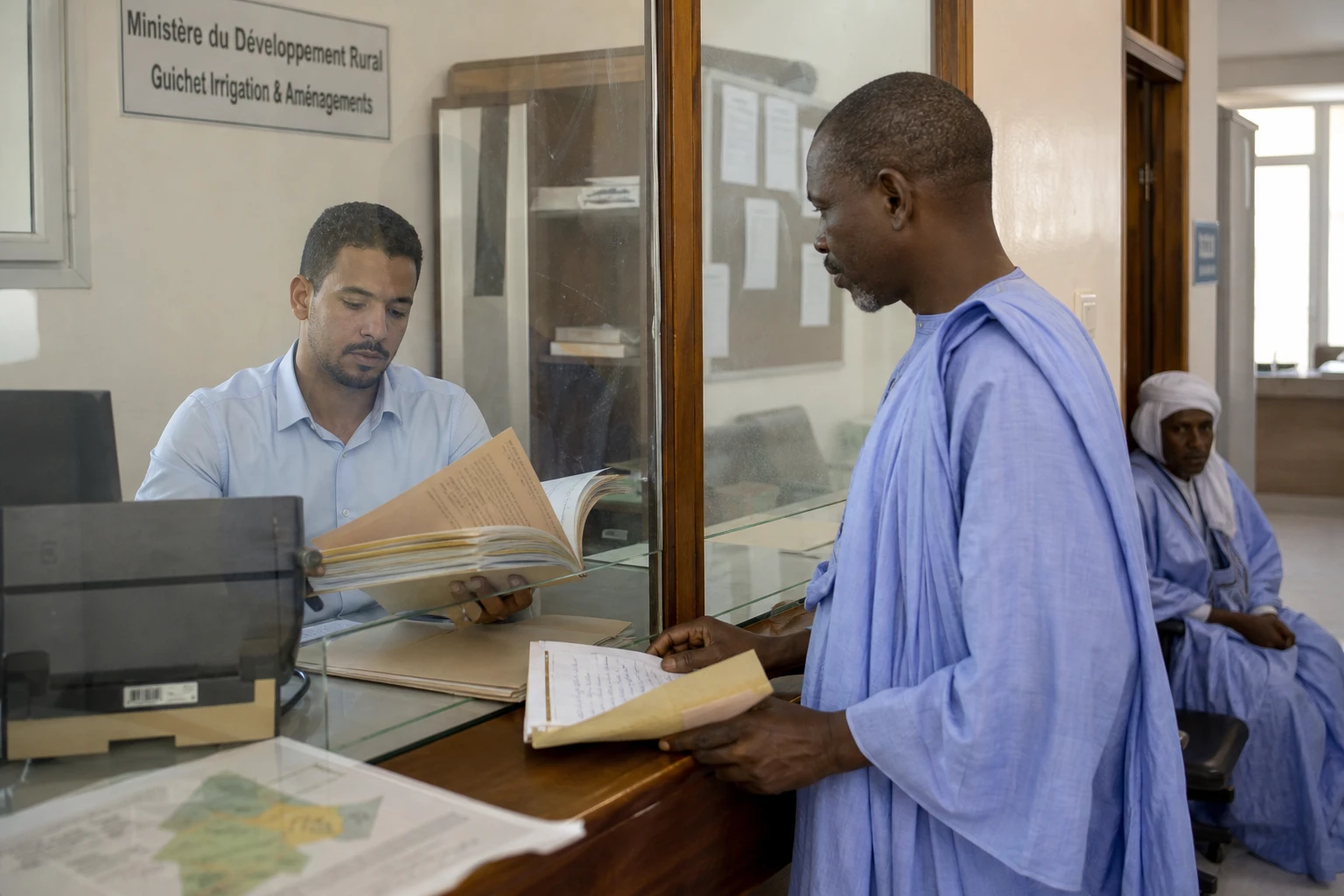
In Brakna, water is as valuable as land
In Boghé, the question is not simply how to grow more. First, it is how to secure water, organise plots and make a value chain sustainable over time. That is the challenge of the agricultural project under discussion between Nouakchott and Italian stakeholders: without reliable irrigation, the announced hectares remain a promise; with a canal, they could become a productive base for rice, wheat and market gardening.
The project is part of a broader context. Italy’s Mattei Plan, launched to structure its cooperation with Africa, lists agriculture and food security among its official priorities. In Nouakchott, this approach has a practical setting in the Senegal River valley, where Mauritania has for several years been seeking to make better use of its irrigated schemes.
A 10,000-to-20,000-hectare project around a new canal
On 1 September 2026, Mauritania’s Minister of Agriculture and Food Sovereignty, Mohamedou Ahmedou Mhaimid, received an Italian delegation that included representatives of B.F.I and Saham. The talks focused on a joint project between SONADER, the National Rural Development Company, and B.F.I, to develop between 10,000 and 20,000 hectares in Brakna by building a new canal near Boghé.
The project aims to integrate wheat into the national agricultural system while developing vegetables and rice and wheat seeds. Its stated goal is clear: to strengthen local production and reduce the country’s dependence on external markets for strategic foodstuffs. No precise start date has been announced at this stage.
This development has not come out of nowhere. In Mauritania, SONADER is already central to schemes for hydro-agricultural development in the valley. The Ministry of Agriculture has also signed a programme with the FAO to provide SONADER with a master plan for the right bank of the Senegal River, backed by $450,000 in funding and involving national and international experts.
Wheat, where Italian and Mauritanian interests meet
On the ground, Mauritania is already testing wheat cultivation on a small scale. In March 2024, the ministry announced the success of a first trial on 200 hectares in Trarza, with yields of between 4 and 5 tonnes per hectare and gross production of about 1,000 tonnes. The same ministry later said the number of varieties adapted to the country had risen to five, a sign that an agronomic base is beginning to take shape.
Under the same project, support for the wheat value chain enabled 16 tonnes of ACSAD seeds to be produced in Aftout and Assaba, with a reported increase of 400% in these volumes. The authorities say there is potential to expand cultivation by a further 100 hectares or so. In other words, the issue is no longer just experimentation, but scaling up.
Bonifiche Ferraresi has already struck numerous agricultural agreements across the continent. The group is involved in large-scale projects in Algeria, Ghana, Senegal, Côte d’Ivoire and Congo, covering areas ranging from 5,000 to 36,000 hectares, depending on the case. Mauritania is therefore becoming a new link in an African strategy combining production, irrigation, training and local processing.
What this arrival means for Mauritania
For the Mauritanian authorities, the benefits are twofold. First, they can attract an investor capable of financing major water infrastructure that the public sector cannot always fund alone. Second, they can accelerate the development of a still-fragile cereal value chain in a country where imports remain a major safeguard for domestic market supplies. The potential benefits extend first to producers in the valley, then to processors, seed producers and distribution networks in Nouakchott and other major cities.
But the issue is not simply an investment announcement. In the Senegal River valley, hydro-agricultural schemes continue to raise the same questions: access to water, canal maintenance, land allocation, the inclusion of family farms and the sharing of benefits. SONADER’s central role in the arrangement is decisive, as the public company holds the technical knowledge of the schemes in Boghé and the rest of Mauritania’s agricultural corridor.
The social impact is significant. If the project remains a productive enclave, it will mainly benefit one operator and a few parts of the value chain. If it is linked to local farmers, women market gardeners, cooperatives and agricultural extension services, it could instead boost rural employment and income flows in Brakna. The difference will lie in the details of the arrangement, not in the slogans.
A useful test for the Senegal River valley and West Africa
Beyond Mauritania, the project raises a broader regional question: how can West Africa’s irrigated valleys become foundations for food security without replicating models poorly suited to local agriculture? The right bank of the Senegal River already brings together issues of water, climate and investment that extend beyond Brakna alone. It also requires projects to be considered from start to finish, from land rights to marketing.
Against this backdrop, Boghé is a site to watch. If the Italian project goes ahead, it will say something about the new relationship between southern Europe and West Africa: less focused on aid, more on productive investment. For Mauritania, the challenge is to turn this window of interest into lasting capacity, with infrastructure, seeds, skills and clear governance. That is the true measure of an agricultural project.