Algeria
 Egypt
 Libya
 Morocco
 Sudan
 Tunisia
 Benin
 Burkina Faso
 Cabo Verde
 Côte d'Ivoire
 Ghana
 Guinea
 Guinea-Bissau
 Liberia
 Mali
 Mauritania
 Niger
 Nigeria
 Senegal
 Sierra Leone
 The Gambia
 Togo
 Central African Republic
 Chad
 DR Congo
 Equatorial Guinea
 Gabon
 Republic of the Congo
 São Tomé and Príncipe
 Burundi
 Comoros
 Djibouti
 Eritrea
 Ethiopia
 Kenya
 Madagascar
 Malawi
 Mauritius
 Mozambique
 Rwanda
 Seychelles
 Somalia
 South Sudan
 Tanzania
 Uganda
 Angola
 Botswana
 Eswatini
 Lesotho
 Namibia
 South Africa
 Zambia
 Zimbabwe
A court case that extends beyond the courtroom
In Yaoundé, a trial can become a test of trust for an entire country. When it concerns the violent death of a journalist, intelligence services and officials already at the top of the state apparatus, every testimony carries weight far beyond the courtroom. The Martinez Zogo case has become one of those moments when Cameroon’s justice system is being watched for its ability to shed light on the facts without yielding to pressure or pre-written narratives.
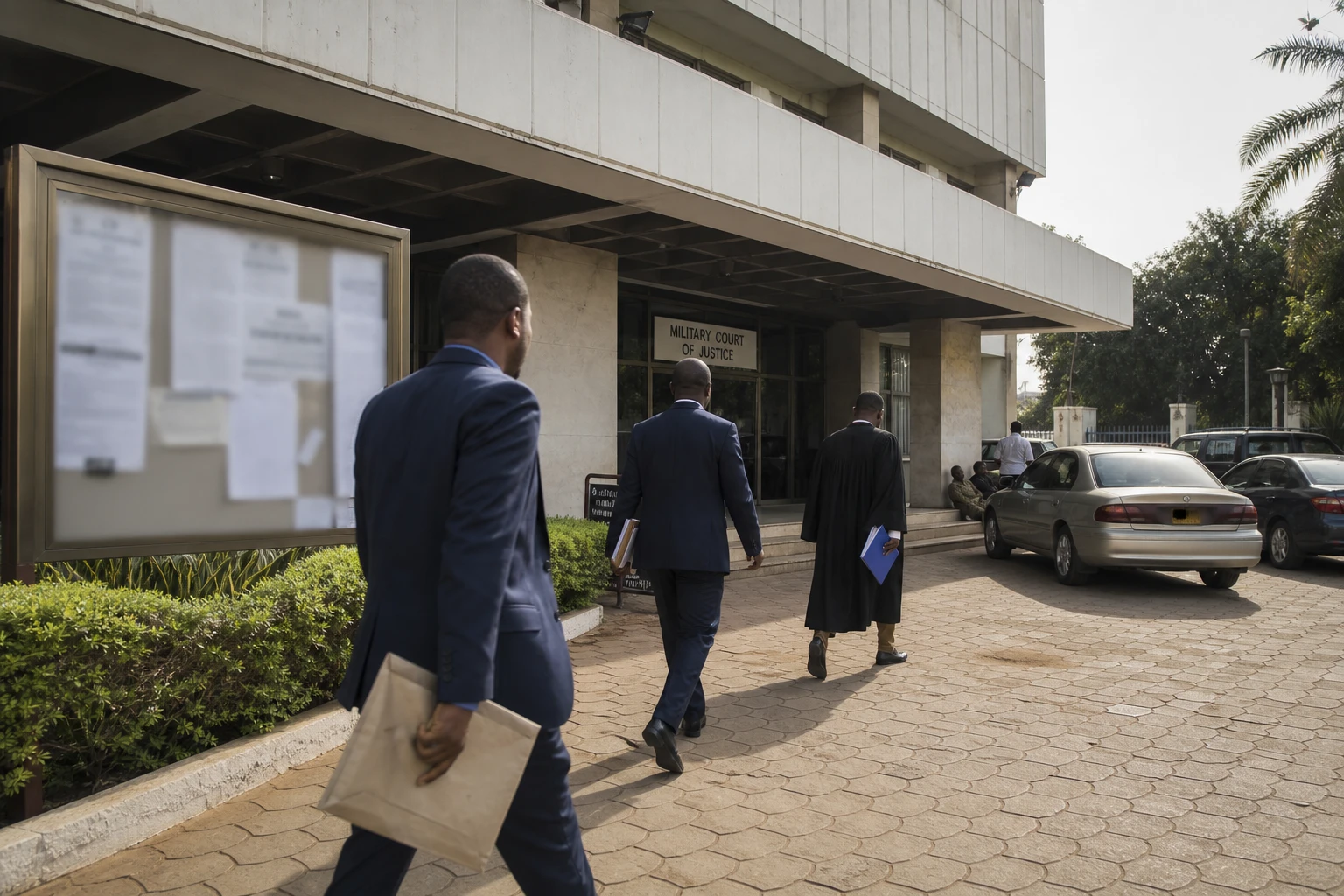
Cameroon is hearing the case before the Yaoundé Military Tribunal, a court established by the Military Justice Code, which provides for one military tribunal per region. This structure explains why a case involving military personnel, former intelligence officials and civilians is being tried in the capital, at the heart of the judicial and security apparatus. In this type of proceeding, the question is not only who acted, but also how the investigation was conducted and what evidence was preserved.
What the 31 August and 1 September hearings brought to light
The hearings on 31 August and 1 September 2026 continued the cross-examination of Colonel Jean-Pierre Otoulou, the lead investigator in this part of the case. Before the tribunal, he maintained that several pieces of evidence gathered during the investigation could link Léopold Maxime Eko Eko, former director-general of the General Directorate of External Research, to the operation that preceded the abduction and death of Martinez Zogo. The defence, for its part, disputes the significance of this evidence and the way it has been interpreted.
Among the issues discussed was the suggestion that Eko Eko had steered investigators towards businessman Jean-Pierre Amougou Belinga, who is also being prosecuted in the case. The witness also referred to the absence of an internal investigation at the DGRE between the journalist’s disappearance and the arrest of Justin Danwe, then the service’s director of operations. Defence lawyers, for their part, stressed the gap between investigative suspicions and criminal evidence establishing an order, complicity or direct participation.
Another sensitive issue concerns the phones attributed to Maxime Eko Eko. The investigator said that only three devices had been handed over to investigators, although the former head of the DGRE had said he owned ten. The hearings also addressed the suspension of some broadcasts after Justin Danwe’s arrest, as well as the analysis of digital data and seized phones. These discussions form part of a sequence already dominated for several months by cyber-forensic examinations and disputes over their interpretation.
A lengthy proceeding, serious charges and strong public expectations
Martinez Zogo, whose real name was Arsène Salomon Mbani Zogo, was abducted on 17 January 2023. His body was found on 22 January 2023 in the outskirts of Yaoundé, at Ebogo III, near Soa. The investigation subsequently led to 17 people being sent for trial before the Yaoundé Military Tribunal. The trial opened on 25 March 2024, after several procedural stages, and the hearings on the merits effectively began on 1 June 2026 with the first prosecution witnesses.
The committal order of 29 February 2024 placed Maxime Eko Eko among the accused, including on a charge of complicity in torture. Justin Danwe faces several charges, including complicity in murder, complicity in arrest and unlawful detention, and complicity in torture. Jean-Pierre Amougou Belinga is also being prosecuted for complicity in torture. Other defendants include military personnel, current or former DGRE officials, journalists and a municipal official. 29 February 2024 therefore remains a key date for understanding the basis on which the accused were sent for trial, even though guilt can only be established at the end of adversarial proceedings.
At the start of the hearings on the merits, all 17 defendants pleaded not guilty. This position underscores an essential point: in such a sensitive case, the tribunal must weigh statements, expert analyses, digital evidence and competing accounts. The role of the defence is not peripheral. It is central, because it requires the prosecution to demonstrate the full chain of events, rather than merely coincidences, associations or supposed affinities.
What the case says about Cameroon and beyond
In Cameroon, this case touches on several key issues at once: the protection of journalists, oversight of security services, the credibility of military justice and the role of digital evidence in criminal cases. Yaoundé is the focus of national, as well as regional, concerns here, because the Cameroonian capital lies at the heart of a Central African country where institutional stability depends to a large extent on the ability of the courts to handle the most high-profile cases.
For the victim’s relatives, the objective is simple: to obtain a clear judicial account of an abduction followed by a violent death. For the accused, the stakes are equally clear: to have the court recognise what constitutes circumstantial evidence, what is an investigative account and what amounts to admissible proof. For public opinion, finally, the trial serves as a barometer. It measures the state’s ability to judge cases involving powerful men without shifting the case’s centre of gravity towards the proceedings themselves.
The case also has continental significance because of the precedent such a trial could set. In several African countries, cases involving journalists, security forces or political and economic players are closely followed by press freedom advocates and judicial observers. Here, the question is not only whether a verdict will be delivered. It is whether the proceedings will have established a robust judicial truth on the basis of evidence that has been verified, debated and tested through adversarial proceedings. That is the standard that will be scrutinised to the end, far beyond Yaoundé.