Algeria
 Egypt
 Libya
 Morocco
 Sudan
 Tunisia
 Benin
 Burkina Faso
 Cabo Verde
 Côte d'Ivoire
 Ghana
 Guinea
 Guinea-Bissau
 Liberia
 Mali
 Mauritania
 Niger
 Nigeria
 Senegal
 Sierra Leone
 The Gambia
 Cameroon
 Central African Republic
 Chad
 DR Congo
 Equatorial Guinea
 Gabon
 Republic of the Congo
 São Tomé and Príncipe
 Burundi
 Comoros
 Djibouti
 Eritrea
 Ethiopia
 Kenya
 Madagascar
 Malawi
 Mauritius
 Mozambique
 Rwanda
 Seychelles
 Somalia
 South Sudan
 Tanzania
 Uganda
 Angola
 Botswana
 Eswatini
 Lesotho
 Namibia
 South Africa
 Zambia
 Zimbabwe
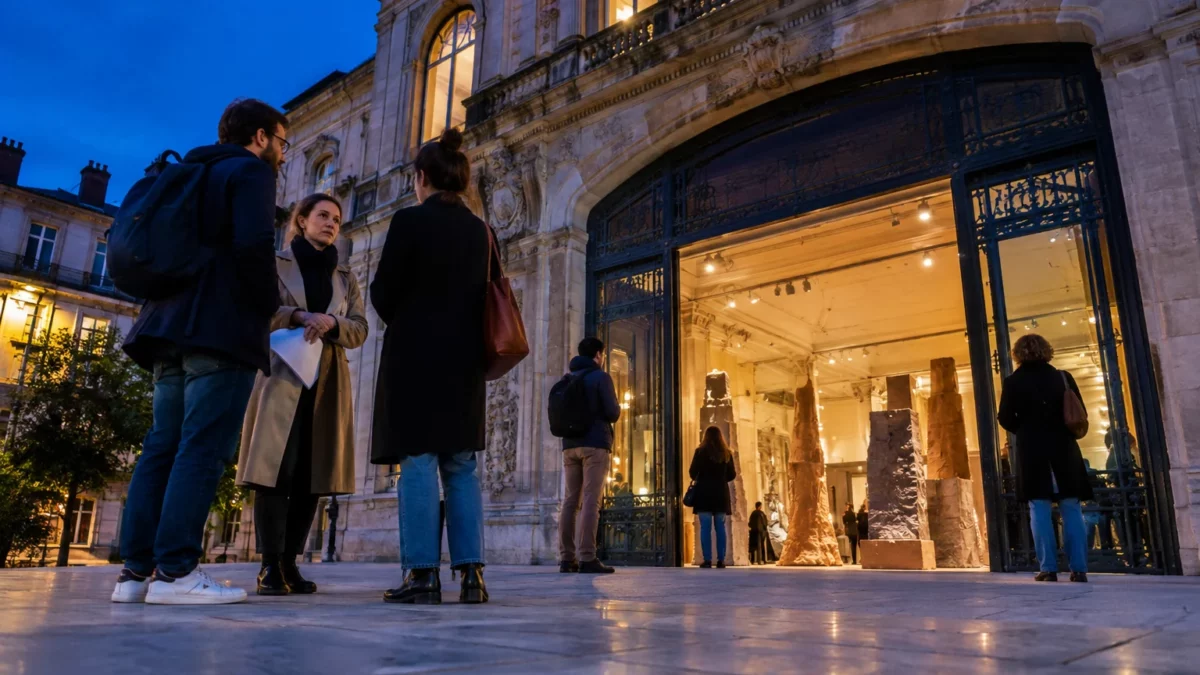
Can a handful of earth become a territory to reinvent? In Lyon, Togolese artist Kokou Ferdinand Makouvia invites visitors to walk through an installation where borders shift and everyone can imagine a different world. His work centres on a practical question: who shapes the places we inhabit, and what memories do their materials carry?
An installation rooted in place and encounters
Entitled The Tectonics of Shadows, the work occupies the Musée des Tissus et des Arts décoratifs in Lyon. It is part of the 18th Contemporary Art Biennale, which runs from 19 September to 13 December 2026 under the theme “Moving from one dream to another”. This edition’s trail spans several sites in Lyon and its metropolitan area, bringing art into dialogue with urban spaces and forms of collective life.
For Makouvia, the room is not simply a container. It becomes the starting point for creation, conceived as a complete work that other forms come to inhabit. Wood, copper, rubber, paper, ceramics or earth: materials are selected and transformed through their encounter with the space. The resulting elements are not presented as isolated objects, but as presences capable, in the artist’s view, of carrying stories and energies.
Moving through the space matters as much as looking. In an interview with French public radio station RFI, Makouvia describes his wish to create a world that is both enveloping and open, where the public can form a personal relationship with the works. This approach echoes the Biennale de Lyon’s presentation of his practice, which highlights the dialogue between sculpture, installation and material.
Fragments that shift borders
The installation includes walls of charred cardboard and forms that evoke continents in motion. This imaginary geography does not claim to depict an exact map. Rather, it opens up a space where territories can be shifted and recomposed. In the interview, the artist links this freedom to the idea of living in peace and being able to imagine relations between peoples differently.
This gesture takes on particular significance in a Biennale edition that explores collective dreams and ways of building society. The institution describes a programme shaped around several dimensions, including the industrial, relational and existential. At the Musée des Tissus, Makouvia’s installation contributes to this reflection through the experience of the place and the movement of the public, rather than through a single explanatory statement.
Residents’ participation in the creation adds a collective dimension. Makouvia says he offered a piece of earth to people he met in the city, leaving them free to make it into a form. The work thus incorporates gestures that do not come solely from the artist’s studio. The final composition brings together an artistic vision and individual contributions without erasing their differences.
A Togolese journey on the international art scene
Born in Lomé in 1989, Kokou Ferdinand Makouvia has studied and worked in several cities, including Abidjan, Valenciennes and Paris. He also draws on his experiences in Togo and on Mina culture, according to his biography published by the Biennale. These references shed light on his attention to memory and the relationships between bodies, objects and places. They do not, however, reduce his work to a single origin: the artist says that his encounters, movements and the passage of time also shape his development.
His journey recalls the long-standing and continuing movement of artists between Lomé, other African cities and international institutions. It also shows that such movement does not necessarily mean a break with local art scenes. In Togo, Makouvia has contributed to the ArtMéssiamé arts initiative, which organises gatherings and residencies in Lomé. In 2022, the Togolese daily L’Éveil de la Nation reported that the project brought together artists and students and ran workshops for children. This activity roots his career in artistic exchanges in Togo, beyond his presence in European exhibitions.
The international visibility of a Togolese artist is not, on its own, enough to describe the vitality of artistic creation in Togo. It does, however, offer a starting point for discussing the practical conditions of production and dissemination: exhibition spaces, residencies, training, funding and public access. Initiatives developed in Lomé and transnational collaborations are complementary dynamics, with different resources and audiences.
From individual experience to shared meaning
The Biennale is being held in France, but the questions raised by the work extend beyond that setting. Wars, displacement and borders affect societies across the world, as Makouvia notes in his interview. His installation does not offer a detailed political answer. Instead, it provides a space in which visitors can experience the possibility of symbolically reorganising territories and relationships.
Across West Africa, this invitation to think about borders and connections resonates in a region where mobility, cultural exchange and shared histories coexist with different political contexts. It does not justify speaking of a single African experience: realities in Togo are not interchangeable with those of neighbouring countries. But Makouvia’s journey between Lomé and several artistic centres makes visible movements that connect art scenes without making them uniform.
The 18th Lyon Biennale remains open until 13 December 2026. Until then, the question is also how visitors will make this collective work their own, and whether the forms of collaboration imagined in the exhibition can find an echo in places of creation in Togo. Here, the dream is not presented as an escape from reality: it becomes a way of trying, together, to inhabit the world differently.