Algeria
 Egypt
 Libya
 Morocco
 Sudan
 Tunisia
 Burkina Faso
 Cabo Verde
 Côte d'Ivoire
 Ghana
 Guinea
 Guinea-Bissau
 Liberia
 Mali
 Mauritania
 Niger
 Nigeria
 Senegal
 Sierra Leone
 The Gambia
 Togo
 Cameroon
 Central African Republic
 Chad
 DR Congo
 Equatorial Guinea
 Gabon
 Republic of the Congo
 São Tomé and Príncipe
 Burundi
 Comoros
 Djibouti
 Eritrea
 Ethiopia
 Kenya
 Madagascar
 Malawi
 Mauritius
 Mozambique
 Rwanda
 Seychelles
 Somalia
 South Sudan
 Tanzania
 Uganda
 Angola
 Botswana
 Eswatini
 Lesotho
 Namibia
 South Africa
 Zambia
 Zimbabwe
A reef thought to be absent tells a different story
Off Cotonou, the sea has not only kept a scientific secret. It has also highlighted a blind spot in research in West Africa: how little is known about the seabed close to the coast, despite its importance for biodiversity, fishing and scientific sovereignty. The rediscovery of a living coral reef in southern Benin is a reminder that a coastline can seem familiar while remaining poorly explored.
The issue goes beyond oceanographic curiosity. In Cotonou, a coastal city exposed to erosion, flooding and urban pressure, every new piece of information about the continental shelf matters to biologists, fishers, maritime authorities and public planners alike. Benin, which shares a dense and contested maritime space in the Gulf of Guinea with its neighbours, is also seeking to better align science, coastal protection and maritime security.
What the researchers actually observed
The findings, published on 20 July 2026 in Frontiers in Marine Science, describe a survey conducted between April and December 2025 as part of the COREB project, or Coral Reefs Rediscovering and Exploration in Benin. The researchers explored Benin’s continental shelf using side-scan sonar and underwater video. They confirmed living coral communities at a depth of about 54 metres, on isolated rocky structures.
The paper also notes that reefs reported as early as 1963-1964 had been presumed dead. This time, the images showed a mosaic of living organisms: at least six octocoral morphotypes, two black coral taxa and eight associated fish species. The authors describe a mesophotic coral “garden” — an ecosystem in the zone of attenuated light, between surface waters and darker depths.
A Beninese media outlet summarised the discovery by placing the site about 20 kilometres off the coast and noting that the project was led by Beninese researcher Gérard Zinzindohoué, with support from National Geographic. This account is consistent with the scientific publication on the existence of a living reef and its location in the Gulf of Guinea.
Another important point: the authors do not describe a continuous barrier. Instead, they refer to scattered hard structures colonised by corals in a sedimentary environment. This distinction matters. It changes how the habitat should be mapped, as well as how its protection should be approached.
Why this discovery matters to Benin beyond the laboratory
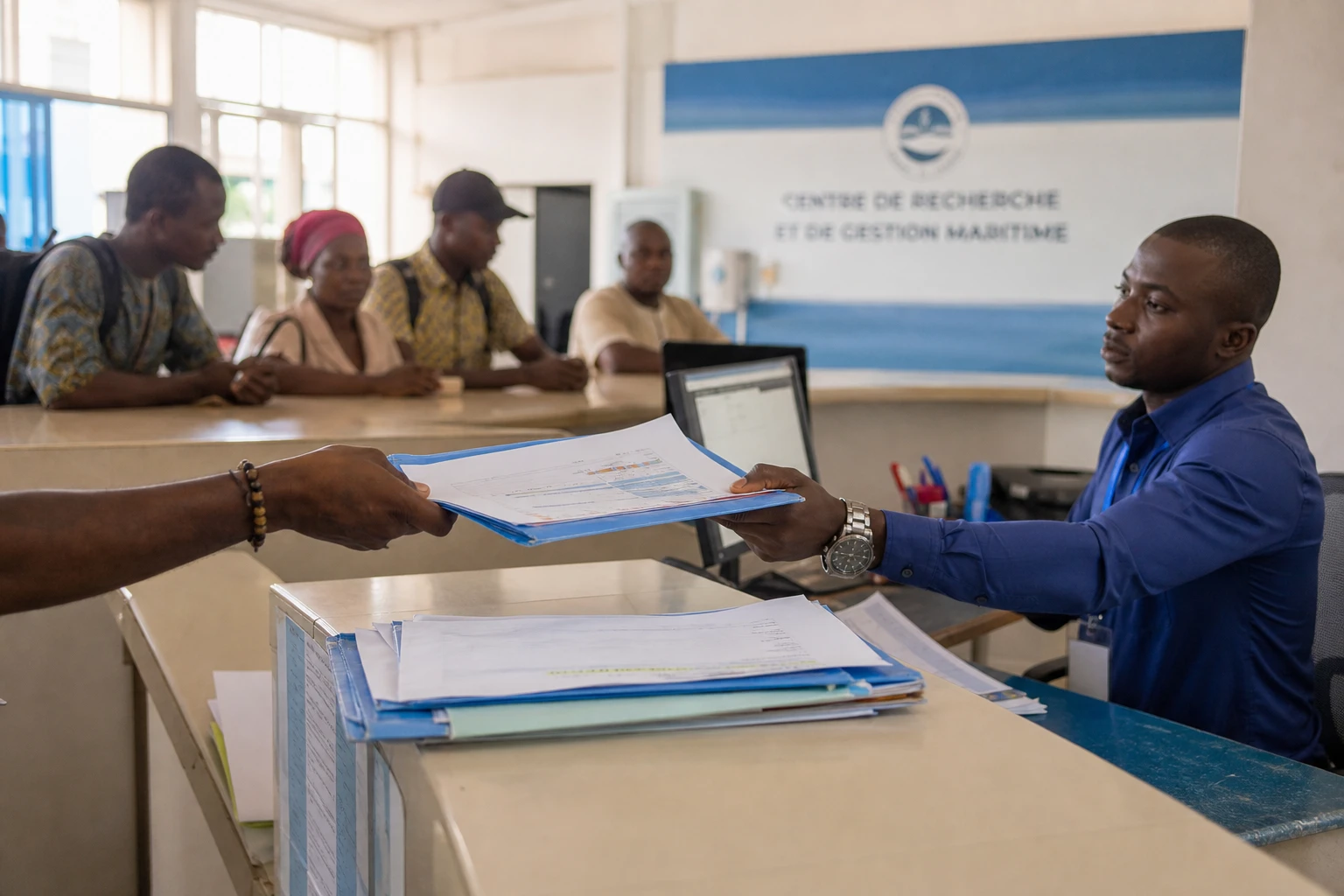
In the Beninese context, the significance of this scientific confirmation is first and foremost institutional. The work brought together Benin’s Institute of Fisheries and Oceanological Research (IRHOB) and the National Authority Responsible for State Action at Sea (ANCAEM), showing that this is not just a marine biology issue, but also one of maritime governance.
There is also a tangible economic stake. A living reef, even in deep water, can play a role in the reproduction of certain species, provide shelter for juveniles and help maintain part of coastal biodiversity. The scientific paper emphasises the need to include these habitats in regional assessments and marine planning. For a country where small-scale fishing remains an important source of coastal income, this is no abstract question. It concerns resources, their sustainability and the trade-offs between exploitation and preservation.
The discovery also sheds light on another reality: the still limited resources available to West African oceanographic research. The researchers had to work from fishing boats because no research vessel was available locally, and some of the funding went towards buying sonar equipment. The project also received a $20,000 grant in January 2025 through the National Geographic Explorers programme, underscoring the reliance of teams on the continent on targeted external funding.
This material constraint should not obscure the positive signal. In Benin, as elsewhere along Africa’s Atlantic coast, marine science is advancing in small steps, with increasingly well-trained teams. The Gulf of Guinea Ocean Sciences Summer School, held in Cotonou in 2026, is part of this effort to build capacity in French-speaking West and Central Africa. The location is significant: Benin’s economic capital is also becoming a hub for training and the exchange of ocean knowledge.
A signal for the Gulf of Guinea and marine Africa
At regional level, the issue goes far beyond Benin alone. The Gulf of Guinea is a space where maritime security, fishing, port pressures, coastal pollution and growing climate risks intersect. A better understanding of deep-water habitats is therefore a management tool as much as a research subject. Beninese authorities themselves are now linking cooperation with their neighbours to maritime security and regional stability.
For Africa, the message is broader still. Most of the reefs known and studied are concentrated elsewhere in the world, while African coastlines remain only partially mapped. The Beninese case shows that an ecosystem can remain invisible for decades not because it has disappeared, but because it has not been observed closely enough. This is a scientific lesson, but also a political one. It highlights the strategic value of marine data produced on the continent, by teams from the continent.
The next steps remain. The authors call for broader mapping, systematic video transects and physical sampling to better define the site’s extent and vulnerability. The next stage is therefore not celebration, but consolidation: measuring, protecting and then integrating this reef into a more complete understanding of Benin’s continental shelf. For Benin, with Porto-Novo and Cotonou facing the coast, the challenge is clear: turn a discovery into a policy of knowledge and preservation.