Algeria
 Egypt
 Libya
 Morocco
 Sudan
 Tunisia
 Benin
 Burkina Faso
 Cabo Verde
 Côte d'Ivoire
 Ghana
 Guinea
 Guinea-Bissau
 Liberia
 Mali
 Mauritania
 Niger
 Nigeria
 Senegal
 Sierra Leone
 The Gambia
 Togo
 Central African Republic
 Chad
 DR Congo
 Equatorial Guinea
 Gabon
 Republic of the Congo
 São Tomé and Príncipe
 Burundi
 Comoros
 Djibouti
 Eritrea
 Ethiopia
 Kenya
 Madagascar
 Malawi
 Mauritius
 Mozambique
 Rwanda
 Seychelles
 Somalia
 South Sudan
 Tanzania
 Uganda
 Angola
 Botswana
 Eswatini
 Lesotho
 Namibia
 South Africa
 Zambia
 Zimbabwe
Women’s football takes on a new status in Yaoundé’s neighbourhoods
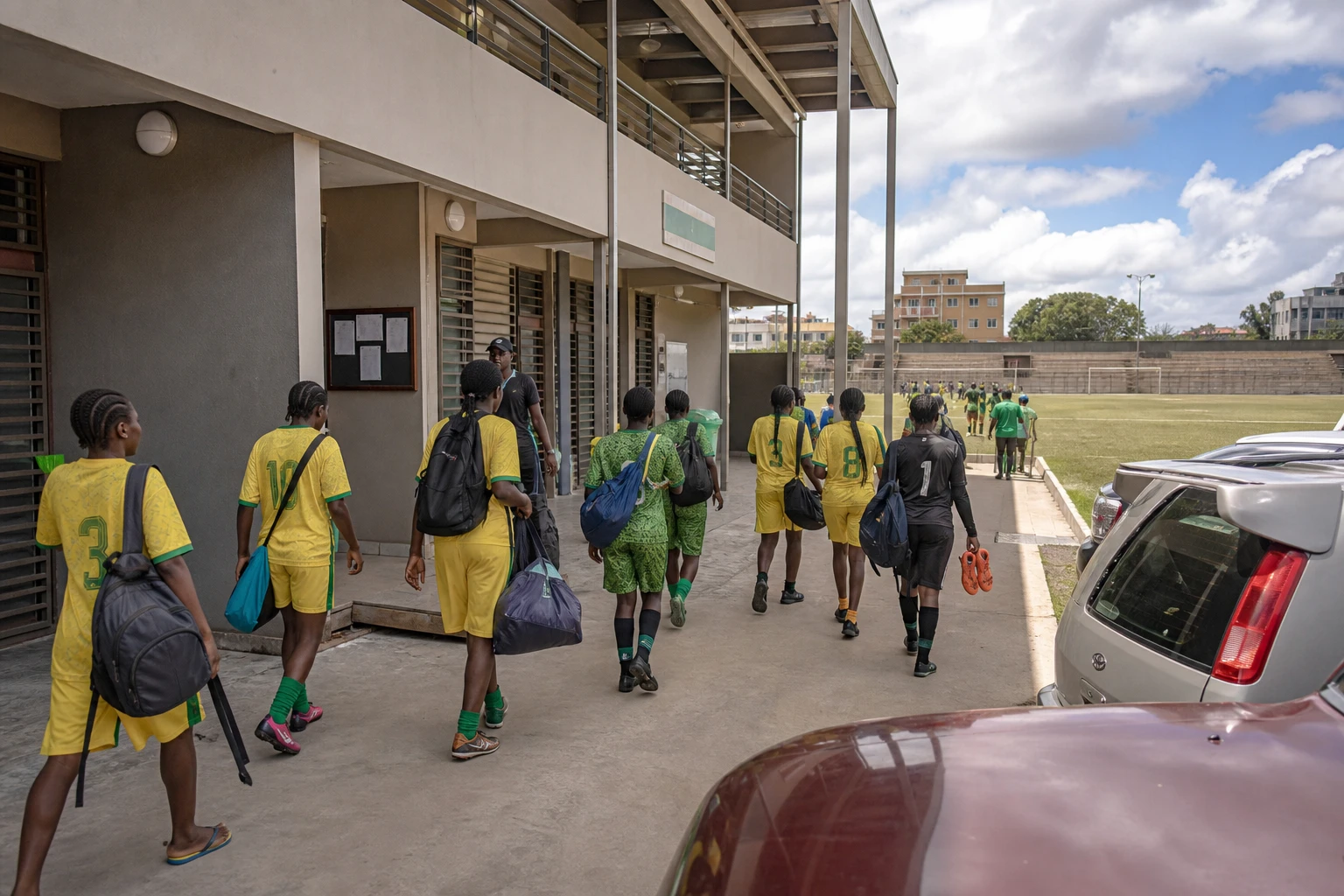
On Yaoundé’s dirt pitches, women’s football no longer looks quite like a holiday pastime. For many young Cameroonian women, it is becoming a real possibility, because a national team has shown that a career at the highest level is not reserved for boys. In Cameroon’s capital, this shift can be seen in people’s attitudes, in registrations for neighbourhood tournaments and in the way parents, sometimes reluctant, are beginning to look at the game differently.
Cameroon is not an isolated island. It belongs to CEMAC, the Central African economic and monetary community, whose headquarters are in Yaoundé. This institutional proximity is also a reminder that sporting, social and educational dynamics are part of a wider regional environment, where sub-regional capitals concentrate both decision-making and the dreams of younger generations.
The spark from Rabat and the ripple effect in Yaoundé
The 2026 Women’s Africa Cup of Nations was held in Morocco from 25 July to 16 August 2026, with the final scheduled for Rabat on Sunday 16 August. CAF had confirmed this expanded schedule, with 16 teams for the first time in the tournament’s history. Cameroon was among the qualified teams and played in the final tournament under a format that was more demanding, more prominent and more widely covered than in previous editions.
At the end of the competition, several sources in agreement reported that the Indomitable Lionesses had triumphed over Malawi, fuelling an immediate sense of pride in local football circles. The victory gave a tangible face to what coaches have described for months as progress in Cameroonian women’s football, driven by a younger, better-organised base with stronger links to the highest level.
In Yaoundé, that inspiration quickly reaches neighbourhood pitches. At one academy, a goalkeeper says she began to believe more in her own prospects after seeing the country’s senior players prevail on the continental stage. Another young player says she wants to follow in the footsteps of established members of the national squad. This is more than admiration. It is a way of imagining what might be possible. Seeing a Cameroonian woman shine in the national team opens up a horizon that family conversations alone do not always manage to sketch out.
Parents, coaches and academies: where selection really begins
Women’s football is not built only in stadiums. It is first developed in families, academies and holiday tournaments. Parental reluctance remains common. It stems from scheduling, prejudice about girls playing sport and, very often, a lack of clear economic prospects. A winning national team does not solve everything, but it weakens an argument long heard in households: “football leads nowhere”.
Coaches, for their part, speak of a psychological shift. After a strong continental performance, young players train with greater purpose. They ask for more sessions. They want clear reference points: position, role, role model, career path. In a country where the FECAFOOT has sent out more signals in recent months in support of youth development and women’s football, this new motivation could become a useful lever if it is matched by more stable leagues, better-coordinated school competitions and better-supervised academies.
The stakes are economic too, even on a small scale. When a sporting pathway gains visibility, it can create opportunities for coaches, trainers, referees, neighbourhood clubs and small private facilities. In major cities such as Yaoundé, demand is already there. But it remains fragile, because pitches are often basic, resources are limited and routes to the elite still depend too heavily on individual talent.
The message from the national team is therefore twofold. For players, it says that progress is possible. For local organisations, it is a reminder that emotion must be turned into a system. Otherwise, the momentum quickly fades once the noise of victory dies down.
A victory that goes beyond sport and speaks to all of Central Africa
In the sub-region, Cameroon holds a special place in sport. Its football tradition has long fuelled national ambitions, among both men and women. The Lionesses’ triumph, if confirmed as a major continental trophy, strengthens this image of sporting power and adds new depth to the story of Cameroonian football. It is no longer just about honouring a prestigious past. It is also about showing that a new generation can take over on its own terms.
For CEMAC, the significance is symbolic. In a region often viewed through the lens of monetary balances, trade and political tensions, sport offers a reminder of another kind of integration: that of shared imagination. Young people in Douala, Yaoundé, Bangui, Libreville and N’Djamena follow the same images, the same role models, the same heroines. Continental competitions then become shared showcases, where each national success quickly spills across borders.
The next step remains to be seen. The most important thing now will be whether this title translates into more matches, resources and stability for Cameroonian women’s football. The question goes beyond the joy of one evening in Rabat. It concerns training, licences, local leagues and the country’s ability to retain its talent rather than let it fade between competitions. That is what truly measures the value of a continental triumph.