Algeria
 Egypt
 Libya
 Morocco
 Sudan
 Tunisia
 Benin
 Burkina Faso
 Cabo Verde
 Côte d'Ivoire
 Ghana
 Guinea
 Guinea-Bissau
 Liberia
 Mali
 Mauritania
 Niger
 Nigeria
 Senegal
 Sierra Leone
 The Gambia
 Togo
 Cameroon
 Central African Republic
 Chad
 DR Congo
 Equatorial Guinea
 Gabon
 São Tomé and Príncipe
 Burundi
 Comoros
 Djibouti
 Eritrea
 Ethiopia
 Kenya
 Madagascar
 Malawi
 Mauritius
 Mozambique
 Rwanda
 Seychelles
 Somalia
 South Sudan
 Tanzania
 Uganda
 Angola
 Botswana
 Eswatini
 Lesotho
 Namibia
 South Africa
 Zambia
 Zimbabwe
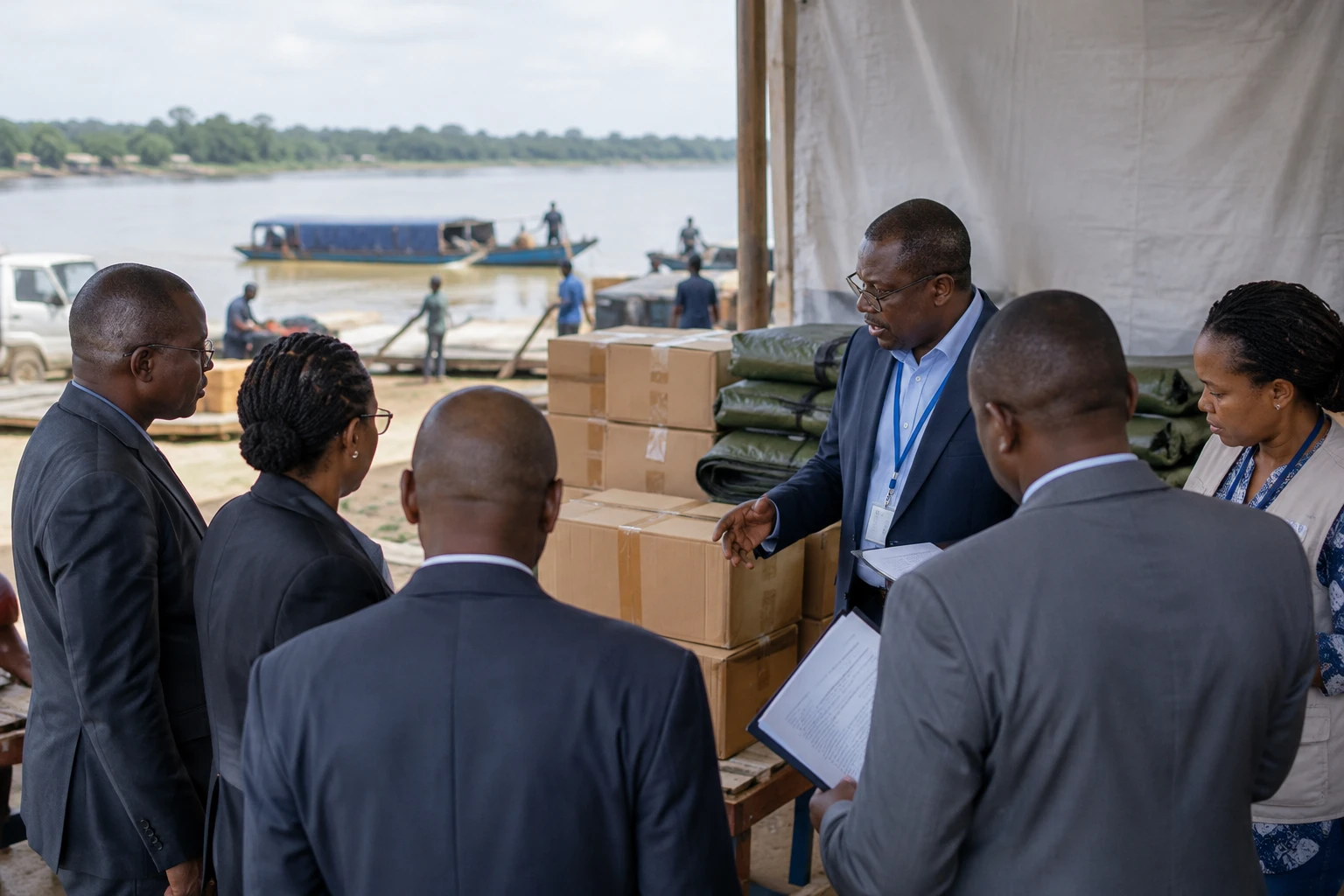
In Likouala, rising waters are testing a very practical question: how can families be reached quickly when routes of travel are themselves becoming difficult to access? In Épéna, the district capital, floods have inundated the town and affected nearby villages. Congolese authorities have announced an emergency response as the rains continue.
Épéna bears the brunt, Impfondo under watch
The government’s initial assessments put the number of people affected in Likouala at 42,847, or more than 4,000 households. Épéna district has suffered the most damage. Around 15 nearby villages have also been affected, while waters are beginning to reach some neighbourhoods in Impfondo, the departmental capital.
The figures were presented in Brazzaville at an interministerial meeting chaired on 20 October by Deputy Prime Minister Jean-Jacques Bouya. The previous day, a government delegation had visited the district to assess needs and inspect the damage. The Congolese News Agency reported that Social Affairs Minister Lydie Pongault described Épéna as largely submerged. The figure of 42,847 people affected was reported by Journal de Brazza, citing government assessments.
The government plans to send food, tarpaulins and medicines to Impfondo by air bridge from Brazzaville. A humanitarian convoy is also due to help build up stocks on the ground. Other goods are to travel along the Congo River, according to government spokesman Thierry Moungalla. The authorities are also considering finding a site to rehouse families whose homes are no longer safe.
These announcements address the immediate emergency, but their effectiveness will depend on access conditions and the regularity of deliveries. River transport is essential in this part of northern Congo; flooding can, however, complicate travel and isolate communities. The information available does not yet specify the full timetable for convoys, the quantities planned or how many people could be rehoused.
A recurring crisis, with logistics key to access
Likouala is one of the departments most exposed to rivers bursting their banks. Its residents depend in particular on waterways to travel and transport goods. When floodwaters cover homes, paths and farmland, the consequences go beyond material damage: supplies, access to healthcare and the continuation of farming or fishing activities can also be affected.
Congo has already experienced a major flood-related crisis during the 2023-2024 rainy season. On 29 December 2023, the government declared a humanitarian emergency. In January 2024, the United Nations said that nine of the country’s 12 departments were affected and that more than 525,000 people needed assistance, a large proportion of them in Likouala. That previous disaster is not the toll from the current episode: it does, however, serve as a reminder that flooding is not an isolated phenomenon in the country’s recent history.
The response must therefore address several different needs. Displaced households need shelter and essential goods; people who remain in flooded areas must be able to receive food and healthcare. Children, older people and those with reduced mobility may face additional obstacles. Finally, aid distributed in accessible centres does not guarantee that remote villages will be reached: the location of stocks and the monitoring of deliveries will be crucial.
From emergency aid to regional preparedness
Likouala lies in the Congo Basin, an area shared by several countries and crossed by waterways that do not stop at national borders. This episode, however, concerns the Republic of the Congo, whose capital is Brazzaville, not neighbouring Democratic Republic of the Congo. Institutionally, the country is a member of the Economic and Monetary Community of Central Africa (CEMAC), which brings together six Central African states. The disaster calls first for a national and local response; it also highlights the value of regional exchanges on flooding, warnings and logistical resources.
The 2023-2024 crisis had involved the Congolese government and United Nations agencies. The UN announced an emergency funding package at the time to support affected populations. For the current episode, announcements of an air bridge, stocks in Impfondo and river transport must still translate into verifiable deliveries and sustained assistance. The next developments to watch are changes in water levels, any expansion of affected areas and the implementation of the announced rehousing plan.
In the short term, the challenge is to reach residents before isolation worsens. In the longer term, recurrent flooding raises questions about preparedness: local warning systems, pre-positioned stocks and appropriate accommodation solutions. For families in Épéna and nearby villages, the priority remains effective access to aid when they need it.