Algeria
 Egypt
 Libya
 Morocco
 Sudan
 Tunisia
 Benin
 Burkina Faso
 Cabo Verde
 Côte d'Ivoire
 Ghana
 Guinea
 Guinea-Bissau
 Liberia
 Mali
 Mauritania
 Niger
 Nigeria
 Senegal
 Sierra Leone
 The Gambia
 Togo
 Cameroon
 Central African Republic
 Chad
 DR Congo
 Equatorial Guinea
 Gabon
 São Tomé and Príncipe
 Burundi
 Comoros
 Djibouti
 Eritrea
 Ethiopia
 Kenya
 Madagascar
 Malawi
 Mauritius
 Mozambique
 Rwanda
 Seychelles
 Somalia
 South Sudan
 Tanzania
 Uganda
 Angola
 Botswana
 Eswatini
 Lesotho
 Namibia
 South Africa
 Zambia
 Zimbabwe
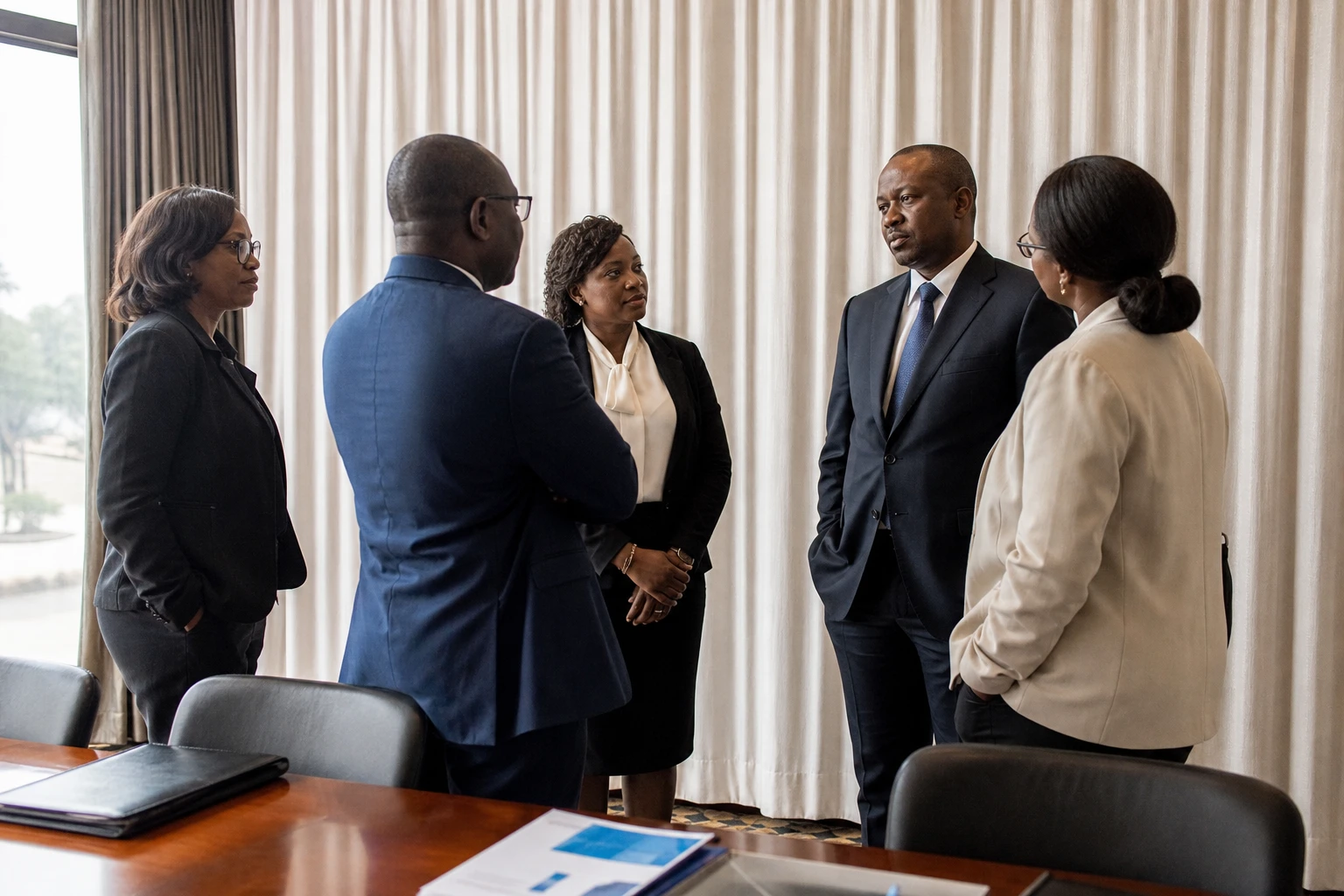
Libreville, a new foothold for a regional financial sector taking shape
In Gabon, the announcement of another financial office signals more than the arrival of a new player. Above all, it points to something broader: Central Africa is still seeking private-sector channels to circulate savings, structure transactions and finance businesses without relying solely on banks or public institutions. In this process, Libreville is taking on a growing role, thanks to its position as the administrative and financial capital of CEMAC, the monetary union comprising six Central African countries.
It is in this context that L’Archer, an investment and advisory group founded in the Republic of the Congo in 2021, has opened a representative office in Libreville. The group says it draws on teams with experience in finance across the sub-region and claims a pan-African ambition. Its presence in Gabon extends a strategy already visible in Brazzaville, Pointe-Noire, Malabo and Paris.
What L’Archer’s arrival in Gabon changes
L’Archer Gabon is headed by Rose Ogouebandja. Her career includes roles at General Electric, BNP Paribas and HSBC, followed by positions working with Gabonese ministers and in presidential communications. This background combines financial expertise, institutional experience and knowledge of local decision-making channels. For an intermediary group, that matters: in CEMAC, trust and the ability to navigate regulation, business and government are as important as the products on offer.
The group says it has been active in Gabon since January 2026 and has taken part in more than five transactions with public- and private-sector players, some completed and others under way. This figure is attributed to the group, as no public disclosure details each transaction. But it points to a rapid start in a market where financing needs are real, particularly for companies seeking to raise funds other than through conventional bank loans.
L’Archer organises its activities through two subsidiaries. L’Archer Securities works in financial intermediation, connecting investors with issuers seeking capital. L’Archer Asset Management focuses on portfolio management and investment advice. The latter is among the asset management companies licensed by COSUMAF, the Central African financial market regulator. This licence is key: it provides an official framework for the business and underscores that, in CEMAC, capital markets finance is first and foremost subject to regulatory compliance.
The recently announced appointment of Maria Dolores Tung Eyang as head of L’Archer Asset Management follows the same drive to professionalise. The group is strengthening its organisational structure as it expands geographically. In Libreville, these two developments matter: a local office without credible local leadership risks being merely decorative. With management based on the ground, L’Archer is instead signalling a commitment to establishing roots.
A signal for BVMAC and CEMAC
The significance of this move extends beyond Gabon. L’Archer is pursuing its development across CEMAC, where the Central African Securities Exchange, BVMAC, remains a small but strategically important market. BVMAC announced that the quarterly summary of its Official Stock Exchange Bulletin covering 1 January to 31 March 2026 would be published on 27 April 2026. At the same time, several group communications and associated professional profiles indicate that L’Archer Securities carried out 181 of the 638 transactions recorded in the first quarter of 2026, putting it first by number of transactions over that period. The figure is consistent with internal messages circulated by the group, but should be read as an indicator of its market position, not as a definitive market report.
This expansion comes as the regional financial market remains shallow. Recent BVMAC data show significant outstanding volumes but often irregular trading activity. In 2025, the market still had only six listed companies and eight bond issuers, according to a report on the CEMAC zone. In other words, the challenge is not simply to increase the number of brokers. Above all, the issuer base must be broadened, investors reassured and orders made easier to execute, so that the exchange does not remain a niche market reserved for a handful of big names.
Gabon nevertheless has an opportunity. Libreville regularly hosts high-level financial and institutional meetings, while Gabon’s presidency is promoting an economic modernisation agenda in 2026, backed by new partnerships and development financing. In this context, a player such as L’Archer could act as an intermediary between the state, local companies and regional investors. For large companies, this opens the door to more sophisticated financing structures. For SMEs, it could provide more direct access to structuring and fundraising solutions.
For Gabon’s economy, the question is a practical one. One more representative office will not by itself deepen the market. But it can speed up the flow of information, bring issuers closer to intermediaries and raise the profile of local transactions. In a financial centre still dominated by a few major players, competition can also drive better service, greater transparency and faster execution. That is what distinguishes a symbolic presence from a useful one.
At regional level, this move is part of a broader trend: CEMAC is seeking to strengthen its capital markets as governments look for financing to meet cash-flow needs, fund infrastructure projects and manage domestic debt. Capital markets remain modest compared with bank financing, but they become a tool of economic sovereignty when they enable local and diaspora funds to be mobilised within a regulated framework. This is the quiet contest that Libreville is now hosting more visibly.
What happens next will depend on L’Archer’s ability to turn a geographical presence into measurable activity, and on the Gabonese market’s capacity to absorb more transactions without compromising rigour. In a Central Africa where financial markets are still taking shape, every new office is judged by the transactions it enables, the trust it builds and the companies it genuinely helps to finance.