Algeria
 Egypt
 Libya
 Morocco
 Sudan
 Tunisia
 Benin
 Burkina Faso
 Cabo Verde
 Côte d'Ivoire
 Ghana
 Guinea
 Guinea-Bissau
 Liberia
 Mali
 Mauritania
 Niger
 Nigeria
 Senegal
 Sierra Leone
 The Gambia
 Cameroon
 Central African Republic
 Chad
 DR Congo
 Equatorial Guinea
 Gabon
 Republic of the Congo
 São Tomé and Príncipe
 Burundi
 Comoros
 Djibouti
 Eritrea
 Ethiopia
 Kenya
 Madagascar
 Malawi
 Mauritius
 Mozambique
 Rwanda
 Seychelles
 Somalia
 South Sudan
 Tanzania
 Uganda
 Angola
 Botswana
 Eswatini
 Lesotho
 Namibia
 South Africa
 Zambia
 Zimbabwe
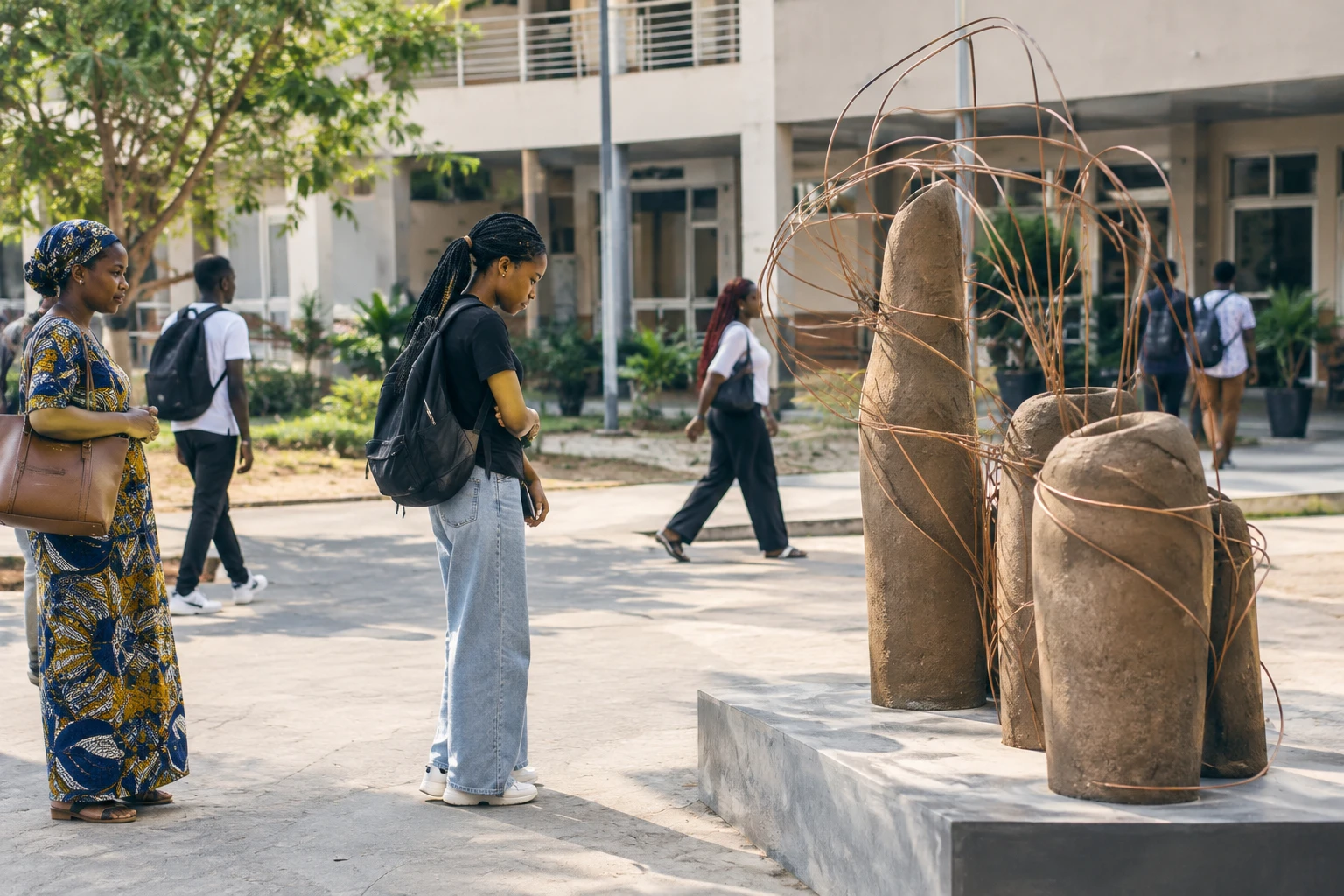
In Lyon, an installation by Togolese sculptor Kokou Ferdinand Makouvia invites visitors to look differently at earth, copper and the objects around them. His work does not present material as a mere tool: it explores what it can tell, hold and bring to light.
From Lomé to the international art scene
Born in 1989 in Lomé, Makouvia studied in Togo and then in Abidjan, Côte d’Ivoire, before continuing his artistic training in France, notably in Valenciennes and Paris. This journey connects several creative spaces without reducing his work to a single geographical origin. The biography published by Galerie Sator confirms these stages and documents his exhibitions.
This movement between countries is also reflected in his exhibition history. His works have been shown at the Dakar Biennale and the Congo Biennale in Kinshasa, both in 2022. These events place his work within African artistic networks, while also bringing it into contact with institutions and audiences in other parts of the world.
In Togo, Lomé remains an important centre for cultural life and artists. But Makouvia’s career also shows that careers are built through exchanges between schools, studios, residencies and biennales, rather than within a single capital. For Togolese artists, such movement can open up spaces for visibility; it does not, however, replace the country’s creative spaces and audiences.
Work shaped by materials
In Lyon, his installation, entitled “Ontology of Projected Movement”, is on display at the Museum of Textiles and Decorative Arts as part of the Contemporary Art Biennale. The Biennale’s official profile of the artist describes a practice combining sculpture and installation, and using wood, rubber, paper and copper, among other materials.
The works occupy the space in several ways: some are attached to the walls, while others rest on the floor or hang suspended. Earth and copper sit alongside forms that seem balanced between rootedness and movement. Visitors therefore encounter more than isolated objects. They move through an environment in which the architecture, light and arrangement of the pieces all contribute to the experience.
Makouvia describes his method as a dialogue with material. The aim is not to impose a shape on it from the outset, but to observe its resistance, possibilities and the relationships it allows. In remarks quoted in the exhibition material, the artist asks the material how it wishes to be named. The phrase conveys an attentive approach, in which the creative act takes shape in stages.
This principle also gives space to the histories contained in objects. For the Biennale, materials can carry memories, energies and stories. Clay, paper and copper wire are therefore not merely aesthetic choices. They help give the works their form and associations, without confining their meaning to a single explanation.
Between memory, spirituality and the present
Makouvia’s work connects different periods of time: the past, the present and what remains to be imagined. His practice makes room for a spiritual dimension, notably through references to memory and Togo’s Mina culture. The Fondation Salomon’s presentation situates these references within his exploration of the visible and the invisible.
This dimension does not turn the works into illustrations of a fixed tradition. It is part of a contemporary inquiry, informed by the artist’s travels and encounters. The forms can suggest connections between people, places and generations, while leaving the public free to form its own interpretation.
The choice of ordinary or transformed materials contributes to this openness. It shifts the boundary between what might be considered noble or secondary, solid or fragile, natural or manufactured. An installation suspended by threads, for example, makes visible the precarious balance linking its elements. The eye is drawn as much to the materials as to the tensions that hold them together.
Biennales as spaces for exchange
The Lyon Biennale gives this approach an international platform, but it is not its only horizon. The artist’s presence in Dakar and Kinshasa highlights the role of artistic events held on the continent in circulating works and ideas. These gatherings allow artists to engage with diverse audiences and build professional connections across national borders.
For Togolese artists, the challenge is also to make their ideas heard in spaces where contemporary African art is not reduced to a single narrative. Makouvia contributes through work that speaks of material, memory and relationships, without claiming to represent Togo or West Africa on his own. This distinction matters: the continent’s art scenes are diverse, and individual journeys do not sum up their countries.
As exhibitions bring together works created in different contexts, one question remains: how can lasting exchanges between African creative spaces and major international institutions be ensured? Makouvia’s career shows the importance of transnational journeys, but also of recognising the stages and networks being built on the continent. In Lyon, his installation offers a sensitive response, without imposing a message: take the time to observe what materials do together.