Algeria
 Egypt
 Libya
 Morocco
 Sudan
 Tunisia
 Benin
 Burkina Faso
 Cabo Verde
 Côte d'Ivoire
 Ghana
 Guinea
 Guinea-Bissau
 Liberia
 Mali
 Mauritania
 Niger
 Nigeria
 Senegal
 Sierra Leone
 The Gambia
 Togo
 Cameroon
 Central African Republic
 Chad
 DR Congo
 Equatorial Guinea
 Gabon
 Republic of the Congo
 São Tomé and Príncipe
 Burundi
 Comoros
 Djibouti
 Eritrea
 Ethiopia
 Madagascar
 Malawi
 Mauritius
 Mozambique
 Rwanda
 Seychelles
 Somalia
 South Sudan
 Tanzania
 Uganda
 Angola
 Botswana
 Eswatini
 Lesotho
 Namibia
 South Africa
 Zambia
 Zimbabwe
When waste becomes an agricultural resource
Across the plains and hills around Nairobi, pressure on the land is reflected not only in yields. It is also visible in the price of inputs, the exhaustion of soils and the search for solutions less dependent on chemical fertilisers. In Kenya, this transition is no passing trend. It responds to a concrete problem: fertility is declining, while producers must continue to supply demanding urban markets and a population with strong food needs.
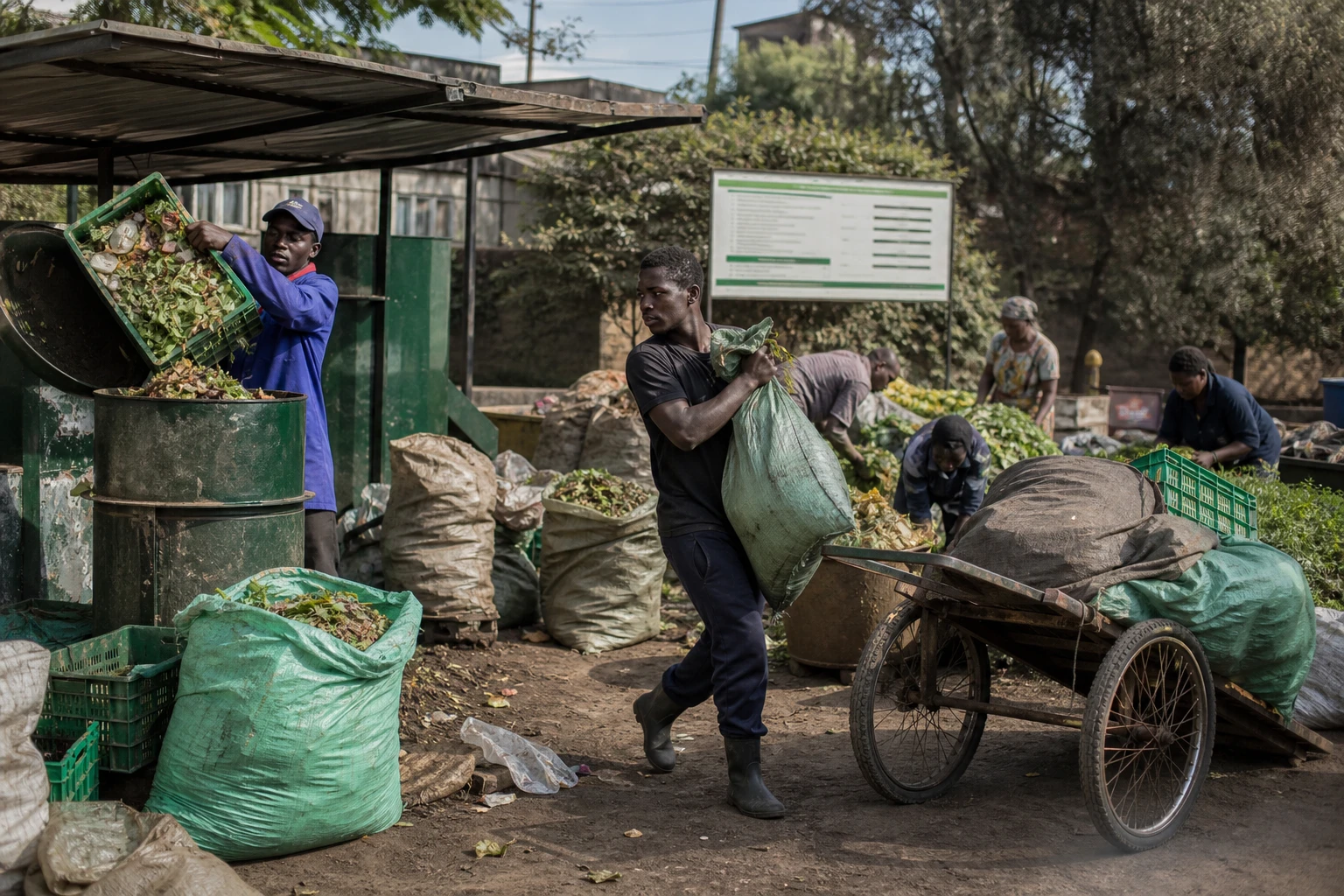
In Lari, in Kiambu County, north-west of Nairobi, some farmers have chosen to let worms do the work for them. Further west, in Nakuru County, others are relying on black soldier fly larvae. In both cases, the principle is the same: turn organic waste into a useful soil amendment, and then into an economic resource. This approach is part of a wider movement towards circular agriculture, already studied by Kenyan researchers and teams across the region.
An old problem, now quantified
The context is clear. In 2025, the Heinrich Böll Foundation estimated that more than 40% of East Africa’s soils were degraded, with regional productivity losses exceeding $65 billion a year. Its Kenya-specific report notes that soil degradation undermines yields, rural employment and food security. The Kenyan edition of the Soil Atlas adds that a significant share of cultivated land suffers from acidity and nutrient deficiencies.
These figures add to other findings. A recent study indexed by the FAO estimates that about 13.29% of Kenyan territory is affected by soil acidity, a level that makes it harder for crops to absorb nutrients. The Kenyan Ministry of Agriculture, for its part, has for several years explained that acidity can be reduced with organic amendments such as manure or compost, and that the cost of fertilisers remains a major obstacle for farmers.
This economic dimension matters greatly. The ministry notes that subsidised fertilisers have long been used to keep prices in check, but the market remains vulnerable to fluctuations. Meanwhile, the Kenya Food Systems Dashboard was still publishing fertiliser price data in 2025, a sign that the market continues to be closely monitored. For many small-scale producers, every bag of inputs therefore weighs on the farming season.
Red worms in Lari, larvae in Nakuru
Against this backdrop, vermicomposting is gaining importance. In Lari, producers use red worms to break down kitchen waste, agricultural residues and manure. The process takes about six weeks. Research from the University of Nairobi shows that the technique is well known in Kenya’s highlands and can turn organic waste into rich compost, for use on site or sale to other farmers.
The principle is simple. The worms break down the material, speed up decomposition and produce compost that is more stable than raw residues. For a farmer, the benefit is not only agronomic. It is also practical. Waste no longer piles up. It becomes an input. And when volumes increase, it can even support a small commercial enterprise. This is what documented projects around Nairobi show, where the compost is already being used by other producers in the area.
In Nakuru, the approach is different but complementary. Black soldier fly larvae consume food waste collected from markets, then turn it into an organic material called frass, which can be reused as a fertiliser. Once mature, the larvae can also be dried and used as a source of protein in animal feed. CGIAR notes, however, that this value chain depends on regular, well-organised collection of organic waste, a point that remains a weakness in several African cities.
What these solutions really change
The value of these methods is not limited to environmental benefits. It is also financial. When mineral fertilisers become expensive or unaffordable, producers seek alternatives that reduce their dependence on imported inputs. Organic amendments are no magic bullet. They work more slowly. They require large volumes. But they improve soil structure, its capacity to retain water and its organic matter content. In a country where rainfall remains irregular, this effect can matter as much as an immediate increase in yields.
Kenyan agroecology specialists nevertheless stress the need for caution. The shift from a chemical to an organic system does not happen in a single season. Synthetic fertilisers often need to be reduced gradually, allowing the soil to regain its biological balance. The transition takes time, training and reliable collection networks. It is therefore more accessible to farms near urban centres, where organic waste is available, than to very remote areas.
The issue also touches on rural employment. Insect-based solutions create activities at several levels: waste collection, larval farming, compost production and animal-feed sales. They thus offer young entrepreneurs a route to diversification, particularly around Nairobi and Kenya’s other urban centres. In a country where agriculture remains a mainstay of employment, this diversification matters as much as the increase in yields itself.
A Kenyan approach in a wider African debate
Beyond Kenya, this development is of interest across East Africa, where soils are degrading under the effects of overgrazing, deforestation, intensive farming practices and a more unstable climate. The issue therefore goes beyond the choice of a single input. It concerns how the countries of the East African Community can secure agricultural production without deepening their dependence on imported fertilisers.
Kenya finds itself at the intersection of two agendas. On the one hand, the state continues to support productivity through policies aimed at access to fertilisers. On the other, researchers, pilot farms and circular-economy players are showing that part of the answer can come from recycling waste and biologically restoring soils. This is not a complete replacement. It is a gradual redefinition of the balance between chemicals, organic matter and local resource management.
What happens next will depend above all on the ability to scale up beyond experimentation. Collection networks, health standards, markets for compost and insect protein, and technical support for rural farms will all be needed. If these conditions improve, red worms and black soldier flies could become more than an agronomic curiosity. They could embody a practical, replicable Kenyan response to the silent crisis affecting soils.