Algeria
 Egypt
 Libya
 Morocco
 Sudan
 Tunisia
 Benin
 Burkina Faso
 Cabo Verde
 Côte d'Ivoire
 Ghana
 Guinea
 Guinea-Bissau
 Liberia
 Mali
 Mauritania
 Niger
 Nigeria
 Senegal
 Sierra Leone
 The Gambia
 Togo
 Cameroon
 Central African Republic
 Chad
 DR Congo
 Equatorial Guinea
 Gabon
 Republic of the Congo
 São Tomé and Príncipe
 Burundi
 Comoros
 Djibouti
 Eritrea
 Ethiopia
 Madagascar
 Malawi
 Mauritius
 Mozambique
 Rwanda
 Seychelles
 Somalia
 South Sudan
 Tanzania
 Uganda
 Angola
 Botswana
 Eswatini
 Lesotho
 Namibia
 South Africa
 Zambia
 Zimbabwe
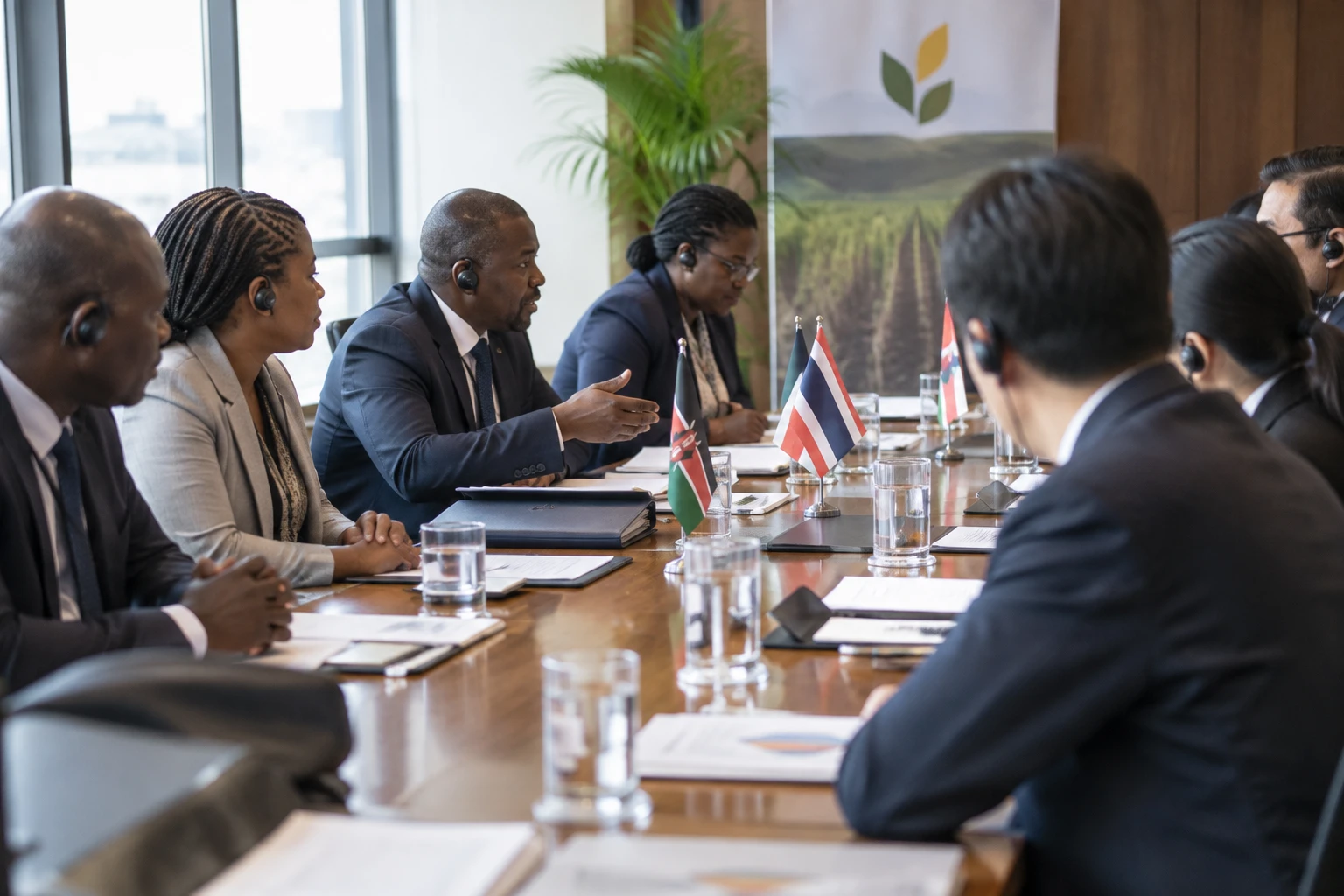
Processing a larger share of Kenya’s harvests at home, rather than selling mostly raw products, is at the heart of discussions with Thailand. For Kenyan farmers and businesses, the challenge is not just attracting capital: it is also about where jobs, added value and markets will be created.
From selling harvests to processing them
Kenyan Agriculture Minister Mutahi Kagwe has invited Thai companies to set up processing plants in Kenya. He was speaking at a meeting with Thailand’s ambassador to Nairobi, Jirusaya Birananda, on 5 November 2026, according to the Kenya News Agency. Kenya’s ministry also reported on the discussions.
The minister’s message is straightforward: investors can process Kenyan agricultural products locally, then sell them in Kenya, Thailand or other markets. This approach could bring producers, factories and commercial networks closer together. It distinguishes industrial investment from simply buying raw materials to be processed abroad.
The initiative is part of a broader economic rapprochement. On 16 September, Federation of Thai Industries president Pimjai Leeissaranukul received Kenya’s ambassador Lucy N. Kiruthu in Bangkok. Their discussions focused, among other things, on agricultural equipment, processed foods and supply chains. The Thai federation confirmed the talks and announced a business meeting between the two countries on 5 and 6 November.
A Kenyan strategy already set out in a national plan
The approach to Thai investors comes as Nairobi seeks to develop its agro-industrial capacity. Agriculture, forestry and fishing accounted for 23.2% of Kenya’s GDP in 2025, according to World Bank data. This economic weight explains why local processing matters for rural incomes as well as industry and trade.
The National Agro-Food Systems Investment Plan, or NASIP, sets targets for 2026-2030. The government plans to mobilise about 1,081 billion Kenyan shillings to modernise value chains, strengthen markets and attract private finance. The official document allocates expected contributions among businesses, the state and development partners.
The agro-industrialisation component includes plans for medium- and large-scale processing parks, as well as county-level collection and processing platforms. The plan targets 15 to 20 agro-industrial parks and 47 county-level platforms. It also aims to increase the share of agricultural products processed locally from 16% to 30% by 2030. These targets are set out in the official NASIP 2026-2030 document.
The figures signal ambition, not guaranteed results. The sites’ usefulness will depend on their construction, connection to power and roads, and access to storage and cold-chain facilities. The plan identifies the private sector as a major source of finance. The challenge will be turning announcements into viable projects and contracts accessible to local businesses.
The conditions for a balanced partnership
Thai companies could provide agricultural machinery, processing technologies, packaging solutions or cold-chain equipment. Investors could also help finance and operate industrial parks, including through partnerships with the state and counties. The Kenya-Thailand business meeting is set to facilitate contacts in agricultural machinery and processed food products.
But the presence of factories alone does not guarantee that benefits will be shared fairly. For small-scale producers, access to the platforms will depend on the prices offered, quality criteria, payment terms and transport costs. Co-operatives and small businesses will need appropriate equipment and finance. Without these links, the new infrastructure risks benefiting large operators first, as they are better able to supply consistent volumes.
Geographical distribution also matters. Facilities concentrated near Nairobi or major transport routes could leave more remote producers behind. The planned 47 county-level platforms could bring collection and processing closer to agricultural areas, provided they are actually funded and connected to markets. Post-harvest losses, storage and preservation will also affect the profitability of value chains.
Another issue is how value is shared. Kenya wants to export more processed products, while Thai companies are looking for investment and sourcing opportunities. Sustainable agreements will need to specify the role of Kenyan suppliers, employee training, skills transfer and producers’ access to contracts. These factors will help show whether co-operation goes beyond trade alone.
An issue that extends beyond the two countries
Kenya is a member of the East African Community (EAC), a regional bloc that facilitates trade among its member states. Additional processing capacity could serve the Kenyan market as well as regional markets, if costs and trade rules allow. NASIP also refers to access to markets under the African Continental Free Trade Area (AfCFTA), which aims to facilitate trade between African countries.
The partnership with Thailand illustrates how African economies are diversifying their trade relations beyond traditional partners. For Nairobi, the central question will be whether investment pledges lead to facilities, local purchases and lasting jobs. The next steps to watch are the follow-up to business meetings, funding announcements and implementation of the infrastructure set out in the national plan.