Algeria
 Egypt
 Libya
 Morocco
 Sudan
 Tunisia
 Benin
 Burkina Faso
 Cabo Verde
 Côte d'Ivoire
 Ghana
 Guinea
 Guinea-Bissau
 Liberia
 Mali
 Mauritania
 Niger
 Nigeria
 Senegal
 Sierra Leone
 The Gambia
 Togo
 Cameroon
 Central African Republic
 Chad
 DR Congo
 Equatorial Guinea
 Gabon
 Republic of the Congo
 São Tomé and Príncipe
 Burundi
 Comoros
 Djibouti
 Eritrea
 Ethiopia
 Madagascar
 Malawi
 Mauritius
 Mozambique
 Rwanda
 Seychelles
 Somalia
 South Sudan
 Tanzania
 Uganda
 Angola
 Botswana
 Eswatini
 Lesotho
 Namibia
 South Africa
 Zambia
 Zimbabwe
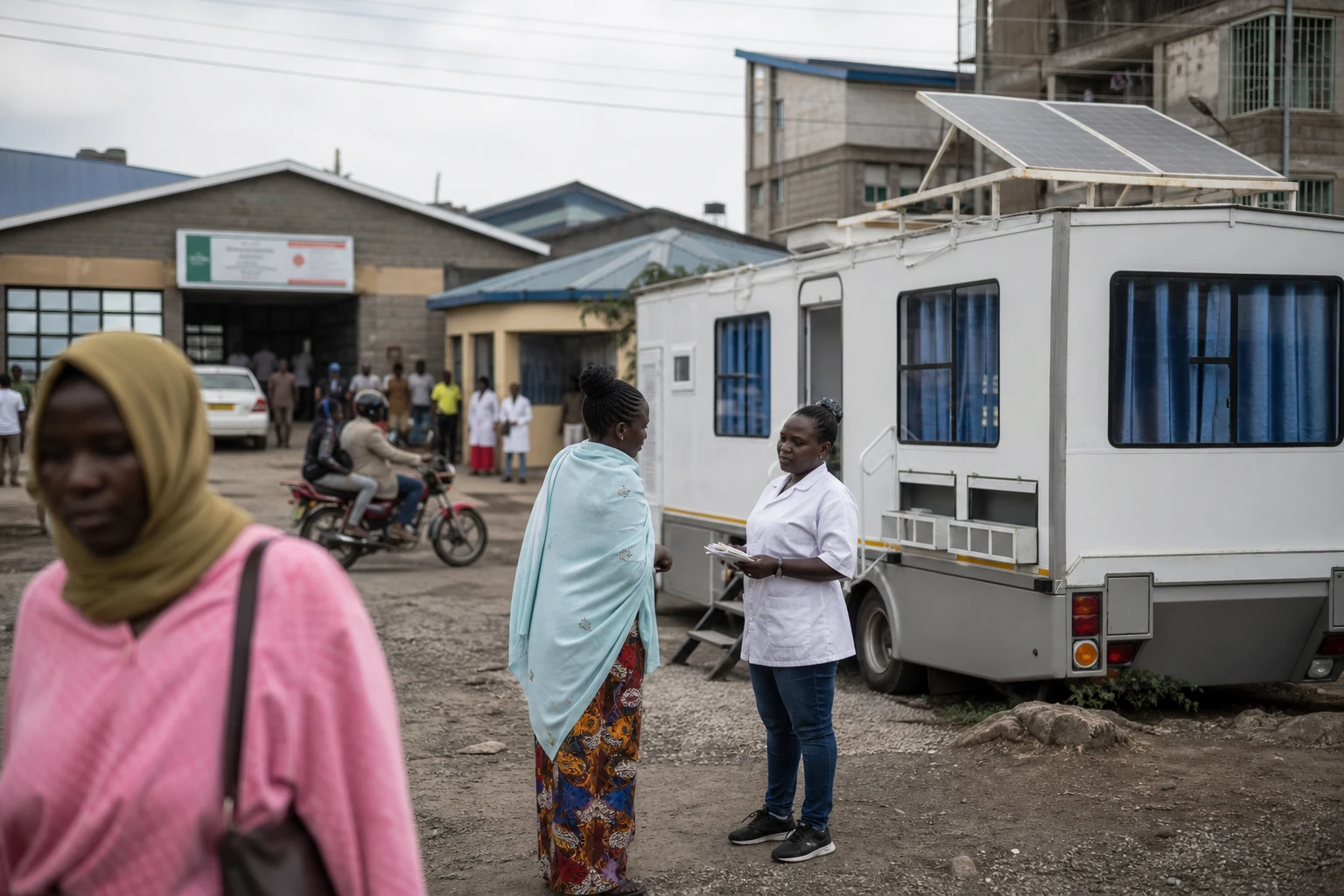
When technology meets the last-mile roads
Across much of Kenya, the challenge is not just providing treatment. It is reaching patients in time. Between remote villages, poor roads and transport costs, distance often becomes as significant a medical obstacle as a shortage of medicines. In recent years, the Kenyan health authorities have also stepped up reforms to bring services closer to communities, while partners such as Amref Health Africa are already working with counties on community health care.
It is in this context that a prototype solar ambulance, designed by a team of Dutch students, takes on particular significance. The issue is not simply automotive innovation. It is a question of whether a vehicle capable of generating and storing its own energy can adapt to the realities of a country where access to care remains unequal across regions.
A prototype designed to provide care on the spot
The vehicle, called Stella Juva, is a two-seater prototype powered by solar panels installed on its roof. According to the team, it can reach 120 kilometres per hour and travel up to 715 kilometres in sunny conditions thanks to its rechargeable battery. The vehicle also carries medical equipment: an X-ray machine, defibrillator, ultrasound scanner, tuberculosis screening kit and refrigerated compartment for vaccines.
The project is not presented as a simple transport ambulance. Its aim is instead to bring care to patients. That is an important distinction in areas where the nearest hospital is too far away, or too expensive to reach. According to the team’s stated plan, the vehicle should be able to operate day and night, even when the sky is overcast, thanks to its energy storage.
The choice of Kenya is no accident. The team said it wanted to test the prototype there in real-world conditions. Amref Health Africa, which supports health programmes in several African countries, said the innovation addressed a practical need, particularly in areas where transport is scarce, fuel is expensive and the electricity grid is unreliable.
Kenya faces the challenge of distance
The debate over medical transport is rooted in a well-documented reality. A World Bank study and analyses on Kenya show that road conditions, access to electricity and digital tools directly affect the quality of care. At primary healthcare facilities, only 56% had a stable electricity supply in data cited by the World Bank, while distance from good-quality roads undermined diagnostic performance.
The Kenyan government also says it is focusing on community-based care. The Ministry of Health announced the deployment of 107,831 community health promoters across all 47 counties as part of universal health coverage. This community-based structure complements primary care networks and ongoing public health reforms.
In this landscape, a solar ambulance is no miracle solution. But it could become a useful tool in rural, pastoralist or remote areas, where patients lose time even before reaching a healthcare facility. Pregnant women, children due for vaccination, and patients with tuberculosis or chronic illnesses are among those most affected. The potential benefit is straightforward: reducing the time between an alert and a response.
What this innovation changes, and what it does not solve
The prototype highlights an often overlooked issue: in many African regions, healthcare problems begin with logistics. A good medical device is useless if it cannot reach the patient. A vaccine also loses value if it cannot be stored properly during transport. That is precisely why health teams working outside cities are increasingly relying on solar-powered solutions, mobile cold chains and vehicles adapted to long journeys.
Kenya offers an interesting testing ground because the country combines several constraints with several advantages. On the one hand, long distances, infrastructure gaps between urban centres and outlying areas, and operating costs weigh on health services. On the other, the country has a strong health innovation ecosystem, organisations such as Amref Health Africa, and a public strategy that places greater emphasis on community-based care and universal health coverage.
The industrial question remains. The prototype was designed by 23 students in one year, demonstrating the project’s agility but also its limitations. To move from demonstration to useful service, it will need to prove its durability, withstand poor roads, ensure maintenance and, above all, find partners capable of producing it on a larger scale. The team itself says it is waiting for support from technical and industrial stakeholders to take the project further.
A development to watch in Africa’s health agenda
Beyond Kenya, this experiment is part of a broader continental trend: using solar power to decentralise essential services. Solar-powered mobile clinics have already been deployed in Kenya, and health projects supported by Amref have shown that mobile systems can also transport vaccines, medicines and medical teams to hard-to-reach areas.
The continental significance is clear. East Africa, through the East African Community, has for several years sought to strengthen cross-border services, health resilience and solutions suited to remote areas. In this context, a prototype such as Stella Juva says more than just something about Dutch ingenuity. Above all, it is a reminder that in public health, an innovation’s value is measured by its ability to reach the regions where the state, counties and communities struggle most to maintain a sustained presence.