Algeria
 Egypt
 Libya
 Morocco
 Sudan
 Tunisia
 Benin
 Burkina Faso
 Cabo Verde
 Côte d'Ivoire
 Ghana
 Guinea
 Guinea-Bissau
 Liberia
 Mali
 Mauritania
 Niger
 Nigeria
 Senegal
 Sierra Leone
 The Gambia
 Togo
 Cameroon
 Central African Republic
 Chad
 DR Congo
 Equatorial Guinea
 Gabon
 Republic of the Congo
 São Tomé and Príncipe
 Burundi
 Comoros
 Djibouti
 Eritrea
 Ethiopia
 Madagascar
 Malawi
 Mauritius
 Mozambique
 Rwanda
 Seychelles
 Somalia
 South Sudan
 Tanzania
 Uganda
 Angola
 Botswana
 Eswatini
 Lesotho
 Namibia
 South Africa
 Zambia
 Zimbabwe
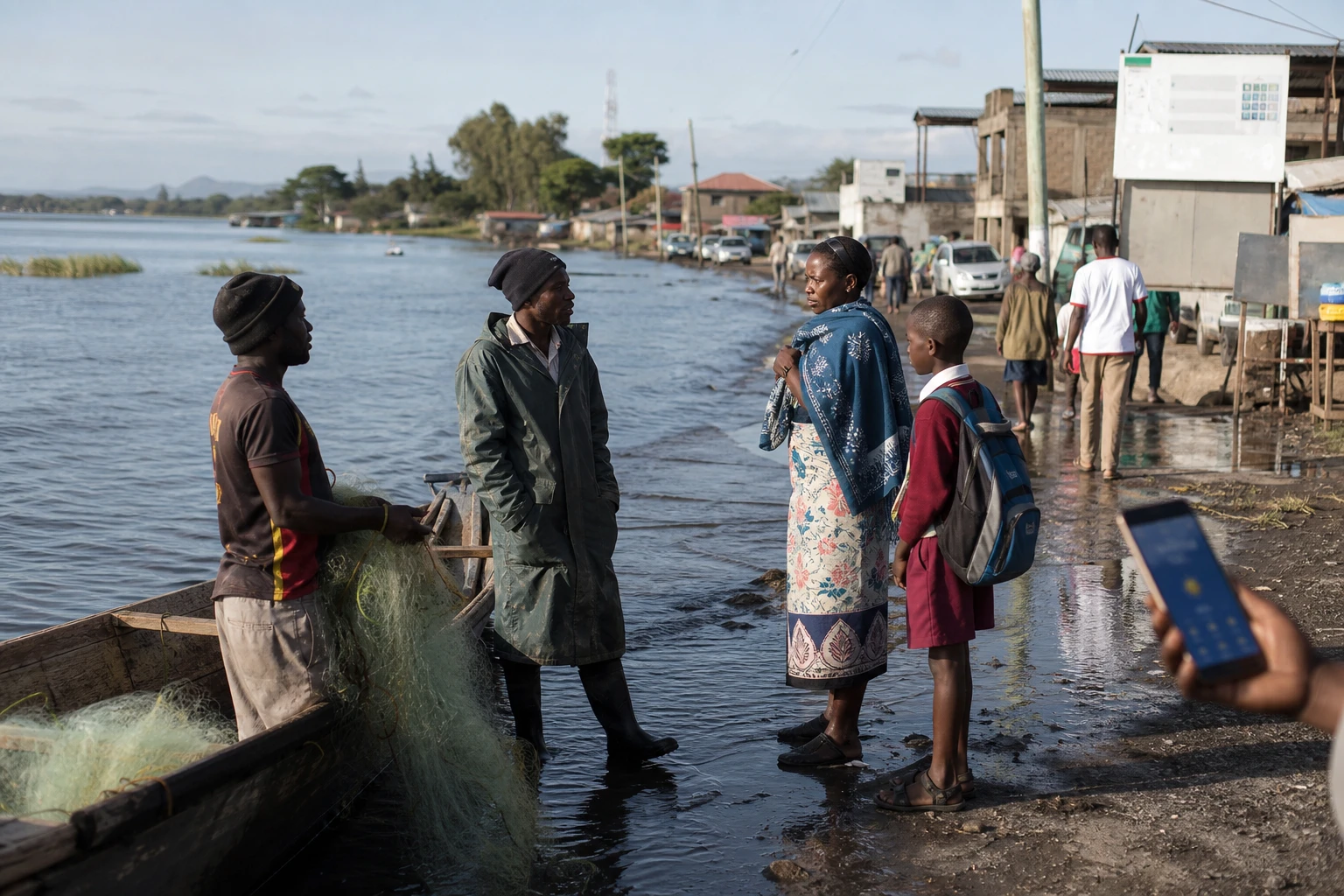
As water advances, the boundary between dry land and danger disappears
In west-central Kenya, Lake Baringo is no longer just a landscape. It has become a front line. As the water encroaches, homes, schools and paths are increasingly exposed. At the same time, hippos and crocodiles are moving closer to homes, turning a hydrological problem into a daily risk for families living around the lake.
The situation reflects a broader reality in East Africa: the lakes of the Rift Valley respond rapidly to extreme rainfall, pressure on catchment areas and settlement along their shores. In Kenya, where Nairobi is closely monitoring alerts from the Kenya Meteorological Department, heavy rainfall in 2026 has affected several parts of the country, including the Rift Valley and the Lake Victoria basin. Kenyan meteorological authorities had already forecast near- or above-normal rainfall in several areas, including Baringo, for the March-May 2026 season.
Lake Baringo, an economic asset under growing strain
Lake Baringo is in Baringo County, Kenya, in the heart of the Rift Valley. The area relies on the lake for fishing, tourism, irrigation and water. The county development plan describes the lake as a central resource for several local sectors. But the same document also notes that fluctuations in water levels tend to worsen with climate change and certain pressures on the catchment.
The area is no stranger to this kind of crisis. Local authorities and several news reports have already documented the flooding of homes, schools, health facilities and tourist sites as the lake rose between 2013 and 2020, and again in subsequent years. The phenomenon affects households, fishers, livestock keepers and service businesses alike. For some residents, the problem is not abstract: it is measured in forced displacement, dangerous school journeys and lost income.
The Kenya Meteorological Department, for its part, says the country has experienced intense rainfall in several regions and that flooding can also affect areas downstream of heavy downpours. In other words, even when rain does not fall directly on a particular locality, water can arrive further downstream as runoff, an overflow or a flood.
Families by the lake face a new, combined threat
The risk around Baringo is not limited to rising water. As the lake expands, it also pushes wildlife into inhabited areas. Kenyan media have previously reported increased numbers of hippos and crocodiles near schools and homes, with fatal or serious accidents reported in the past. This forced coexistence makes journeys more dangerous, especially for children, fishers and residents who still cross flooded areas to get to work or school.
In the county, authorities have also launched long-term responses, including climate adaptation and water-access projects funded with support from local resilience programmes. This highlights an important point: the crisis is not only environmental, but also a matter of planning. Where shores have been settled too close to the water, routes are fragile and warning systems remain incomplete, every rise in water level becomes a social emergency.
The case of Baringo also highlights a familiar divide between the centre and the periphery. In Nairobi, the issue is often discussed in terms of weather, alerts or crisis management. On the ground, it means lost property, children out of school, disrupted fishing areas and families forced to choose between safety and access to livelihoods. The poorest households, which live closest to the shores, pay the highest price.
A warning for East Africa, not just one county
The Baringo case extends beyond the local area. Across the East African Community, countries face the same chain of events: more erratic rainfall, faster flooding, pressure on lakes, and competing demands for water, agriculture, fishing and housing. UN Environment analyses point out that African lakes face combined pressures: climate change, population growth, pollution and uncontrolled land use.
For Kenya, the challenge is now twofold. It must protect lakeside residents while also preserving the local economy around the lake. This requires concrete decisions on shoreline zoning, safe routes, early warnings, wetland restoration and coordination between the national government, Baringo County and risk management services. Without this, each rainy season will continue to shift the problem from one year to the next.
Across the continent, Baringo illustrates a shift already under way in several African countries: water is no longer just a resource to be distributed; it is also a source of vulnerability that must be anticipated. A significant part of Africa’s resilience is at stake here, from the local level to regional climate cooperation frameworks. Lake Baringo offers a reminder for all of East Africa: when the environment changes faster than planning can keep pace, people’s daily lives become the front line of adaptation.