Algeria
 Egypt
 Libya
 Morocco
 Sudan
 Tunisia
 Benin
 Burkina Faso
 Cabo Verde
 Côte d'Ivoire
 Ghana
 Guinea
 Guinea-Bissau
 Liberia
 Mali
 Mauritania
 Niger
 Nigeria
 Senegal
 Sierra Leone
 The Gambia
 Togo
 Cameroon
 Central African Republic
 Chad
 DR Congo
 Equatorial Guinea
 Gabon
 Republic of the Congo
 São Tomé and Príncipe
 Burundi
 Comoros
 Djibouti
 Eritrea
 Ethiopia
 Madagascar
 Malawi
 Mauritius
 Mozambique
 Rwanda
 Seychelles
 Somalia
 South Sudan
 Tanzania
 Uganda
 Angola
 Botswana
 Eswatini
 Lesotho
 Namibia
 South Africa
 Zambia
 Zimbabwe
A digital market seeking greater depth
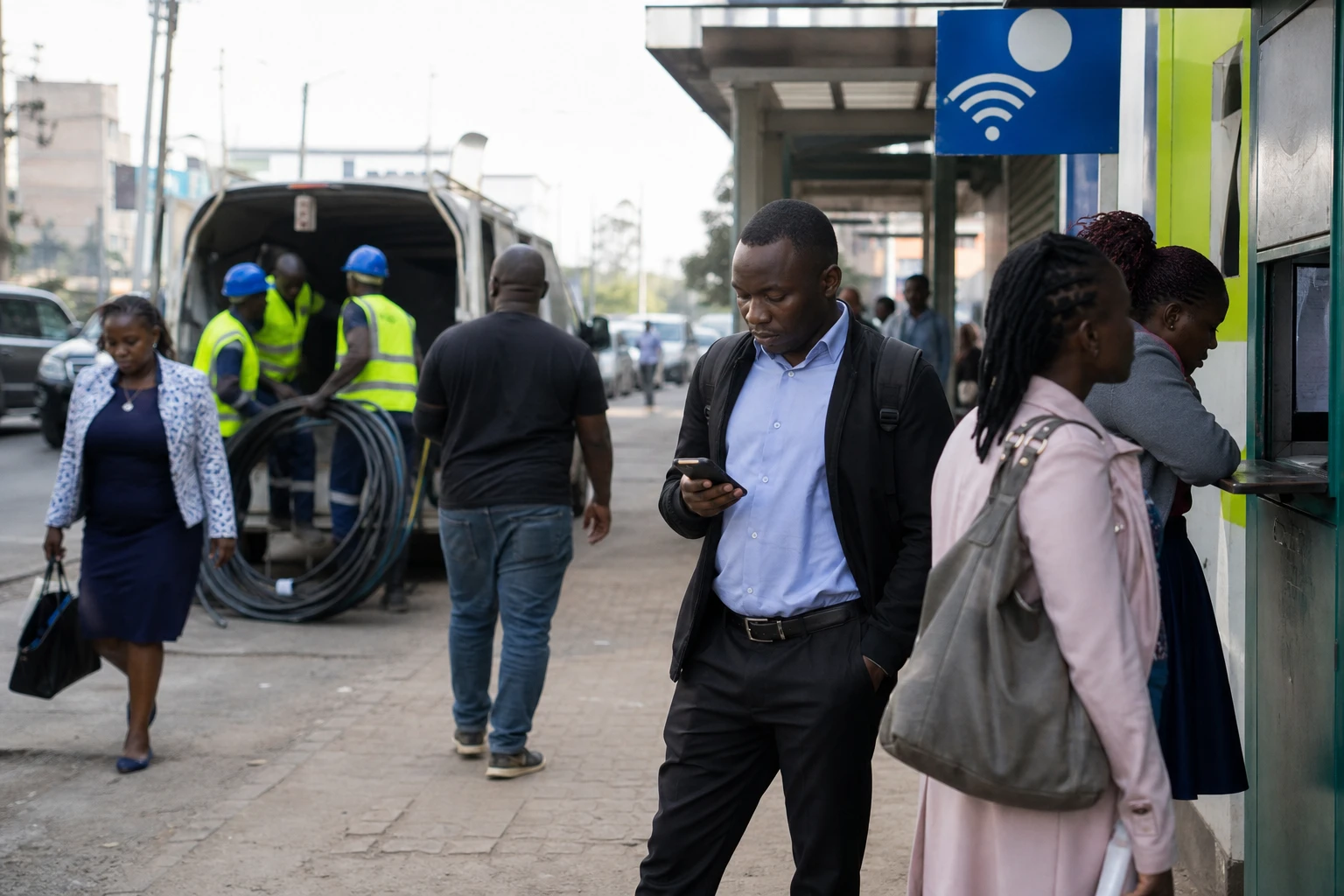
Kenya is not short of ambition or digital use. The country is already one of the continent’s most active markets for online services, mobile payments and public platforms. But the real challenge now lies not just in the app visible on a phone. It is in the invisible layers: fibre, towers, data centres, cloud and cybersecurity. This is where the country’s ability to keep Nairobi as a regional technology hub will be determined, as East Africa seeks to better connect its markets and administrations.
This step forms part of the trajectory of the Digital Superhighway, the Kenyan government’s major digital infrastructure project. The ICT Authority says the national plan targets 100,000 km of fibre-optic cable, 25,000 public Wi-Fi hotspots and digital hubs across the country. The project is also linked to the digitisation of public services, already under way through programmes such as KDEAP, funded by the World Bank, which aims to improve access to high-speed internet and online government services by 2028.
What the Chinese delegation is proposing
In Nairobi, a delegation from China’s Guodong group discussed an investment of 38.8 billion Kenyan shillings, or about $300 million, with Kenyan officials. The project covers several areas: telecoms towers, smart cities, data centres, fibre-optic cable, cloud infrastructure and green digital technologies. The meeting was held with the secretariat responsible for investment promotion, at a time when Kenya is seeking to attract more private capital into its strategic infrastructure.
For now, this is an expression of investment intent, not a project under way. That is an important distinction. In digital infrastructure projects, an announcement matters less than the timetable, financing structure, licences, access to land and deployment contracts. Guodong, for its part, already has a substantial portfolio in telecommunications and mobile towers, with an international expansion strategy backed by China’s Silk Roads. Its own website refers to recent discussions with Kenyan counterparts on communications infrastructure and data centres.
The message from Kenyan officials is clear: the country wants to speed up connectivity across its territory and reduce the cost of broadband. The ICT Authority describes its role as that of a digital public infrastructure operator, with a national fibre network, a shared network for the state and two major data centres in Nairobi. The government is also seeking better regional interconnection, a crucial point for trade within the East African Community.
Why the offer appeals to Nairobi
Kenya’s logic is simple: it wants to modernise quickly without adding further to public debt. Digital infrastructure is expensive. It requires capital, maintenance and operators able to sustain it over the long term. That is why Nairobi is holding more talks with foreign investors while maintaining its rhetoric on technological sovereignty. In this equation, fibre-optic cable, data centres and towers are not symbols. They are assets that determine the quality of public services, the speed of payments, the reliability of commercial exchanges and the movement of data.
The project also has a social dimension. In rural areas and urban outskirts, poor connectivity limits access to administrative services, telemedicine, digital education and opportunities for small businesses. In Nairobi, by contrast, the benefits are more immediate for start-ups, call centres, fintech and digital service providers. The same project therefore has different effects in different parts of the country. This is a central challenge in a country where digital growth is strong but unevenly distributed.
The choice of a Chinese partner is not incidental. Beijing remains a major player in physical infrastructure across the continent, while African states are seeking more flexible arrangements than traditional sovereign financing. Kenya is no exception. It is trying to diversify its partners, drawing on multilateral institutions, private capital and Asian companies. In Guodong’s case, the attraction is clear: the company brings expertise in towers and networks. But Nairobi’s challenge will be to ensure that this contribution aligns with public standards, digital security objectives and national strategy.
What this deal says about East Africa
Beyond Kenya, this deal speaks to a regional contest. East Africa wants to build its own digital corridors, connect its markets and make the movement of services more efficient. Kenya already has a head start thanks to Nairobi, its entrepreneurial ecosystem and its telecoms operators. But that lead cannot be preserved through inertia. It requires robust backbones, secure data centres and strong cross-border interconnections. That is precisely what Kenya’s strategy seeks to achieve, in line with digital transformation ambitions also being pursued at the continental level.
What happens next will depend on three factors. First, whether these discussions become a formal agreement. Second, whether the Kenyan government can distribute infrastructure beyond major centres. Finally, the role the project leaves to local companies, regional operators and public service needs. If these conditions are met, the Guodong deal could become a useful test: of a Kenya that is no longer content to host innovation, but is seeking to own the pipes, servers and relays that make it possible.