Algeria
 Egypt
 Libya
 Morocco
 Sudan
 Tunisia
 Benin
 Burkina Faso
 Cabo Verde
 Côte d'Ivoire
 Ghana
 Guinea
 Guinea-Bissau
 Liberia
 Mali
 Mauritania
 Niger
 Nigeria
 Senegal
 Sierra Leone
 The Gambia
 Togo
 Cameroon
 Central African Republic
 Chad
 DR Congo
 Equatorial Guinea
 Gabon
 Republic of the Congo
 São Tomé and Príncipe
 Burundi
 Comoros
 Djibouti
 Eritrea
 Ethiopia
 Madagascar
 Malawi
 Mauritius
 Mozambique
 Rwanda
 Seychelles
 Somalia
 South Sudan
 Tanzania
 Uganda
 Angola
 Botswana
 Eswatini
 Lesotho
 Namibia
 South Africa
 Zambia
 Zimbabwe
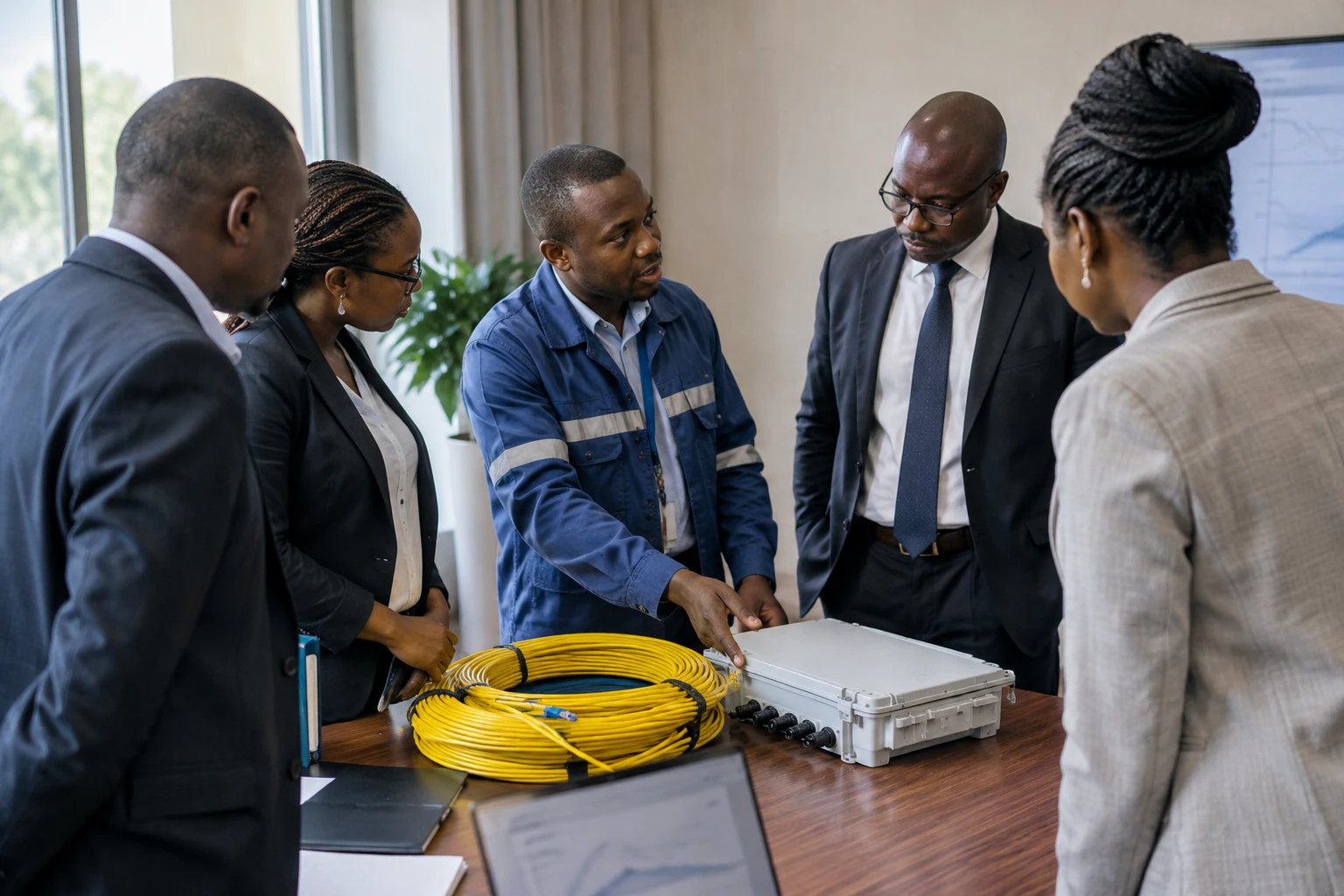
In Kenya, the next broadband challenge is no longer simply to increase the number of subscriptions. It is to bring fibre to neighbourhoods, secondary cities and rural areas, and then make connections affordable. This is where households and businesses’ practical access to the digital economy will be determined.
Extending the network beyond the main routes
On 13 October 2026 in Nairobi, Principal Secretary for Information Technology and the Digital Economy John Kipchumba Tanui unveiled a scheme to finance at least 27,000 kilometres of new infrastructure. The state plans to contribute 13 billion Kenyan shillings, with the aim of attracting a comparable amount from private investors. The sums have been announced as a means of leveraging finance; the private contribution has not yet been presented as committed.
The project covers several levels of the network. Backbone links carry data over long distances. Middle-mile sections bring fibre closer to towns and neighbourhoods. Finally, cross-border connections are intended to link Kenya’s network with those of neighbouring countries. The overall plan is designed to fill identified gaps and make it easier for internet service providers, which then connect customers, to do their work.
The programme falls under the Kenya Digital Economy Acceleration Project (KDEAP), led by the ICT Authority with support from the World Bank. According to information released in Nairobi, companies would be selected through multi-round reverse auctions: they submit competing bids to carry out the work while also mobilising private capital. The unprofitable sections have reportedly been identified with the support of a consultant.
Demand is growing, but subscriptions do not tell the whole story
Data from the Communications Authority of Kenya show rapid growth in fixed internet. At the end of June 2026, the country had about 2.84 million fixed subscriptions, up 32.4% year on year. Fibre accounted for nearly 1.57 million, an annual increase of 29.7%. The Authority publishes its figures in quarterly reports on communications services.
This growth gives a measure of demand, but it does not mean that every household is connected or can afford a subscription. A kilometre of fibre laid does not automatically become a home connection: local equipment, investment by operators, a suitable service and an affordable price are still needed. Subscriptions measure active lines, not the number of people reached or the quality of service in each county.
The government is targeting more than eight million fixed broadband connections and says it wants to bring internet access closer to every household already connected to electricity. This is a political target, not an achieved result. Formal businesses and public administrations can benefit from stable connections for payments, public services and professional exchanges. For small businesses, self-employed workers and people living far from urban centres, the impact will depend above all on price, service continuity and last-mile expansion.
Public funding must deliver verifiable results
The proposed model aims to share risk between the state and operators. Competition can help direct public money to the most useful links, provided that award rules are transparent and coverage commitments are monitored. Deadlines, actual costs, service quality and the terms of access to infrastructure for different providers will also need to be tracked.
The strategy builds on a trajectory already under way. In January 2026, the Kenyan daily Business Daily, citing a Treasury budget document, reported that the national network totalled 80,633 kilometres of fibre as of 2025, including 30,454 kilometres in the public sector and 50,179 in the private sector. These figures are not directly comparable with the additions announced by John Tanui: they cover different scopes and reference periods. This distinction matters when assessing what has been built and avoiding double-counting the same sections.
There is also an issue of territorial equity. Profitable routes in major cities attract operators more readily than sparsely populated areas, where the cost per subscriber is higher. The use of public funds is specifically intended to narrow this gap. But the number of kilometres laid will not be enough to prove that underserved areas have benefited from the programme: the location of the works and the number of actual connections will be decisive.
National infrastructure with regional effects
Cross-border links give the project an East African dimension. Kenya is a member of the East African Community (EAC), which brings together eight countries and is also working towards regional digital integration. In September 2026, the EAC and the Intergovernmental Authority on Development (IGAD) brought representatives of East African countries together in Nairobi to discuss connectivity and cross-border digital services.
More links can facilitate data exchanges and strengthen connections between the region’s markets, administrations and businesses. They do not, however, guarantee lower prices or frictionless traffic: these outcomes also depend on interconnection rules, competition and coordination among regulators. For operators and users alike, the challenge is therefore both technical and regulatory.
The next concrete step is the outcome of the tender, with applications, according to the announced timetable, expected by 29 October 2026. Award decisions will show which sections are prioritised and what share of private funding is actually mobilised. In Kenya, success will be measured less by the announcement of a number of kilometres than by whether residents and businesses can obtain a reliable connection at an affordable cost.