Algeria
 Egypt
 Libya
 Morocco
 Sudan
 Tunisia
 Benin
 Burkina Faso
 Cabo Verde
 Côte d'Ivoire
 Ghana
 Guinea
 Guinea-Bissau
 Liberia
 Mali
 Mauritania
 Niger
 Nigeria
 Senegal
 Sierra Leone
 The Gambia
 Togo
 Cameroon
 Central African Republic
 Chad
 DR Congo
 Equatorial Guinea
 Gabon
 Republic of the Congo
 São Tomé and Príncipe
 Burundi
 Comoros
 Djibouti
 Eritrea
 Ethiopia
 Madagascar
 Malawi
 Mauritius
 Mozambique
 Rwanda
 Seychelles
 Somalia
 South Sudan
 Tanzania
 Uganda
 Angola
 Botswana
 Eswatini
 Lesotho
 Namibia
 South Africa
 Zambia
 Zimbabwe
A quarantine that goes beyond public health
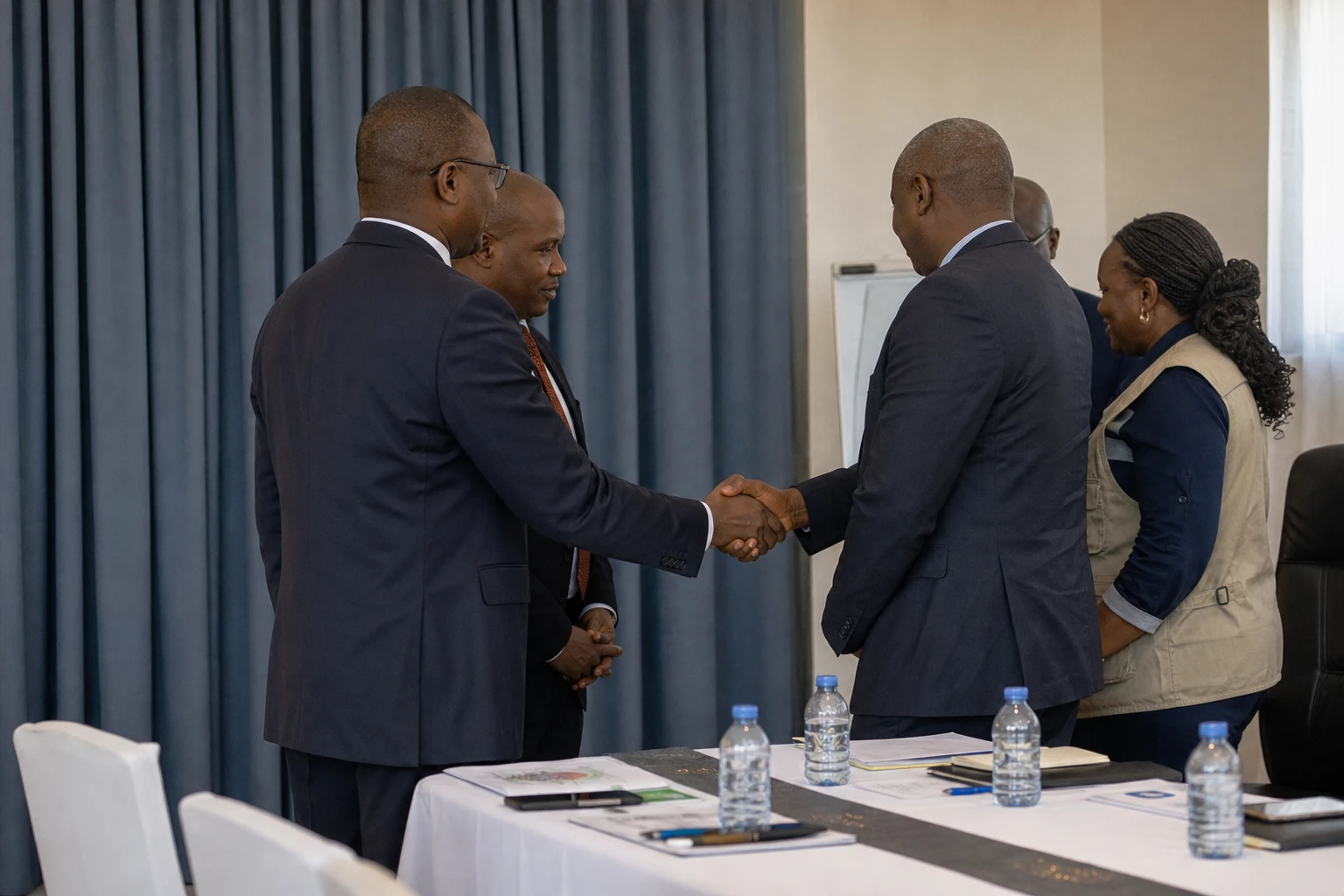
In Nairobi, the question is not only who is placed in quarantine. It is also how a country that serves as a transit hub and regional coordinator, and asserts health sovereignty, manages a crisis originating in eastern Democratic Republic of the Congo. In this case, Kenya finds itself at the intersection of three forces: public health, law and diplomacy with Washington.
The starting point lies more than 1,000 kilometres from Nairobi, in eastern DRC, where an Ebola outbreak caused by the Bundibugyo virus has been spreading since May 2026. The WHO describes an active outbreak, with transmission remaining difficult to contain amid insecurity, population movement and uneven healthcare capacity. The WHO Regional Office for Africa and Africa CDC, for their part, have launched a joint continental plan to strengthen surveillance, laboratories, care and cross-border coordination.
What happened in Nairobi
According to reports carried by Reuters and picked up by the Kenyan press, seven American aid workers who had returned from DRC, where they were taking part in the Ebola response, began quarantine at a new facility in Kenya after US authorities imposed travel restrictions. They are described as the first known occupants of the site, at the centre of a controversy that has already led to a court-ordered suspension of the project.
The Kenyan government had already been held back by the courts. In late May and early June 2026, the Nairobi High Court ordered the suspension of the establishment or operation of an Ebola quarantine and treatment facility, as well as the disclosure of related agreements, risk assessments and operating protocols. Kenyan media have also reported that the executive continued to defend the project, presenting it as a health preparedness tool, to the dismay of several rights groups.
Kenya’s Ministry of Health, for its part, says the country remains free of Ebola and has stepped up its preparedness. It says it has activated a national incident management system, trained more than 1,000 health workers and deployed border control measures, particularly at Malaba, the main crossing with Uganda. This mobilisation shows that Nairobi is not merely observing the crisis in DRC; it is monitoring it as an immediate regional risk.
Why the case is sensitive in Kenya
The dispute reveals a familiar tension in global health: how to protect exposed people swiftly without giving the impression that a country is agreeing to host another country’s health risks. In Kenya, that tension is heightened by the political sensitivity of military facilities, in this case Laikipia Air Base, and by questions over transparency surrounding an agreement reportedly worth US$13.5 million. The controversy is therefore not only medical; it concerns public oversight of decisions that commit the state.
The debate also has a social dimension. In a capital such as Nairobi, where diplomats, aid workers, logistics operators and health staff move about, any announcement related to Ebola triggers immediate concern. By contrast, in rural areas and at East African border posts, the issues are even more concrete: screening travellers, tracing contacts, availability of protective equipment and access to care in the event of a suspected case. The Kenyan state says it has strengthened these links in the chain, but public trust also depends on clear procedures.
The decision to quarantine foreign nationals exposed to the virus in Kenya also raises questions about the balance between cooperation and asymmetry. During this outbreak, Africa CDC has called for more autonomous funding of the African response, stressing that the continent cannot depend indefinitely on solutions from outside. In this context, Kenya appears at once as a logistical partner, a vigilant neighbouring country and a place where the contours of a more assertive African health sovereignty are still being negotiated.
A Kenyan case, but also a regional and continental one
The case goes beyond relations between Nairobi and Washington. It forms part of a regional framework in which East Africa, through the East African Community and WHO Africa mechanisms, is seeking to better coordinate alerts, border controls and emergency responses. The presence of Kenyan representatives at regional meetings in Kampala shows that countries in the region understand that an outbreak does not stay local for long when trade and travel routes remain open.
The case also has continental significance because of the precedent it may set in a crisis. Kenya is testing, in real time, an African state’s ability to demand transparency on a sensitive health project while continuing to work with its partners. At the level of the African Union and Africa CDC, the case serves as a reminder: outbreaks are not contained in laboratories alone, but also in courts, parliaments and border posts, and through trust between governments and populations.
The next points to watch are the course of the outbreak in DRC, regional coordination and the legal proceedings in Nairobi. If the outbreak continues to spread, pressure on neighbouring countries will remain high. If, on the other hand, the response manages to break the chains of transmission, Kenya may be able to close this chapter without turning a precautionary measure into an enduring political precedent.