Algeria
 Egypt
 Libya
 Morocco
 Sudan
 Tunisia
 Benin
 Burkina Faso
 Cabo Verde
 Côte d'Ivoire
 Ghana
 Guinea
 Guinea-Bissau
 Liberia
 Mali
 Mauritania
 Niger
 Nigeria
 Senegal
 Sierra Leone
 The Gambia
 Togo
 Cameroon
 Central African Republic
 Chad
 DR Congo
 Equatorial Guinea
 Gabon
 Republic of the Congo
 São Tomé and Príncipe
 Burundi
 Comoros
 Djibouti
 Eritrea
 Ethiopia
 Madagascar
 Malawi
 Mauritius
 Mozambique
 Rwanda
 Seychelles
 Somalia
 South Sudan
 Tanzania
 Uganda
 Angola
 Botswana
 Eswatini
 Lesotho
 Namibia
 South Africa
 Zambia
 Zimbabwe
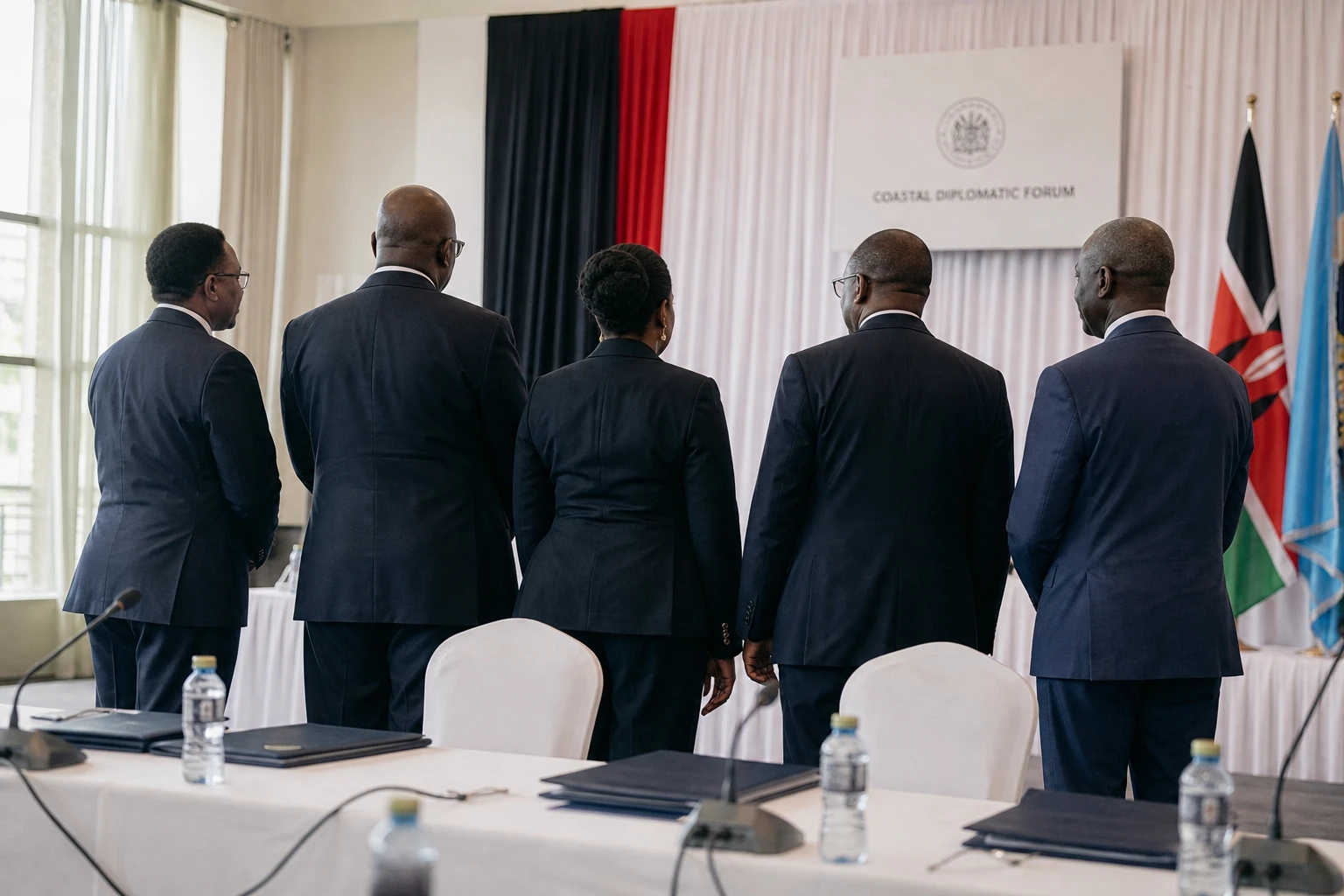
Training diplomats is a question of sovereignty
In African capitals, diplomacy is no longer confined to ceremonies or summit photographs. It is also conducted in negotiating rooms, through technical dossiers and in the ability to defend national interests without improvisation.
This is the shift Nairobi wants to accelerate. The Kenya Foreign Service Academy presented, on 26 August 2026, a resource mobilisation strategy for the period 2026-2029. The stated objective is clear: to raise $30 million, or about 3.9 billion Kenyan shillings, to fund diplomatic training, research, digital transformation and the institutional consolidation of the academy. Kenya’s Ministry of Foreign Affairs presents the plan as a lever to modernise the foreign service. The official statement from the Ministry of Foreign Affairs sets out this roadmap.
The message from the Kenyan government is simple: a country that wants to carry weight must invest in its personnel, its tools and the production of expertise. Diplomacy is no longer just a matter of representation. It is becoming an economic, security and strategic instrument.
An academy established to professionalise Kenyan diplomacy
The Foreign Service Academy is not a new institution. Established in 2006 as the Foreign Service Institute, it took its current name in 2017. The Foreign Service Act of 2021 then gave it semi-autonomous status, strengthening its capacity to provide training, conduct research and forge partnerships. The ministry also notes that the academy has already trained more than 5,000 Kenyan officials and diplomats from other countries in the region. The academy’s institutional page traces this development.
This expansion is part of a broader reorganisation of Kenyan foreign policy. In 2026, the ministry sent multiple signals in favour of an results-oriented diplomacy, with more research, pre-deployment training and links with universities. A recent meeting between the academy and the University of Nairobi focused on the country’s diplomatic footprint and aligning missions with national priorities. The account of this academic dialogue shows that Nairobi wants to ground its foreign policy in the production of knowledge.
This choice is not insignificant. In a region where trade, security and migration decisions are becoming more complex, technical expertise becomes a source of leverage. For a state such as Kenya, the quality of its diplomats has a direct bearing on contracts, mediation efforts and the country’s visibility.
A regional signal for East Africa
The regional context lends weight to this strategy. Kenya is a member of the East African Community, or EAC, a bloc comprising eight partner states that is pursuing deeper economic, political and social integration. In 2026, the organisation launched its seventh development strategy, focused on regional integration, digital transformation and institutional resilience. EAC documentation confirms this direction.
In this context, Kenya is not just pursuing its own national agenda. It is also involved in issues where the region is under strain, including exchanges with South Sudan, cross-border trade dynamics and peace initiatives. In March 2026, economic discussions between Nairobi and Juba again showed that Kenyan diplomacy remains a tool for engagement with neighbours, business and stabilisation. The website of Kenya’s ministry responsible for the East African Community reported on these discussions.
This regional dimension also explains why the academy wants to position itself as a future continental centre of excellence. Kenya wants to train its own diplomats, but also to become a knowledge hub for East Africa and beyond. It is a way of turning Nairobi into a centre for producing expertise, not just a capital of representation. The UN in Nairobi recently reiterated the country’s strategic role as a host and partner in diplomacy, development and peace.
The expected benefits are tangible. For leaders, better-trained diplomats make it easier to attract investment, defend Kenyan positions and coordinate regionally. For citizens, diplomacy can affect jobs, trade, the movement of skills and the country’s influence on issues that touch daily life, from the prices of imported goods to security concerns. In a tougher international environment, Kenya is therefore seeking not to speak louder, but to speak better.
Ultimately, the issue goes beyond the academy itself. It says something about the place Nairobi wants to occupy in Africa today: that of a state that does not simply react to negotiations, but prepares its officials to lead them. What happens next will depend on the ability to fund the plan, attract credible partners and make the academy a lasting instrument of public power. The real impact of this reform will be determined there in the coming months.