Algeria
 Egypt
 Libya
 Morocco
 Sudan
 Tunisia
 Benin
 Burkina Faso
 Cabo Verde
 Côte d'Ivoire
 Ghana
 Guinea
 Guinea-Bissau
 Liberia
 Mali
 Mauritania
 Niger
 Nigeria
 Senegal
 Sierra Leone
 The Gambia
 Togo
 Cameroon
 Central African Republic
 Chad
 DR Congo
 Equatorial Guinea
 Gabon
 Republic of the Congo
 São Tomé and Príncipe
 Burundi
 Comoros
 Djibouti
 Eritrea
 Ethiopia
 Madagascar
 Malawi
 Mauritius
 Mozambique
 Rwanda
 Seychelles
 Somalia
 South Sudan
 Tanzania
 Uganda
 Angola
 Botswana
 Eswatini
 Lesotho
 Namibia
 South Africa
 Zambia
 Zimbabwe
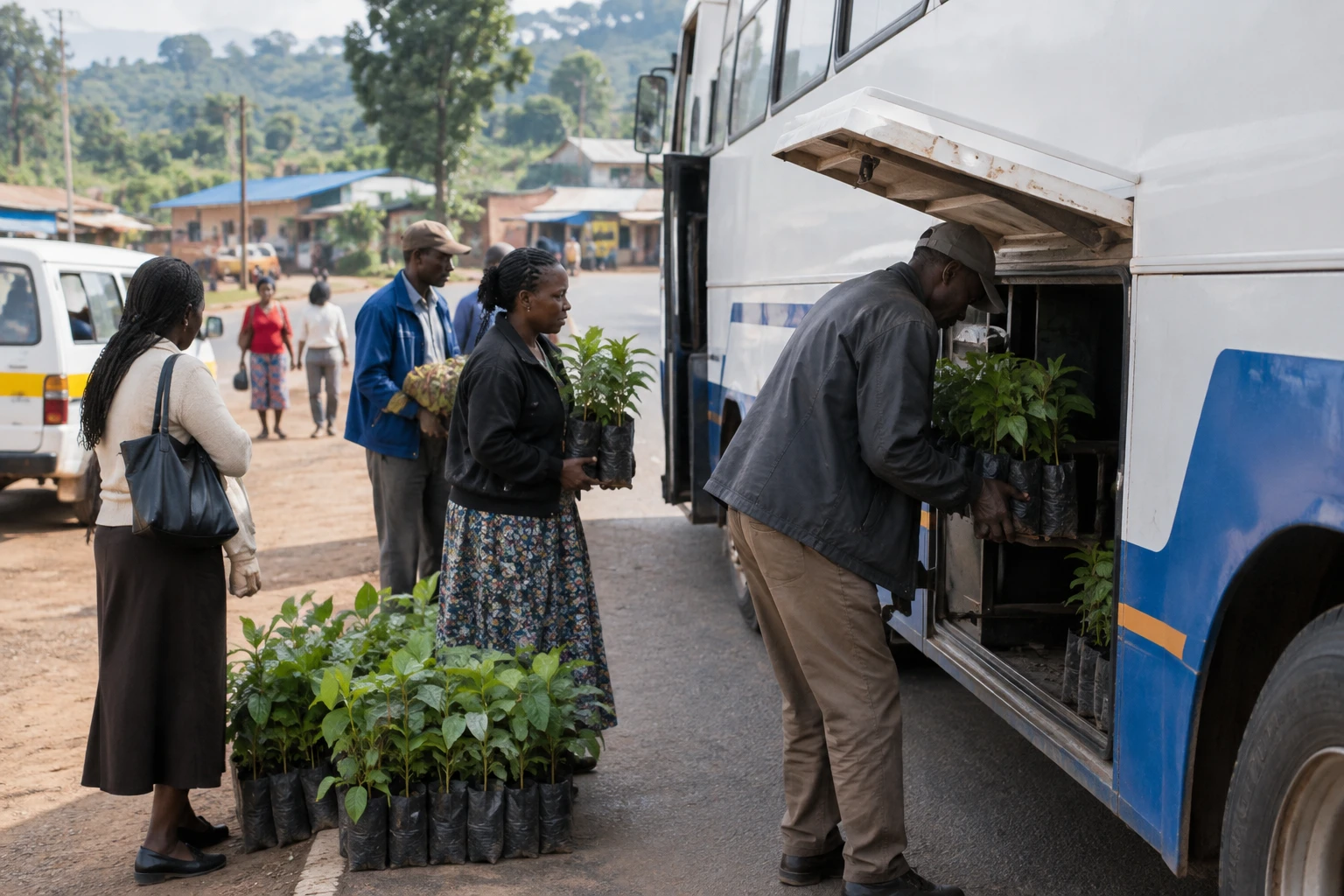
In Kenya, cocoa is still an emerging sector. The challenge is therefore not simply to distribute seedlings: it is also to establish where the trees can grow, support producers over several years and ensure that their harvests will find a buyer.
This ambition is taking shape in a country whose agricultural export earnings rely in particular on tea, cut flowers and horticulture. It opens up a new avenue for diversification, but planting announcements alone are not enough to show that regular commercial production is already established.
From Mount Elgon to proposed growing areas
On 10 October 2026, in Endebess, in Trans Nzoia County, President William Ruto linked the promotion of cocoa to national Mazingira Day celebrations, which focus on the environment. Seedlings were distributed at the event. The date and location were also reported by Kenyan public media.
The announcement is part of a national programme launched during the year. In July, the government said it intended to distribute two million cocoa seedlings before the end of 2026. Principal Secretary for Forestry Mugambi Gitonga said at the time that nearly 5.9 million hectares could be suitable for the crop. This is potential estimated by the authorities, not an area already planted or confirmed as capable of producing a profitable crop.
The programme also provides for a seed production centre at the Kenya Forestry Research Institute in Kaptagat. Distributions are planned in several counties, including Elgeyo-Marakwet, Meru, Kirinyaga and Kilifi. In July, the government also announced 10,000 cocoa seedlings for farmers in Kirinyaga. These steps are intended to test the crop in different environments before any expansion.
A sector still difficult to measure
Kenya is not starting from scratch, but the available data point to irregular activity that is poorly documented. According to International Trade Centre data series, declared exports of cocoa beans reached 475 tonnes in 2021, then fell to zero in 2022. They stood at one tonne in 2023; no quantity was reported in 2024, before a figure of 302 tonnes in 2025.
These figures should be treated with caution. Customs statistics record trade, not necessarily the agricultural origin of the beans. They are therefore not enough to establish that all 302 tonnes exported in 2025 were grown in Kenya. Trade data also classify beans separately from processed products: an export of chocolate or cocoa powder does not, by itself, prove that a local harvest exists.
The government describes cocoa as a new strategic crop. In November 2024, it was listed among the regulated crops under the Crops Act of 2013. This framework gives the Agriculture and Food Authority of Kenya (AFA) a role in promoting and regulating the crops concerned, including by overseeing operators and facilitating market access.
Regulation can organise a sector, but it cannot replace agricultural data or support on the ground. The public statistics cited in the debate do not yet make it possible to determine precisely how much land is devoted to cocoa. The authorities will therefore need to document the seedlings distributed, their survival rates, the first harvests and sales actually originating from Kenyan farms.
Potential incomes, but a long timeline
For farmers, the first concern is investment risk. A cocoa tree does not provide an immediate income: producers must devote time and land to a crop whose yield and markets have yet to be established locally. The announced cost of a seedling was 200 Kenyan shillings. In Endebess, William Ruto raised the possibility of a subsidy to make them more accessible. A promise of support does not, however, specify the amount or how it will be distributed.
The areas selected and the conditions in which the crop is grown will matter as much as the number of seedlings. Varieties must adapt to local soils and climate. Farmers will also need support with tree maintenance, and with fermenting and drying the beans, steps that affect their quality and price. Without training, predictable markets and transparent sharing of costs, expansion could leave producers bearing most of the risk.
The proposed model combines cocoa with agroforestry, meaning the cultivation of trees alongside other agricultural activities. This approach can help diversify incomes and integrate trees into farms. But its results will depend on local choices: a cocoa plantation should not be presented as an automatic environmental gain. Land use, water availability and the place of food crops will also need to be taken into account.
For Kenya, the challenge is to supplement its agricultural exports without undermining existing incomes. Nairobi can co-ordinate the national strategy, but counties, research institutes, co-operatives and buyers will have a direct role in putting it into practice. The needs of a rural farm are not the same as those of an urban-based processor or exporter.
A gamble that extends beyond Kenya’s borders
The initiative forms part of East African economic integration. Within the East African Community (EAC), Kenya trades with neighbouring countries such as Uganda and Tanzania. A viable sector could supply regional trade, but these markets are not reserved for Kenyan production: they also receive beans and processed products from other countries.
At continental level, the initiative is a reminder that countries are seeking to capture more value from agriculture, from cultivation to processing. Kenya does not yet have the standing of Africa’s major cocoa producers. Its strategy will be judged less by announcements than by verifiable results: seedlings actually delivered to farmers, survival rates, harvest volumes, the origin of exported beans and purchase contracts available to producers.
The next data on the 2026 campaign will show whether the target of two million seedlings is progressing beyond announcements. They will also reveal whether experience in counties such as Trans Nzoia and Kirinyaga is leading to a traceable sector capable of paying farmers and providing regular markets.