Algeria
 Egypt
 Libya
 Morocco
 Sudan
 Tunisia
 Benin
 Burkina Faso
 Cabo Verde
 Côte d'Ivoire
 Ghana
 Guinea
 Guinea-Bissau
 Liberia
 Mali
 Mauritania
 Niger
 Nigeria
 Senegal
 Sierra Leone
 The Gambia
 Togo
 Cameroon
 Central African Republic
 Chad
 DR Congo
 Equatorial Guinea
 Gabon
 Republic of the Congo
 São Tomé and Príncipe
 Burundi
 Comoros
 Djibouti
 Eritrea
 Ethiopia
 Madagascar
 Malawi
 Mauritius
 Mozambique
 Rwanda
 Seychelles
 Somalia
 South Sudan
 Tanzania
 Uganda
 Angola
 Botswana
 Eswatini
 Lesotho
 Namibia
 South Africa
 Zambia
 Zimbabwe
When cooking becomes an issue of energy, health and budgets
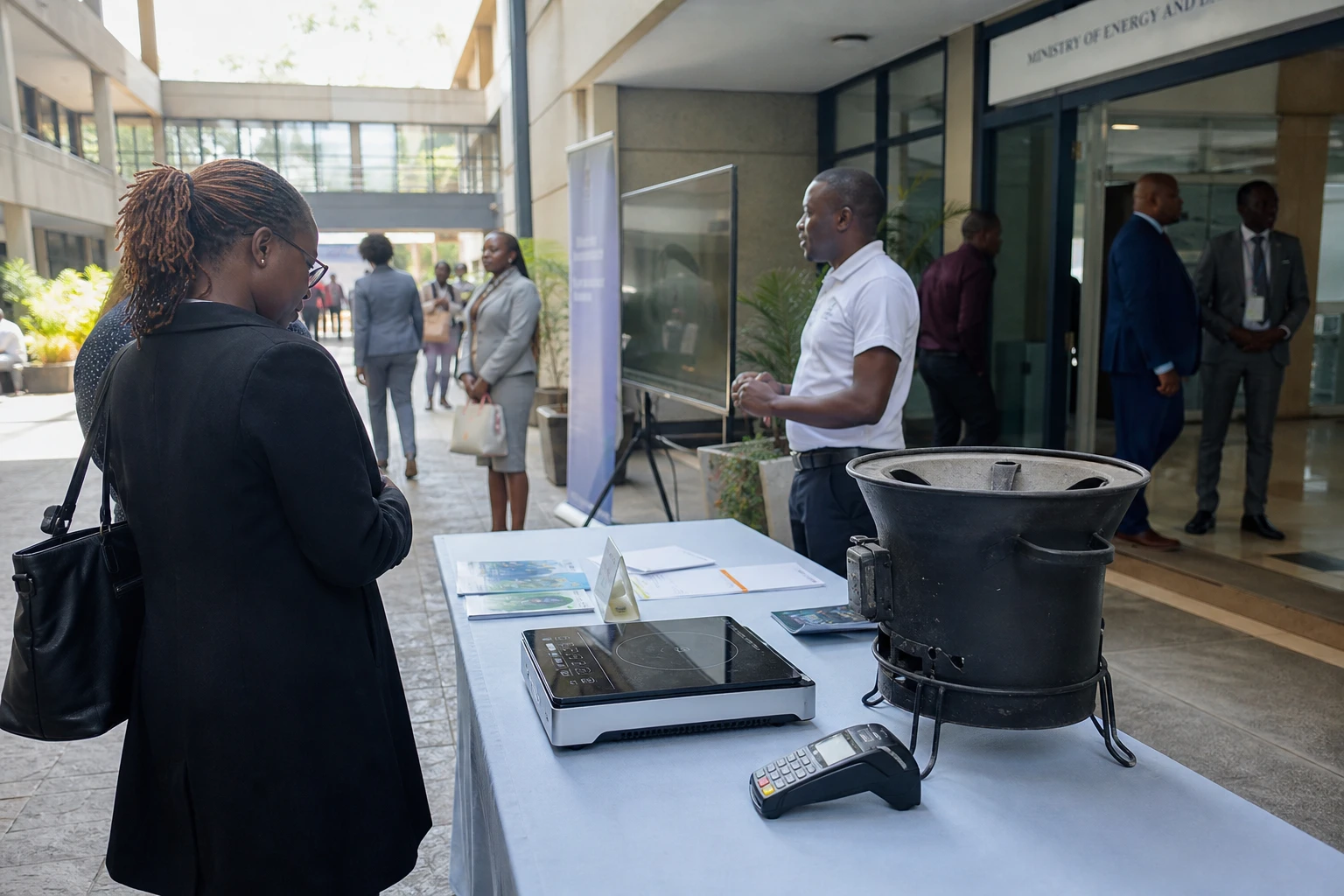
In Nairobi, switching from a charcoal stove to an electric cooker is not simply a household decision. It is often an economic, health and even urban choice: less smoke in the kitchen, less time spent looking for fuel, and a more manageable daily bill. In Kenyan cities, this shift also tells another story: the growth of a clean-cooking market built around electricity, improved biomass stoves and still-debated financial mechanisms, including carbon credits.
Kenya is at the heart of this transition. The country has adopted a national clean cooking transition strategy, designed to coordinate electricity, biogas, LPG, biomass fuels and lower-pollution solutions. This approach is part of a wider framework led by the African Development Bank and the World Bank to achieve universal access to energy, with an explicit goal of clean cooking by 2030. In East Africa, this issue directly affects urban and peri-urban households, as well as rural areas where wood is often still the cheapest option in the short term.
Cleaner stoves, but a funding model still under debate
The figures show the scale of the challenge. The International Energy Agency says that nearly one billion people in Africa still lack access to clean cooking, with serious consequences for health and forests. The agency also considers clean cooking one of the continent’s major energy security blind spots. Against this backdrop, the progress seen in Kenya matters, but is not enough on its own to change the scale of the problem.
In Nairobi, Mary Kavutha’s experience illustrates this shift. Like many urban households, she has moved from charcoal to an induction cooker. The benefits are immediate: less smoke, faster cooking and safer use in a home shared with young children. This change says a great deal about the evolution of demand in Kenya. Families are looking for cleaner appliances, but above all they want equipment that is affordable and compatible with irregular incomes.
This is where carbon credits come in. The principle is simple: when a project cuts emissions by replacing polluting cooking with a cleaner solution, that reduction can be certified and then monetised on the carbon market. The resulting revenue is used to lower the price paid by households or to fund the distribution of equipment. BURN, a Nairobi-based company, presents this model as a key deployment tool. It says it has distributed millions of cookers across several African countries and is betting on a combination of electric cooking, LPG and improved biomass.
But the use of carbon finance is not universally supported. Several experts believe the mechanism can help the sector expand, but cannot on its own fund a rapid, large-scale transition. That is the heart of the debate: carbon credits can help lower the upfront cost, especially for low-income households, but they depend on the quality of certification, the price of credits and the stability of international demand. In other words, they are a lever, not a complete solution.
What this transition means for Kenya and beyond
For the Kenyan government, clean cooking is no longer just a matter of social policy. It now involves energy planning, public health, climate and local industry. The government has already laid the foundations for a transition strategy aimed at addressing both the supply gap and the cost barrier. The question is no longer whether clean cooking is desirable. It has become a matter of implementation: how to produce, distribute, finance and maintain this equipment over time.
The contrast is clear between urban households connected to the grid, which can consider induction or hybrid models, and rural or peri-urban households, which still depend heavily on wood and charcoal. In cities, comfort, safety and the bill are often the priorities. Elsewhere, the main obstacle remains reliable access to affordable energy. That is why more efficient biomass cookers continue to play an important transitional role in Kenya and other African countries. They reduce fuel consumption and emissions without immediately imposing a sharp increase in costs on households.
The signal from Nairobi extends beyond the Kenyan market. During recent initiatives on energy access, several African countries reaffirmed their clean cooking goals, while new funding was announced at continental level. In July 2026, the IEA reported $900 million in new commitments for clean cooking in Africa, in addition to sums already mobilised since the 2024 Paris summit. The message is clear: the transition will not come from a single instrument or a single country, but from a combination of public policies, concessional finance, industrial innovation and market-based solutions.
For the continent, the stakes are strategic. Clean cooking affects the health of women and children, pressure on forests, electricity demand and local industrialisation. Kenya, where public strategies and private-sector players are advancing together, serves as a testing ground. If the model can combine affordability, equipment quality and credible financing, it could inspire other markets in East Africa and then further afield. If, on the other hand, carbon remains too fragile a safety net, the transition will remain slow and uneven. This is the tension that merits close attention as African commitments are, or are not, translated into genuinely cleaner households.