Algeria
 Egypt
 Libya
 Morocco
 Sudan
 Tunisia
 Benin
 Burkina Faso
 Cabo Verde
 Côte d'Ivoire
 Ghana
 Guinea
 Guinea-Bissau
 Liberia
 Mali
 Mauritania
 Niger
 Nigeria
 Senegal
 Sierra Leone
 The Gambia
 Togo
 Cameroon
 Central African Republic
 Chad
 DR Congo
 Equatorial Guinea
 Gabon
 Republic of the Congo
 São Tomé and Príncipe
 Burundi
 Comoros
 Djibouti
 Eritrea
 Kenya
 Madagascar
 Malawi
 Mauritius
 Mozambique
 Rwanda
 Seychelles
 Somalia
 South Sudan
 Tanzania
 Uganda
 Angola
 Botswana
 Eswatini
 Lesotho
 Namibia
 South Africa
 Zambia
 Zimbabwe
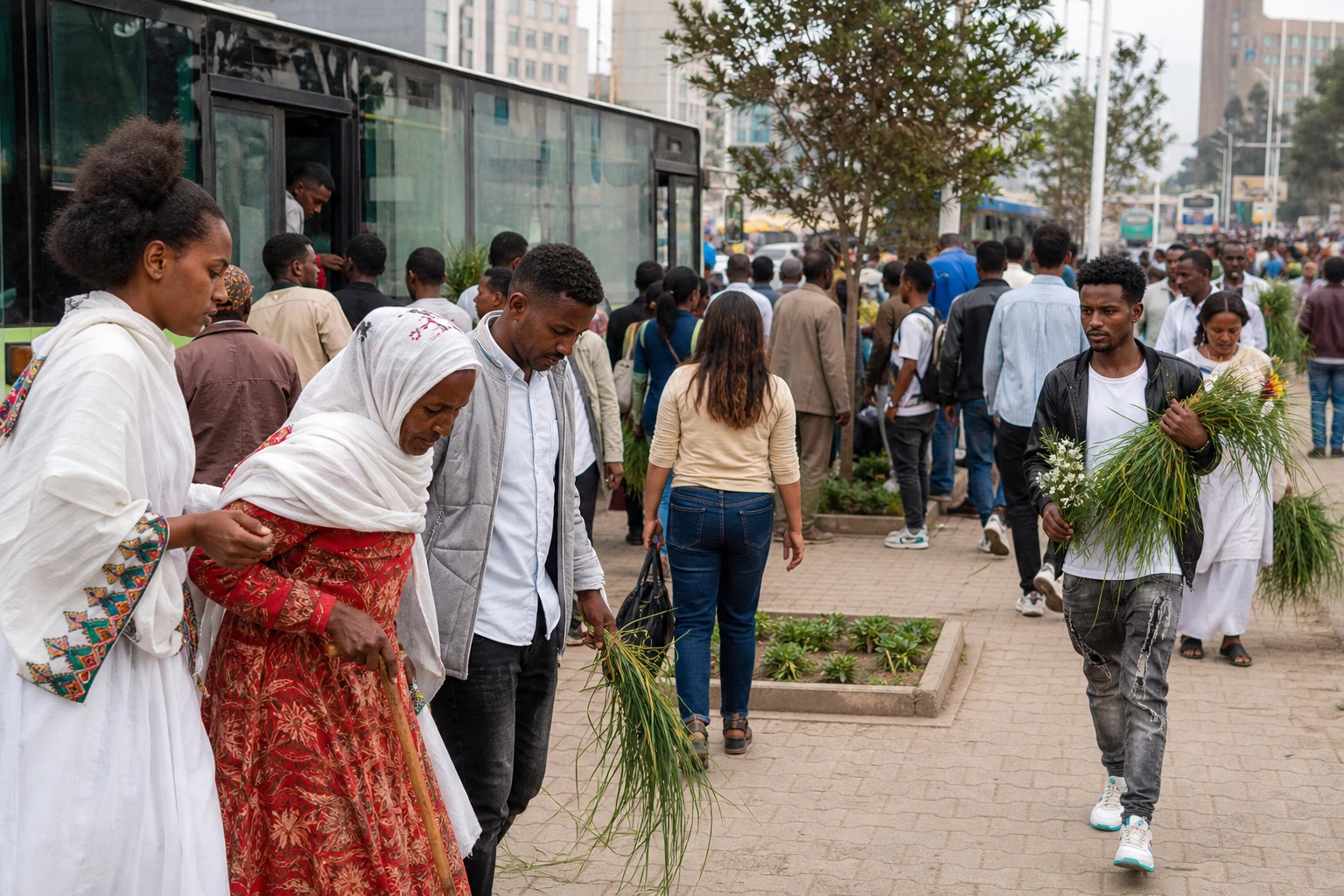
In Addis Ababa, Irreecha is more than a ceremony. Each year, the festival turns a moment of gratitude into a space for cultural transmission, gathering and dialogue. On 4 October 2025, hundreds of thousands of people converged on Hora Finfinnee, the sacred site in the Ethiopian capital, to celebrate Oromo heritage.
A festival of gratitude at the heart of Ethiopia
Irreecha marks the end of the rainy season and the start of Birraa, a period associated with spring, the resumption of agricultural activities and hopes for a season of abundance. For the Oromo, Ethiopia’s largest ethnolinguistic group, the festival is a time to give thanks to Waaqa, the name for God in the Oromo spiritual tradition.
At Hora Finfinnee, participants brought fresh grass and flowers. These accompany prayers, blessings and ritual gestures performed near the water. Songs and dances set the rhythm of the ceremony, while the Abbaa Gadaa, guardians of the Oromo people’s traditional system of governance, led the different parts of the celebration.
Women also held a central place in the procession. In the Gadaa system, the traditional social and political institution of the Oromo, they are associated with mediation, transmission and the pursuit of peace. This gives Irreecha a significance that goes beyond religious expression alone.
The celebration also took place that weekend at Hora Arsadi, near Bishoftu, in the Oromia region. These two sites are the main national centres of Irreecha. Participants came from different parts of Oromia, as well as from other regions of Ethiopia.
Oromo culture at the centre of public life
Traditional clothing, adornments, music and dances gave the ceremony a high profile. The festival allows younger generations to discover practices passed down by families, elders and customary leaders.
This visibility matters in a federal country marked by great linguistic, cultural and political diversity. Ethiopia is home to many peoples and communities. In this context, Irreecha gives the Oromo a space in which their history, language and symbols take centre stage in public life.
The international recognition of the Gadaa system by UNESCO has strengthened this heritage dimension. It has also helped bring Oromo traditions into debates on safeguarding living cultures. Irreecha, however, is not frozen folklore. The festival is still practised by communities and continues to evolve with Ethiopian society.
In Addis Ababa, this evolution is also visible in the way the city is organised. The ceremonies attract visitors, researchers and members of the diaspora. They support transport, hotel, restaurant and informal trading activity. The benefits accrue mainly to areas near the gathering sites, but they also contribute to the capital’s cultural promotion.
A message of peace amid national tensions
The organisers placed the 2025 celebration under the banner of peace, unity and brotherhood. Prime Minister Abiy Ahmed also sent a message to the Oromo and all Ethiopians. He presented Irreecha as an opportunity to strengthen forgiveness, reconciliation and dialogue.
The message comes as Ethiopia continues to face armed and political tensions in several regions. The Tigray conflict ended with the Pretoria Agreement in November 2022, but stabilisation remains incomplete. In some areas, clashes, displacement and disagreements between federal and regional authorities continue to weigh on daily life.
In Oromia, violence involving security forces and the Oromo Liberation Army has also marked recent years. The federal authorities are calling for disarmament and dialogue. Local actors, for their part, are calling for a political response to grievances relating to governance, security and representation.
In this context, the message of peace carried by Irreecha has practical significance. It is addressed to communities, but also to the authorities. A festival can create an opportunity for people to meet. On its own, it cannot resolve disputes. Its credibility will therefore depend on the institutions’ ability to turn calls for reconciliation into lasting measures.
Addis Ababa, capital and space for negotiating identity
Holding Irreecha in Addis Ababa has particular significance. The capital lies at the heart of the Oromia region, while coming under a separate municipal administration. Its status has long fuelled debate over the rights of Oromo people, access to land, urban planning and relations between the city and the surrounding region.
The name Finfinnee, used in the Oromo language, recalls the capital’s earlier history and the place of the territory in Oromo memory. For participants, gathering at Hora Finfinnee is therefore a way to celebrate a tradition while also linking contemporary culture to a historic place.
Municipal authorities have highlighted urban development works and Addis Ababa’s capacity to host major events. Participants also see it as an opportunity to present a city in transition. This narrative of development remains tied, however, to sensitive questions about access to public spaces, urban displacement and the effects of growth on residents of peripheral neighbourhoods.
A significance that extends beyond Ethiopia’s borders
Irreecha resonates across East Africa. Oromo culture extends beyond Ethiopia, notably into Kenya, and the diaspora takes part in celebrations in Europe, North America and the Gulf states. The festival thus becomes a link between communities living in different places.
It is also part of the dynamics of the Intergovernmental Authority on Development, IGAD, a regional organisation bringing together several countries in the Horn of Africa. The region’s crises cross borders. Calls for peace, the movement of people and the preservation of heritage therefore have regional significance.
After the 2025 celebration, the question will be whether Irreecha can retain its cultural character while serving as a bridge in a country that remains fragmented. Its strength lies precisely in this balance: affirming an Oromo identity without giving up the idea of a shared Ethiopian space.