Algeria
 Egypt
 Libya
 Morocco
 Sudan
 Tunisia
 Benin
 Burkina Faso
 Cabo Verde
 Côte d'Ivoire
 Ghana
 Guinea
 Guinea-Bissau
 Liberia
 Mali
 Mauritania
 Niger
 Nigeria
 Senegal
 Sierra Leone
 The Gambia
 Togo
 Cameroon
 Central African Republic
 Chad
 DR Congo
 Equatorial Guinea
 Gabon
 Republic of the Congo
 São Tomé and Príncipe
 Burundi
 Comoros
 Djibouti
 Eritrea
 Kenya
 Madagascar
 Malawi
 Mauritius
 Mozambique
 Rwanda
 Seychelles
 Somalia
 South Sudan
 Tanzania
 Uganda
 Angola
 Botswana
 Eswatini
 Lesotho
 Namibia
 South Africa
 Zambia
 Zimbabwe
A quiet but decisive front on the edge of Ethiopia
In eastern Sudan, front lines are not being fought over only around Khartoum, Darfur or Kordofan. They are also shifting towards agricultural and border areas such as Blue Nile, where a town like Geissan carries far more weight than its size suggests. There, controlling a locality also means controlling roads, stocks, population movements and part of the military pressure across south-eastern Sudan.
This shift explains why every advance is being closely watched, from Damazin to the Ethiopian border. It also serves as a reminder that Sudan’s war has long spilled beyond the sole confrontation between the army and the Rapid Support Forces (RSF), the powerful paramilitary force that grew out of the former Janjaweed militia system and became one of the two main sides in the open war that began on 15 April 2023.
According to several sources on the ground and humanitarian observers, recent clashes in Blue Nile are part of a broader sequence marked by cross-border movements, repeated accusations against Ethiopia and the belligerents’ search for logistical depth. The stakes therefore go beyond Geissan: they concern the stability of an already sensitive border between Sudan and Ethiopia, and the corridors linking the region to the Horn of Africa.
Geissan, a tactical gain in a war of attrition
On Wednesday 12 August, the RSF said it had taken control of Geissan, in Blue Nile state, south-eastern Sudan. The town lies near the Ethiopian border and about 180 kilometres from Damazin, the state capital. The fighting was reportedly preceded the previous day by drone strikes and heavy artillery fire. The Sudanese army, for its part, said fighting was continuing and that its local base remained in the hands of its forces.
The available information points above all to a battle for control of the ground and the narrative. The RSF circulated photographs and videos from the town centre to demonstrate its advance. The army, meanwhile, disputed claims that the town had been fully captured and said positions remained contested. In this kind of war, capturing a locality is not measured only by planting a flag in a central square. It also depends on the ability to hold a base, secure routes and prevent the enemy from returning.
Geissan had already been under pressure for several months. Earlier fighting had forced civilians to flee, and the town had already emerged as a prime target for the RSF and its allies. At the start of the summer, the Sudanese army had also conducted operations in the area, while repeated clashes were reported in other parts of Blue Nile, notably around Kurmuk, which is also close to Ethiopia.
A militarised border, civilians caught in the crossfire
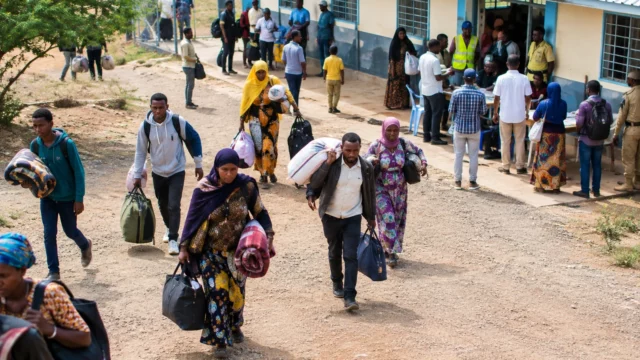
The human impact is immediate. The International Organization for Migration (IOM) has reported displacement in Blue Nile, while its Sudan monitoring indicates that nearly 59,742 people were displaced from areas of the state between 11 January and 21 May 2026. Across the Sudanese conflict as a whole, the figures have become staggering: the IOM now speaks of several million people displaced nationwide, amid the collapse of basic services and fragile humanitarian access.
In Geissan, the shock is not only military. Local authorities say the attack took place in the middle of the harvest season. In a region where agriculture shapes everyday life, the loss of a harvest or the looting of a market is no minor matter. It means less food, less income, fewer seeds for the next season and greater dependence on aid or informal networks. Blue Nile, like other Sudanese states, is already paying the price of a war economy that is undermining trade between towns, rural areas and cross-border markets.
Several accounts that corroborate one another also show how this war is sustained by its rear bases. In February 2026, press investigations described a clandestine camp in Ethiopia intended to train fighters linked to the RSF, amid suspicions of outside support. Addis Ababa has denied any direct involvement, while Khartoum regularly accuses it of allowing reinforcements or supplies to reach the paramilitaries. Ethiopia, for its part, also accuses Sudan of maintaining military ties with Ethiopian internal opponents. This exchange of accusations shows just how much the border is not merely a line on a map, but a zone of regional rivalries.
Why Blue Nile matters to Khartoum, Addis Ababa and the wider region
Blue Nile gives this battle a significance beyond its local scale. The area controls supply routes, protects water sources and borders a zone where trafficking, the movement of fighters and civilian displacement are difficult to disentangle. When the RSF gains ground there, it is seeking less a symbol than a corridor for action. When the army resists, it is defending both its south-eastern flank and the possibility of maintaining links with other fronts.
The regional dimension is just as clear. Ethiopia, a neighbouring country and a central actor in the Horn of Africa, finds itself effectively at the heart of a war in which it denies being a party. Any escalation on the Sudanese border could complicate the management of refugees, trade and internal security on both sides. It could also affect already fragile balances across the Horn, where crises pile up rather than replace one another.
For the African Union, this latest sequence is another warning. Sudan’s conflict is no longer confined to a contest between commanders in Khartoum. It has taken on a cross-border dimension, with external supply lines, shifting alliances and a human toll that continues to rise. As long as Blue Nile remains an active theatre, the war will retain its capacity to spread, displace populations and destabilise neighbouring states. The next developments will therefore unfold as much in military headquarters as in the region’s diplomatic corridors.