Algeria
 Egypt
 Libya
 Morocco
 Sudan
 Tunisia
 Benin
 Burkina Faso
 Cabo Verde
 Côte d'Ivoire
 Ghana
 Guinea
 Guinea-Bissau
 Liberia
 Mali
 Mauritania
 Niger
 Nigeria
 Senegal
 Sierra Leone
 The Gambia
 Togo
 Cameroon
 Central African Republic
 Chad
 DR Congo
 Equatorial Guinea
 Republic of the Congo
 São Tomé and Príncipe
 Burundi
 Comoros
 Djibouti
 Eritrea
 Ethiopia
 Kenya
 Madagascar
 Malawi
 Mauritius
 Mozambique
 Rwanda
 Seychelles
 Somalia
 South Sudan
 Tanzania
 Uganda
 Angola
 Botswana
 Eswatini
 Lesotho
 Namibia
 South Africa
 Zambia
 Zimbabwe
Two capitals, the same diplomatic calculus
When two African countries, distant geographically but close in their economic interests, choose to sign a general framework for cooperation, the gesture goes beyond a simple official photograph. It says something very concrete: on a continent where markets remain too fragmented, states are now seeking links between regions so they can sell, invest, train and provide more security for themselves. The rapprochement between Gabon, in Central Africa, and Sierra Leone, on West Africa’s Atlantic coast, fits this logic.
The regional context makes this move easy to understand. Gabon is engaged in a phase of diplomatic repositioning following the transition that began in 2023. Sierra Leone, for its part, holds the presidency of ECOWAS, the Economic Community of West African States, in 2026, giving it particular visibility on issues of integration, security and the movement of goods and people. At the same time, the African Union is pushing for the implementation of the African Continental Free Trade Area, the agreement intended to reduce barriers to trade between African states.
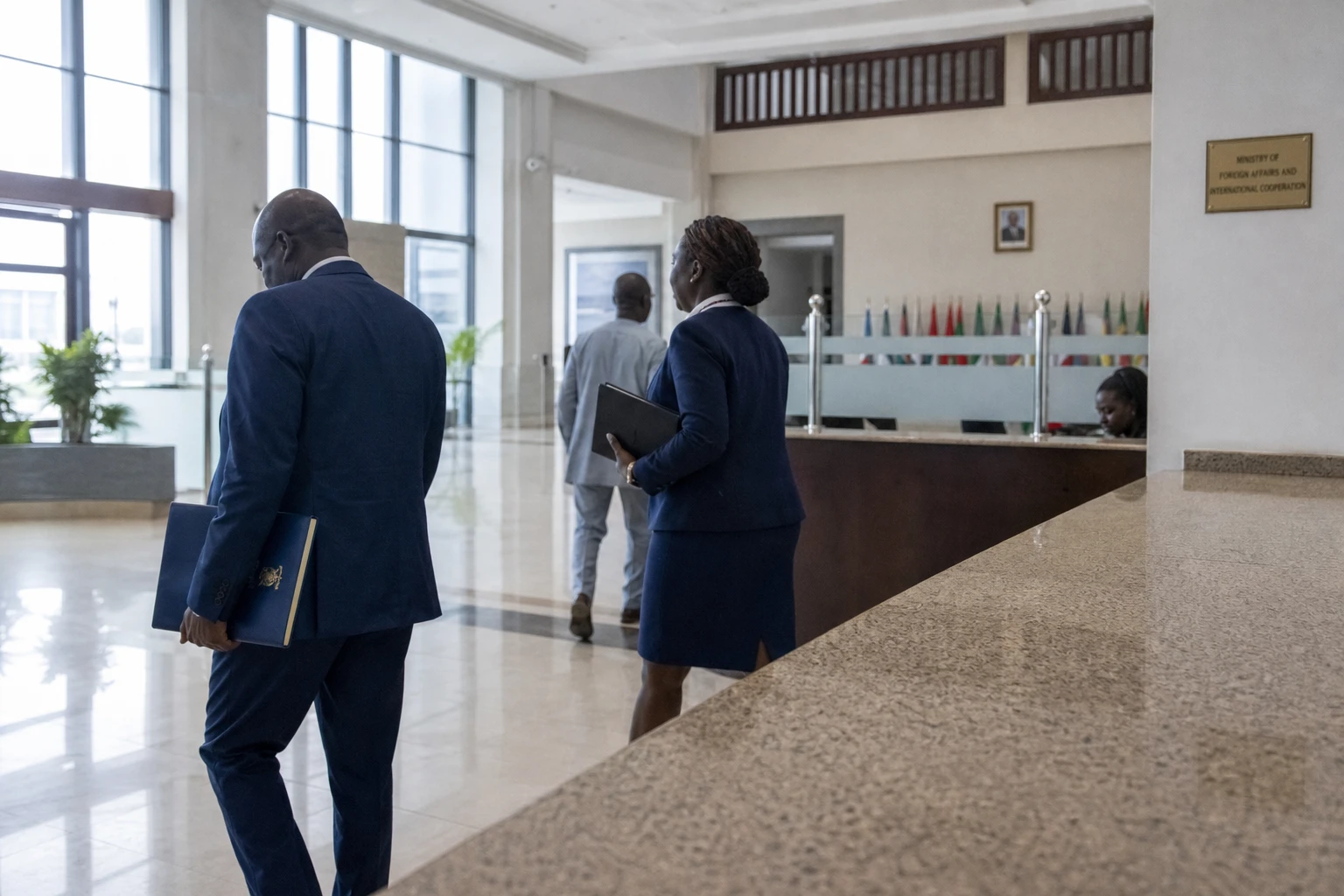
The agreement signed in Freetown by Brice Clotaire Oligui Nguema and Julius Maada Bio therefore comes amid an active period of diplomacy, in which bilateral visits also serve to diversify economic alliances. The Gabonese president undertook a tour of West Africa during which he also visited Ghana and Gambia, while Freetown is stepping up exchanges with several partners on the continent. The two capitals are seeking to turn this political engagement into more tangible gains for their economies.
What the agreement covers, and why it matters
The general memorandum of understanding announced by the two presidencies covers a wide range of areas: trade, investment, agriculture, education, health, tourism, culture, transport, security and defence, energy, mineral resources and science. In other words, this is not a text limited to foreign ministries. It sets out a framework for government departments, private-sector operators, universities, hospitals and security services. Implementation is to be overseen by a joint commission tasked with monitoring the commitments.
Two points merit attention. First, the agreement aims to open up trade further and stimulate investment, with an explicit reference to the AfCFTA, the African Continental Free Trade Area. Second, it provides for the reciprocal opening of diplomatic missions and a visa exemption for diplomats and holders of service passports. This kind of facilitation does more than change relations between ministries; it also reduces administrative frictions that often slow business, public projects and technical travel.
The security component is just as important. The Gabonese communiqué emphasises maritime defence, border protection and the preservation of fishery resources. This language points to a specific reality for coastal states: piracy, trafficking, illegal fishing, surveillance of exclusive economic zones and the security of maritime routes. In the African Atlantic, these issues have a direct impact on public revenues, coastal employment and informal activities linked to the shoreline.
Current trade flows between the two countries remain low. The text cites trade worth US$125,000 in 2023, according to the Observatory of Economic Complexity. Even taken with caution, this figure shows how far there is to go. Above all, it is a reminder that a political agreement alone does not create a market. Shipping links, common standards, banks willing to support trade, co-operating customs services and operators able to test the Gabon–Sierra Leone route in practice are all needed.
Potential gains, but no guarantees
For Gabon, the aim is clear: to broaden its partnerships beyond traditional channels and give greater depth to an economic diplomacy focused on diversification. Libreville is seeking to make the most of its strengths in agriculture, infrastructure, mining, energy and services. The Gabonese head of state’s recent visits to construction sites, farms and cooperation projects show a determination to link foreign policy with the country’s domestic transformation.
For Sierra Leone, the agreement could serve a dual purpose. On the one hand, it strengthens an active diplomacy that is also pursued through West African regional frameworks. On the other, it gives Freetown additional partners in sectors the country wants to modernise, notably agriculture, health, energy and transport. This positioning matters in an economy still dependent on a handful of products and exposed to external shocks. Diversifying markets and alliances is therefore an issue of stability as well as growth.
The political significance is regional too. ECOWAS and the African Union have for several years championed more concrete integration: free movement, regional value chains, shared security and trade harmonisation. In this context, an agreement between a Central African state and a West African state shows that pan-African cooperation is no longer confined to immediate neighbours. States are also seeking interregional bridges to overcome the narrowness of their national markets.
The question of implementation remains. Agreements of this kind often run up against administrative delays, a lack of funding, weak logistics links and the gap between announcements and the private sector’s actual capacity. This is where the announced joint commission comes in: it will have to set priorities, establish a timetable, select a few visible projects and ensure the text does not remain a mere political signal. Without that, the diplomatic momentum will quickly dissipate.
What to watch next
The next steps will show whether the rapprochement between Libreville and Freetown produces anything beyond a protocol-driven thaw. It will be important to watch for the actual establishment of diplomatic missions, the first meetings of the joint commission, sectoral announcements on agriculture or health, and, above all, concrete measures that could make it easier to do business between the two economies. If the two capitals want to make this framework useful, they will have to link it to measurable projects, public timetables and private-sector players able to invest.
At continental level, this kind of cooperation also speaks to an Africa seeking more African solutions to its own obstacles. The aim is not to accumulate signatures. It is to enable products, skills and capital to move more freely between African regions, without waiting for an external partner to validate the project. That is precisely the spirit of the AfCFTA, which has yet to be built in practice.