Algeria
 Egypt
 Libya
 Morocco
 Sudan
 Tunisia
 Benin
 Burkina Faso
 Cabo Verde
 Côte d'Ivoire
 Ghana
 Guinea
 Guinea-Bissau
 Liberia
 Mali
 Mauritania
 Niger
 Nigeria
 Senegal
 Sierra Leone
 The Gambia
 Togo
 Cameroon
 Central African Republic
 Chad
 DR Congo
 Equatorial Guinea
 Republic of the Congo
 São Tomé and Príncipe
 Burundi
 Comoros
 Djibouti
 Eritrea
 Ethiopia
 Kenya
 Madagascar
 Malawi
 Mauritius
 Mozambique
 Rwanda
 Seychelles
 Somalia
 South Sudan
 Tanzania
 Uganda
 Angola
 Botswana
 Eswatini
 Lesotho
 Namibia
 South Africa
 Zambia
 Zimbabwe
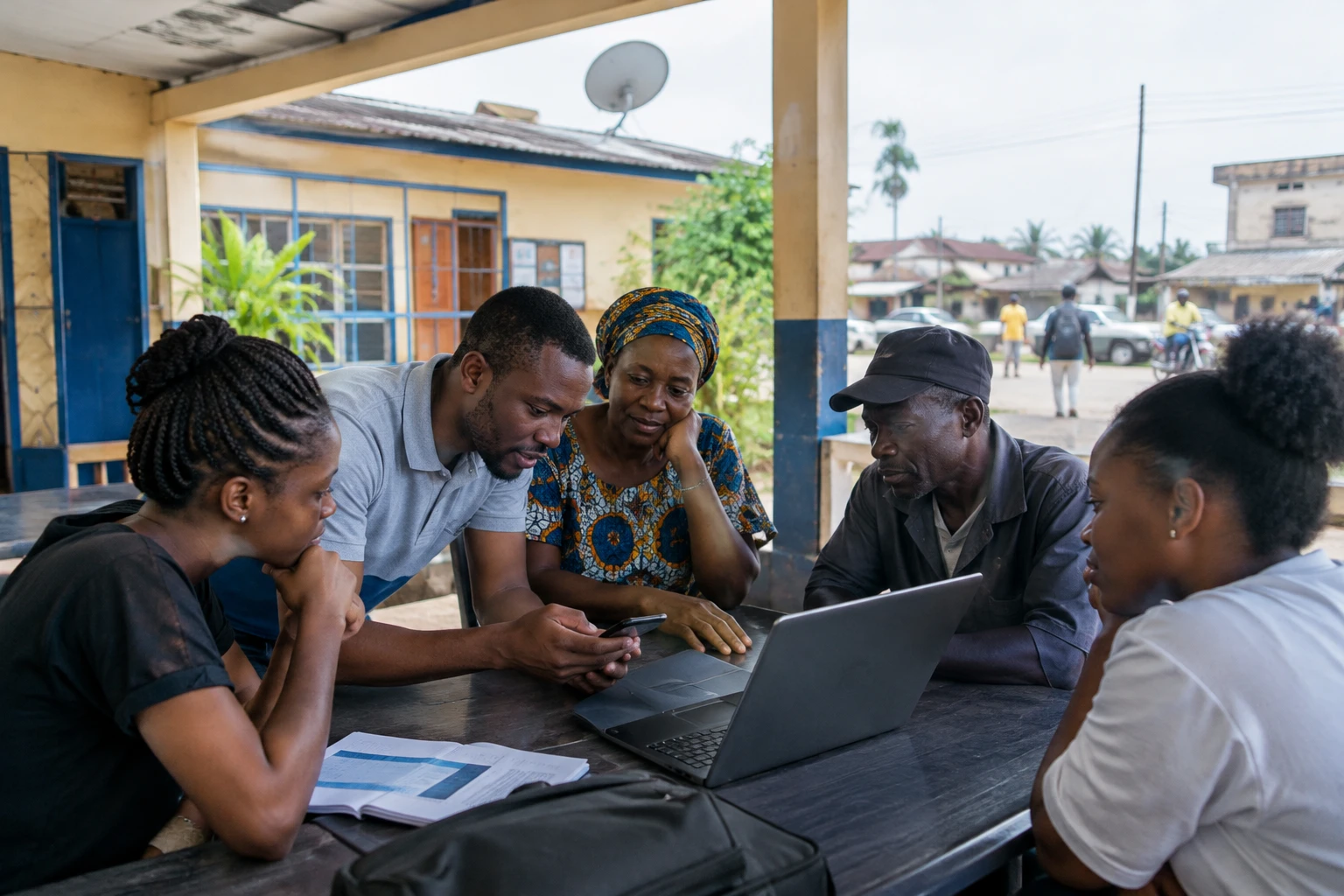
In villages where a few dozen people live far from major roads, the question is not just whether a signal is available. The connection must also be affordable, reliable and useful in everyday life. Gabon is considering satellite technology as a complementary way to reach these communities.
A response for areas that are hard to connect
The issue reflects a mixed picture. Mobile networks cover a large share of Gabon’s population, but this average masks the difficulties facing rural and sparsely populated areas. According to Digital Economy Minister Mark-Alexandre Doumba, more than 200 villages still do not have internet access. Some have only 20 or 30 residents.
In these circumstances, installing a mast in every community can be difficult to justify commercially. Satellite technology could bypass some of the constraints posed by distance and terrain. It would not necessarily replace terrestrial networks: it could complement them, particularly where fibre or mobile masts have not been deployed.
Gabon is a member of the Economic and Monetary Community of Central Africa (CEMAC), which brings together six countries. In this region, access to digital services also depends on infrastructure, population density and governments’ ability to coordinate their policies. Gabon’s challenge is therefore part of a wider question: how can territories be connected without making digital inclusion dependent solely on investments that are profitable in the short term?
Starlink and Eutelsat announced, but no detailed timetable
Ahead of Digital Week, held in Libreville from 26 to 30 October 2026, Mark-Alexandre Doumba told the Gabonese Press Agency that the authorities planned to authorise satellite internet providers, including Starlink and Eutelsat, in the near future. The event brings together public officials and industry players to discuss the country’s digital transformation.
The announcement does not mean that the services are already open to the public. The minister gave no specific launch date. Authorisation conditions, technical arrangements, prices and priority areas remain to be clarified. An announced commercial service therefore does not guarantee that a resident of a remote village will be able to subscribe in the coming months.
The regulatory precedent is significant. In October 2025, the Electronic Communications and Postal Regulatory Authority (ARCEP) had said that Starlink was not authorised to provide its services in Gabon and warned against selling them without approval. The current announcement points to a shift in the authorities’ position, but only a formal decision by the regulator will establish the rules. ARCEP’s warning, reported in November 2025, therefore highlights the gap between a political intention and an effective regulatory opening.
Connectivity alone does not guarantee use
Coverage is a first step, not a complete measure of access. World Bank data, based on series from the International Telecommunication Union (ITU), show that 68.7% of Gabon’s population used the internet in 2024. In other words, around three in ten people were not counted as users. This figure measures recent network use, not simply whether a signal is available.
Cost can hold back adoption. In 2025, the ITU estimated that a fixed broadband package with 5 GB cost the equivalent of 6.63% of gross national income per capita in Gabon. For a mobile package of the same volume, the figure was 2.65%. These averages do not show what each household spends, but they highlight that price remains an issue, particularly for people on low incomes and small informal businesses.
Equipment, electricity and digital skills must also be considered. A satellite dish does not automatically solve the lack of a suitable smartphone, a stable power supply or accessible payment methods. In villages, connection quality and the ability to repair equipment will also matter. In cities, the challenge may be less about coverage than the price of data packages and devices.
Satellite technology could reduce connection costs in some places, but it does not guarantee cheaper subscriptions. Terminals and their installation also represent an expense. The chosen model will therefore be decisive: individual connections, shared equipment in a community centre, or a public scheme supporting the least populated areas. The authorities have not yet set out these options.
A challenge for regulation and digital sovereignty
The arrival of several providers could widen choice and offer a solution where conventional networks are slow to expand. It also raises regulatory questions: minimum service quality, user protection, data handling, taxation and operators’ obligations. The framework will need to clarify how new players fit alongside existing providers and universal service objectives.
For the Gabonese authorities, the balance is delicate. Accelerating connectivity in remote areas while maintaining effective regulatory control requires clear rules. For residents, success will be measured less by the number of satellites available than by whether they can access useful services: administrative procedures, education, healthcare, information and commercial opportunities.
Digital Week in Libreville provides a forum to present the country’s ambitions, but the decisive step will come with the authorisations and practical deployment arrangements. Across the CEMAC region, Gabon’s experience will be watched with interest: it could inform debate about how terrestrial networks and satellite solutions can complement one another, without confusing announced coverage with access that people actually use.