
 Algeria
 Egypt
 Libya
 Morocco
 Sudan
 Tunisia
 Benin
 Burkina Faso
 Cabo Verde
 Côte d'Ivoire
 Ghana
 Guinea
 Guinea-Bissau
 Liberia
 Mali
 Mauritania
 Niger
 Nigeria
 Senegal
 Sierra Leone
 The Gambia
 Togo
 Cameroon
 Central African Republic
 Chad
 DR Congo
 Equatorial Guinea
 Republic of the Congo
 São Tomé and Príncipe
 Burundi
 Comoros
 Djibouti
 Eritrea
 Ethiopia
 Kenya
 Madagascar
 Malawi
 Mauritius
 Mozambique
 Rwanda
 Seychelles
 Somalia
 South Sudan
 Tanzania
 Uganda
 Angola
 Botswana
 Eswatini
 Lesotho
 Namibia
 South Africa
 Zambia
 Zimbabwe
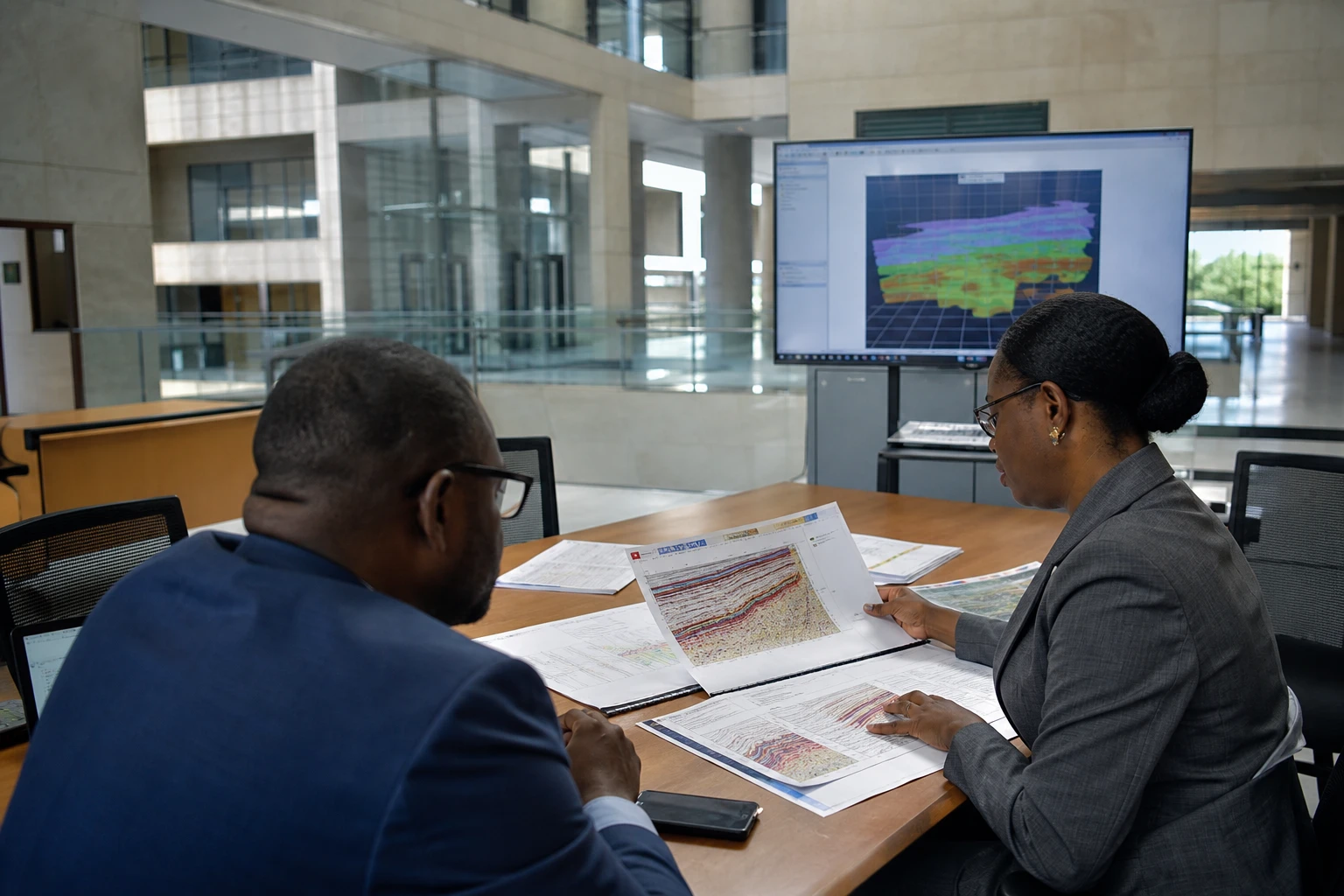
In Gabon, the next oil battle will be fought first over data. Before financing a deep-water well, companies need to understand the shape of the subsoil, its faults and its geological traps. Libreville therefore wants to make its maritime domain clearer to investors.
The Gabonese government signed a ten-year agreement with TGS in London on 1st October 2026. The Norwegian group specialises in geoscientific data and imaging services for the energy industry. The agreement was concluded on the sidelines of the World Energies Summit, held on 29 and 30 September 2026.
A strategy focused on understanding the subsoil
The partnership covers several stages. TGS is to market data already available, reprocess old seismic surveys and, if necessary, acquire new information in deep and ultra-deep-water areas.
Seismic surveying involves sending sound waves into the seabed and then analysing their return. This method makes it possible to map geological structures beneath the ocean floor. It does not guarantee the presence of oil. It does, however, reduce uncertainty before a possible well is drilled.
According to information released by TGS and reported by several Gabonese media outlets, the agreement gives it exclusive rights over a large part of Gabon’s deep-water offshore area. Interested operators should therefore have a clearly identified point of contact for accessing the available data.
For Gabon, the challenge is to turn a dispersed technical asset into a tool for attracting investment. Older surveys can still be made more precise through advances in processing and interpretation software. This reanalysis does not, however, replace new surveys, which are needed when existing data are incomplete.
The financial value of the agreement has not been made public. The available information also does not specify the detailed arrangements for sharing revenue from the marketing of the data.
A shift towards deep water
The focus on deep-water offshore exploration comes as Gabon’s oil sector needs to replenish some of its reserves. Several mature fields are in natural decline. The government is therefore seeking to keep production above 220 000 barrels a day in the medium term, a target cited by the African Energy Chamber.
Production figures should, however, be treated with caution. The Organisation of the Petroleum Exporting Countries estimated Gabonese production at about 210 000 barrels a day in March 2026, compared with more than 220 000 barrels a day at the beginning of 2025. These levels can vary according to counting methods, technical stoppages and operators’ decisions.
Until now, a large share of Gabon’s oil activity has been concentrated in shallower areas and on known fields. Deep water offers different potential, but developing it requires more capital, technology and time.
The Diaman and Leopard discoveries have already demonstrated the geological interest of the Gabonese offshore basin. They do not, however, in themselves guarantee industrial development. Several years can pass between a discovery, a final investment decision and first production.
Memorandums do not yet amount to contracts
The agreement with TGS accompanies a series of discussions with several major companies. In 2025, ExxonMobil and BP signed memorandums of understanding with the Gabonese authorities to study the potential of deep waters. A memorandum of understanding, or MoU, sets out a framework for co-operation. It is not yet an operating contract.
In April 2026, Gabon’s Minister of Petroleum, Clotaire Kondja, said it would take four to six months to reach production-sharing contracts with BP and ExxonMobil. In this type of contract, the state and the operator define the terms of exploration, recoverable costs and the division of production in the event of a commercial discovery.
As of 5 October 2026, no public announcement had confirmed the signing of these contracts. The deadline highlights the difference between a company’s stated interest and its final financial commitment. Negotiations may still cover taxation, the duration of licences, local content, environmental obligations and the state’s share.
Shell also signed a memorandum with Gabon on 17 June 2026. The document concerns the research, assessment and technical analysis of several deep- and ultra-deep-water blocks. It marks the company’s return to the Gabonese sector after its withdrawal in 2018.
These discussions put Libreville in the position of seeking capital and technology. They also give the government an opportunity to negotiate broader benefits. Skilled jobs, training, local services and the participation of Gabonese companies will be important indicators of the real value of this revival.
A regional issue for Central Africa
Gabon is a member of the Economic and Monetary Community of Central Africa, CEMAC, which brings together six countries that share, among other things, the Central African CFA franc. Its oil sector is also part of the wider Gulf of Guinea dynamic, where states are seeking to attract new investment despite the energy transition and market volatility.
Regional competition is intense. Angola, the Republic of the Congo, Equatorial Guinea and Nigeria are also offering offshore blocks. For companies, data quality alone is not enough. Regulatory stability, legal certainty, the availability of port infrastructure and the ability to export also matter.
For the Gabonese authorities, the contract with TGS is therefore a preparatory step. It may make the blocks more visible and facilitate discussions with operators. It does not automatically create new reserves, guarantee a well will be drilled or replace future production-sharing contracts.
What happens next will depend on three factors: the quality of the reprocessed data, the concrete interest of companies and Libreville’s ability to turn that interest into investment. The next signal to watch will be the possible conclusion of contracts with BP, ExxonMobil or other operators. That is when Gabon’s strategy will move from promoting its subsoil to developing it in practice.



