Algeria
 Egypt
 Libya
 Morocco
 Sudan
 Tunisia
 Benin
 Burkina Faso
 Cabo Verde
 Côte d'Ivoire
 Ghana
 Guinea
 Guinea-Bissau
 Liberia
 Mali
 Mauritania
 Niger
 Nigeria
 Senegal
 Sierra Leone
 The Gambia
 Togo
 Cameroon
 Central African Republic
 Chad
 DR Congo
 Equatorial Guinea
 Republic of the Congo
 São Tomé and Príncipe
 Burundi
 Comoros
 Djibouti
 Eritrea
 Ethiopia
 Kenya
 Madagascar
 Malawi
 Mauritius
 Mozambique
 Rwanda
 Seychelles
 Somalia
 South Sudan
 Tanzania
 Uganda
 Angola
 Botswana
 Eswatini
 Lesotho
 Namibia
 South Africa
 Zambia
 Zimbabwe
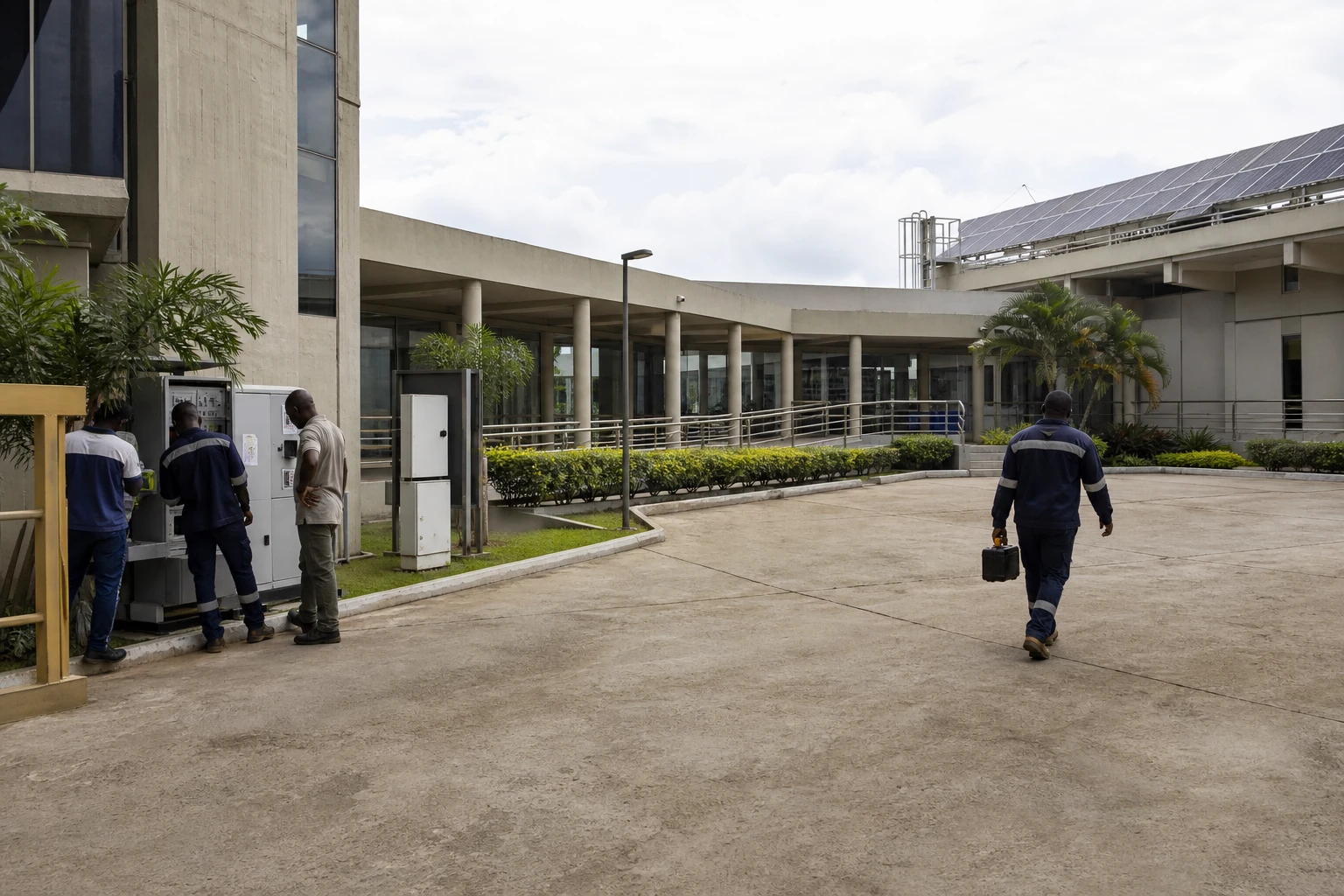
In Libreville, electricity has become about more than household comfort. It will determine Gabon’s ability to process some of its manganese at home, create more industrial jobs and reduce its dependence on exports of raw ore.
A mining project facing a national constraint
Gabon has embarked on a new phase of its industrialisation policy. The country wants to increase the value generated from its natural resources, particularly manganese mined in Haut-Ogooué. This direction follows the path set in 2023 and subsequently reinforced by the authorities who took office after the transition.
On 20 July 2026, the Gabonese state, Eramet and its subsidiary Comilog signed a memorandum of understanding in Paris. It provides for studies of several industrial projects that could process up to 700 000 tonnes of ore a year in Gabon by the end of 2031. Gabon’s Ministry of Mines presents this roadmap as a lever for economic sovereignty.
This ambition does not rest solely on building factories. It also requires a reliable electricity supply, available in mining areas and at a cost compatible with metallurgical production. Without this guarantee, investments risk remaining at the study stage.
Libreville faces a projected 500-megawatt shortfall
The warning came at a meeting in China between Gabon’s Minister of Mines, Sosthène Nguema Nguema, and teams from Huawei Digital Power Technologies. Discussions focused on ways to bring electricity generation closer to industrial hubs.
According to figures reported by the Gabonese Press Agency, Libreville is said to have a shortfall of about 500 megawatts. Nationwide, demand could reach nearly 2.5 gigawatts if mining and industrial activity expands in line with stated targets.
These estimates still need to be clarified through detailed public data on demand, the capacity actually available and peak consumption. They nonetheless show the gap between current capacity and Gabon’s industrial ambitions.
The Gabonese Energy and Water Company, SEEG, says it has hydroelectric and thermal equipment with a generating capacity of 452 megawatts. This installed capacity does not mean that all of this power is available at all times. The condition of power stations, technical shutdowns, the transmission network and distribution losses reduce the margin that can actually be used.
An energy strategy still taking shape
The Gabonese government has announced more than 800 billion CFA francs to strengthen electricity capacity. In his State of the Nation address on 15 June 2026, President Brice Clotaire Oligui Nguema also listed energy among the priorities of his seven-year term. The Gabonese presidency referred to a far-reaching reform of the water and electricity sector.
The National Energy Pact, for its part, sets a target of 1 100 megawatts of installed capacity by 2030. Drawn up under the Mission 300 initiative, the document is intended to provide a framework for mobilising funding and improving access to electricity. It also provides for a clarification of responsibilities among the state, public operators and private investors.
The challenge, then, is to move from announcements to construction. Projects need a timetable, secured financing, a clearly identified lead organisation and a transparent tariff-setting mechanism. These factors will shape industrialists’ confidence as much as the nominal capacity of future power stations.
Gabon nevertheless has significant advantages. Its hydroelectric potential is generally estimated at around 6 000 megawatts, while only part of it has been harnessed. The Booué project, developed with EDF Power Solutions and Gabon Power Company, is expected to have an estimated capacity of nearly 400 megawatts. The Gabonese government describes this infrastructure as a major project for Central Africa.
Generate power near the mines or upgrade the grid first?
Huawei proposes combining several technologies: hydroelectric power, solar photovoltaics and batteries. This approach could enable some energy to be generated close to mining sites, rather than relying solely on a national grid already under strain.
Batteries could absorb fluctuations in solar generation and support installations during peaks in demand. They would not, however, replace baseload power stations or transmission lines. Their value will depend on investment costs, equipment lifespan and maintenance conditions in Gabon.
A decentralised solution could quickly meet the needs of some industrial sites. However, it carries a risk of fragmentation if each company develops its own system without coordination with SEEG and the public authorities. The challenge is therefore to build a coherent system capable of supplying mines, factories, cities and local economic activity.
Manganese processing will also have different effects across regions. In Moanda and Haut-Ogooué, it could support employment, subcontractors and industry-related services. In Libreville, improved electricity supply would benefit households, small businesses and public administrations. But concentrating investment around major mining operators alone could widen the gap with other provinces.
A test for Gabonese industrialisation
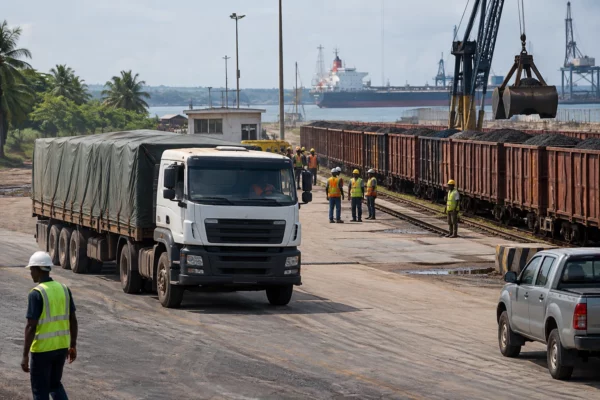
Comilog remains the central player in the sector. The company mines manganese in Moanda and already has processing facilities at the Moanda Metallurgical Complex. The new target of 700 000 tonnes a year would expand this industrial base, but it will require additional infrastructure, particularly for energy, rail transport and port logistics.
The timetable adds particular pressure. Gabon plans to ban exports of raw manganese from January 2029 to encourage local processing. This deadline comes before the target date for processing 700 000 tonnes. It therefore requires a gradual ramp-up, with credible interim capacity to avoid a disruption to exports and public revenue.
The issue also extends beyond Gabon’s borders. Gabon belongs to the Central African Economic and Monetary Community, CEMAC, which brings together six states that share, among other things, the Central African CFA franc. A more integrated mining industry could strengthen regional trade, provided electricity, rail and port infrastructure is planned with a corridor approach.
The next step will therefore be more technical than symbolic. The projects selected, their financing, the responsibilities of the state, SEEG, Gabon Power Company and mining companies, and the price of electricity offered to industrial users will all need to be made clear. For Gabon, success in manganese processing will depend as much on power stations and electricity lines as on metallurgical plants.