
 Algeria
 Egypt
 Libya
 Morocco
 Sudan
 Tunisia
 Benin
 Burkina Faso
 Cabo Verde
 Côte d'Ivoire
 Ghana
 Guinea
 Guinea-Bissau
 Liberia
 Mali
 Mauritania
 Niger
 Nigeria
 Senegal
 Sierra Leone
 The Gambia
 Togo
 Cameroon
 Central African Republic
 Chad
 DR Congo
 Equatorial Guinea
 Republic of the Congo
 São Tomé and Príncipe
 Burundi
 Comoros
 Djibouti
 Eritrea
 Ethiopia
 Kenya
 Madagascar
 Malawi
 Mauritius
 Mozambique
 Rwanda
 Seychelles
 Somalia
 South Sudan
 Tanzania
 Uganda
 Angola
 Botswana
 Eswatini
 Lesotho
 Namibia
 South Africa
 Zambia
 Zimbabwe
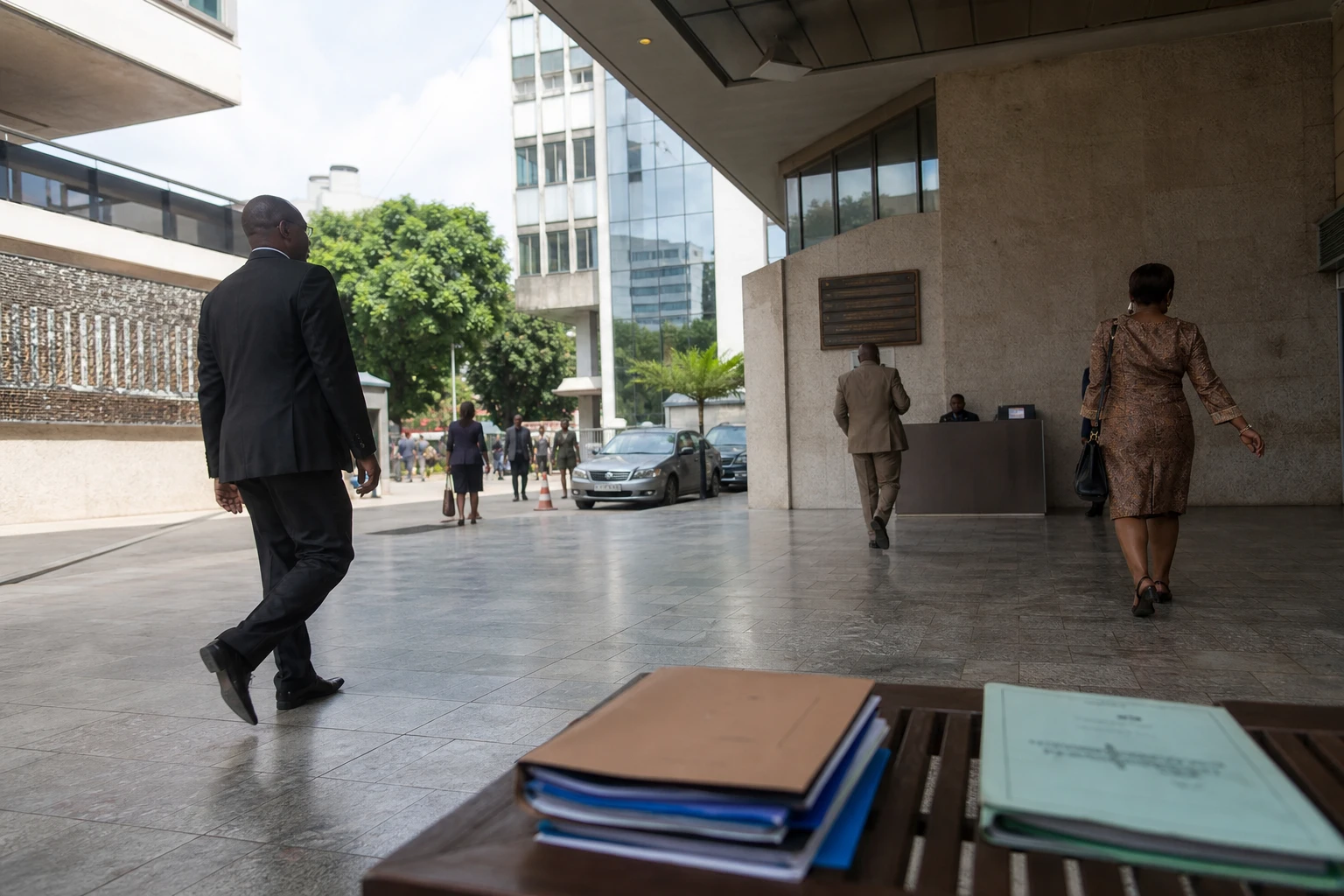
In Libreville, the stakes go beyond the ore
Gabon is seeking to break out of a long-standing paradox: exporting large quantities of raw materials while capturing too little value on its own territory. In a country where manganese carries significant economic weight, the question is no longer simply how to produce, but how to process, transport and power the industry without disrupting the rest of the productive chain. This shift directly affects jobs, public revenues and Gabon’s place in global critical metals supply chains.
The issue is also political. In Libreville, Gabon’s authorities are making this move up the value chain part of a broader strategy for economic sovereignty, following the transition launched in 2023 and the establishment of the Fifth Republic in 2024. The country is moving forward with CEMAC, the Central African Economic and Monetary Community, where states have for several years sought to better connect electricity, logistics and industrialisation. In this framework, manganese is not just an ore: it is a test of the credibility of local processing policy.
Political, industrial and symbolic agreements
On 20 July 2026 in Paris, Brice Clotaire Oligui Nguema and Emmanuel Macron initialled three co-operation agreements. One concerns manganese, as Gabon prepares to end exports of raw ore from 1 January 2029. Another part covers the reshaping of the French military presence around the former Camp de Gaulle in Libreville, with a more focused approach to training and supporting Gabonese forces. A third strand supports bilateral relations within a broader framework of economic and institutional co-operation.
On mining, the Gabonese state has already set the direction. The Council of Ministers announced on 30 May 2025 that exports of raw manganese would be banned from 1 January 2029. In September 2025, the government specified that a transition period would run until 31 December 2028, allowing operators to build or modernise local processing facilities and submit their industrial plans. In early 2026, the Ministry of Mines confirmed that local processing was being closely monitored with industrial partners.
The timetable is therefore known. Its feasibility remains to be seen. The authorities say they are targeting three industrial projects under study, with a goal of processing up to 700,000 tonnes locally per year by 2031. This target does not start from scratch: Gabon already has a major mining operation in Moanda, in the south-east of the country, where Comilog, an Eramet subsidiary, extracts manganese. The company says it produced 7.1mn tonnes in 2025 and notes that any expansion of its capacity will depend on major investment, reliable energy and a stable economic framework.
What Gabon stands to gain, and what it still needs to build
The government’s rationale is clear: move beyond the role of a mere supplier of raw ore and do more processing. In practice, that means more local value added, more technicians, more industrial maintenance, more domestic subcontracting and, in time, higher tax revenues. The reasoning is sound. But it depends on a simple condition: access to electricity, roads and rail, and a business environment capable of supporting plants that require more capital than the mines themselves.
Energy remains the key challenge. Processing manganese requires a stable, low-cost power supply. In Gabon, however, the authorities are still seeking to secure a more robust energy mix, with regional interconnection projects in the CEMAC area and recent announcements concerning the national energy and water fund. This constraint explains the caution among industrialists: without a reliable power supply, a smelter or alloy plant can quickly become too expensive to operate. The issue is therefore not only about mining; it also concerns energy sovereignty and regional development.
For local communities, the expected impact is not automatic. The benefits of a plant will not be felt in the same way in Libreville, Moanda or the towns along the Transgabonais railway. In the capital, debate centres on the quality of investment and the state’s ability to turn agreements into lasting jobs. In the country’s interior, residents are primarily looking for infrastructure, services and more regular incomes. Without a network of logistics and social infrastructure, local processing could remain just another slogan.
For France, the stakes are different. Paris is supporting a country where its economic interests remain concentrated in a few strategic sectors, foremost among them mining. Oligui Nguema’s state visit follows Emmanuel Macron’s trip to Libreville in November 2025, which had already emphasised a partnership described as more balanced. The latest sequence says something about Franco-Gabonese relations: they remain close, but are adjusting to a context in which Libreville is asserting greater room for manoeuvre.
A Gabonese initiative with wider resonance
Gabonese manganese also matters in a continental equation. In Central Africa, several states now want to turn their raw materials into semi-finished or finished products rather than simply export them in volume. Gabon is thus part of a broader movement: African states seeking to take back control of industrialisation, mining taxation and the value chains linked to the global energy transition. The issue matters to CEMAC as much as to the African Union, which for several years has been promoting the local processing agenda and the African Continental Free Trade Area, AfCFTA.
For Gabon, the next step will be decisive: turning intentions into visible construction projects before the end of the 2028 transition period. That is when the strength of the commitments made in Paris, operators’ ability to finance industrial facilities and the state’s capacity to provide the promised energy, land and regulatory certainty will be put to the test. In other words, the real test will not take place only in diplomatic salons, but on power grids, at freight stations and at industrial sites.



