Algeria
 Egypt
 Libya
 Morocco
 Sudan
 Tunisia
 Benin
 Burkina Faso
 Cabo Verde
 Côte d'Ivoire
 Ghana
 Guinea
 Guinea-Bissau
 Liberia
 Mali
 Mauritania
 Niger
 Nigeria
 Senegal
 Sierra Leone
 The Gambia
 Togo
 Cameroon
 Central African Republic
 Chad
 DR Congo
 Equatorial Guinea
 Republic of the Congo
 São Tomé and Príncipe
 Burundi
 Comoros
 Djibouti
 Eritrea
 Ethiopia
 Kenya
 Madagascar
 Malawi
 Mauritius
 Mozambique
 Rwanda
 Seychelles
 Somalia
 South Sudan
 Tanzania
 Uganda
 Angola
 Botswana
 Eswatini
 Lesotho
 Namibia
 South Africa
 Zambia
 Zimbabwe
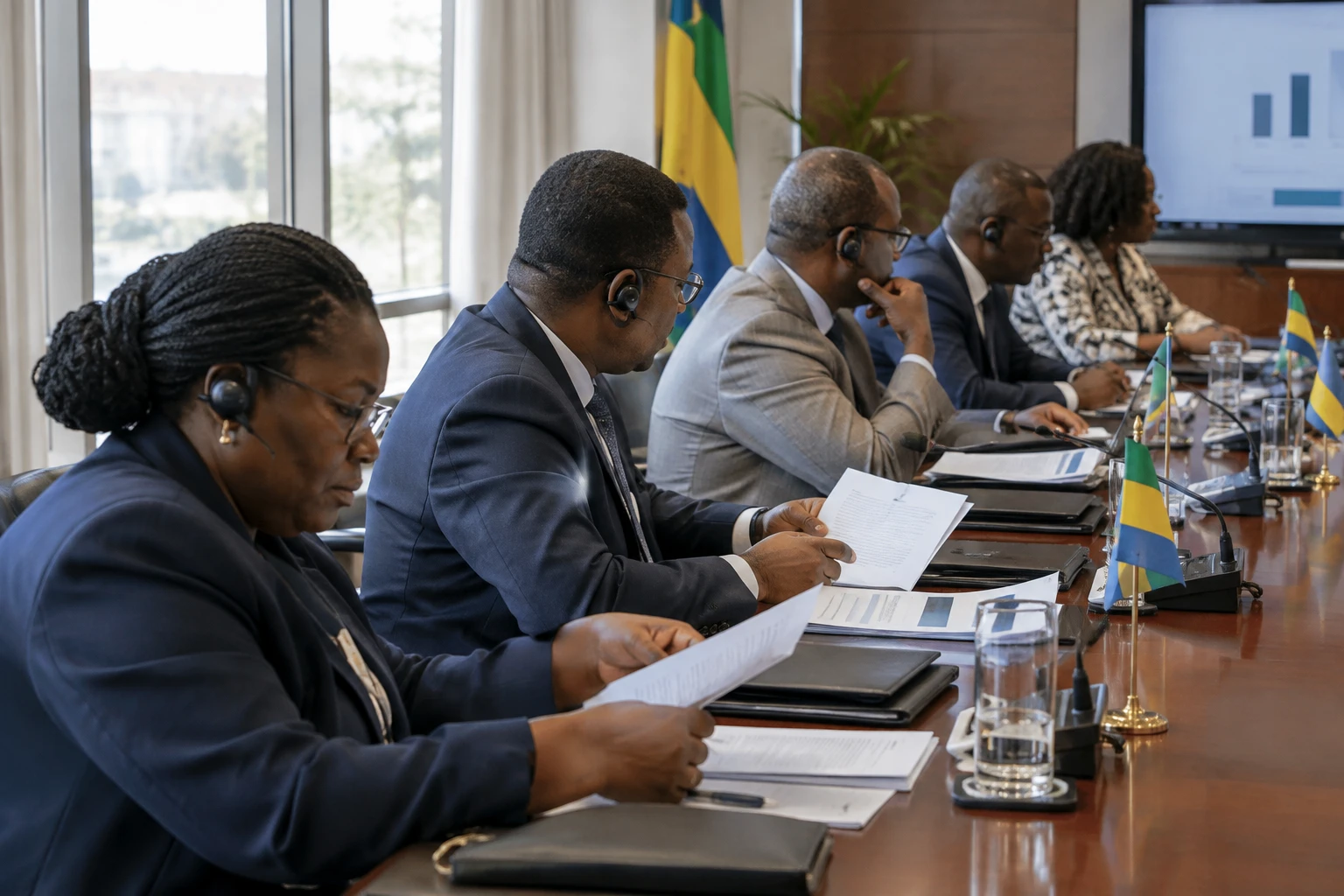
Prices at the pump remain contained. But the gap between what motorists pay and the cost of fuel is placing an increasingly heavy burden on the Gabonese state budget. In Libreville and other provinces, the question is now how to protect purchasing power without devoting to this support resources needed for public services.
A bill rising with oil markets
On 21 October 2026, Ismaël Gnamalengoungou Oligui, director general of the Stabilisation and Equalisation Fund (CAISTAB), defended a revision of the mechanism on national television. CAISTAB plays a role in stabilising hydrocarbon prices and offsetting some distribution costs. He said the state had spent CFAF 147 billion on subsidies between January and September 2026. This figure, given by the official and reported by the Gabonese press, has not been published as a detailed breakdown accessible in the sources consulted.
The debate had already reached the Council of Ministers on 8 October. In its statement, the Presidency refers to a monthly cost that rose from CFAF 7 billion to CFAF 9 billion before the war in Ukraine, then to CFAF 30 billion in September 2026, driven by tensions in the Middle East. The same text reports that President Brice Clotaire Oligui Nguema asked the government to examine ways to reduce, or eventually eliminate, the cost of the mechanism. The September figure is therefore documented in the official statement, while the nine-month total comes from the CAISTAB director’s remarks.
In October, according to prices and estimates reported by CAISTAB, a litre of petrol sells for CFAF 595, while its estimated cost is CFAF 970. Diesel is priced at CFAF 575, against an estimated cost of CFAF 1,190. Stabilisation absorbs part of the difference. Equalisation also helps keep prices comparable across the country, despite variations in transport and supply costs.
Broad-based support, unevenly distributed benefits
The difficulty is not only the scale of the spending. It also concerns who benefits. The World Bank’s 2026 Gabon Public Finance Review estimates that 96% of the cost of petrol and diesel subsidies goes to the wealthiest half of the population. It puts their cost at 1% of gross domestic product in 2024. This finding concerns the distribution of the direct benefit linked to fuel consumption; it does not, on its own, measure indirect effects on transport or the prices of goods.
Ismaël Gnamalengoungou Oligui disputes an interpretation that would reduce the support to motorists alone. He points out that energy prices can also affect public transport and electricity production. This argument deserves consideration: a rise in fuel prices can have an impact beyond households that buy fuel directly. But such pass-through does not guarantee that the benefits of the subsidy actually reach those who need it most.
To target support more effectively, the CAISTAB director has raised the prospect of differentiating assistance according to income or ability to consume, potentially using digital tools. The World Bank, for its part, recommends gradual reform accompanied by targeted compensation measures, such as social transfers and temporary support for some transport operators. These options require public criteria, reliable data and means of appeal. Without them, vulnerable households, informal-sector workers and people living far from administrative services risk being left out.
The social cost of a poorly prepared reform
Scrapping or reducing subsidies is therefore not simply a matter of accounting savings. For low-income households, transport already takes up a share of their income. For small traders and transport operators, fuel is a business cost. A rapid increase can feed through to fares and the prices of some goods. Conversely, maintaining a costly general subsidy leaves the budget with less room to invest in health, education or social protection.
The World Bank report describes this tension precisely: subsidies, the wage bill and debt service constrain productive and social spending. It estimates that social sectors received 4% of GDP in 2023-2024. Reallocating some resources could therefore address tangible needs, provided that the savings are traceable and actually devoted to these priorities. This is as much a matter of trust as of public finance.
Recent developments also show that regulated prices do not remove supply vulnerabilities. The Council of Ministers meeting on 8 October followed a fuel shortage and called for measures to modernise the Gabonese Refining Company (SOGARA), build up strategic stocks and study the possibility of a new refinery. External tensions can make products more expensive; national storage, refining and distribution capacity also determines how resilient the country is.
A Gabonese debate shaped by CEMAC’s shared constraints
Gabon shares the Economic and Monetary Community of Central Africa (CEMAC), a regional framework for economic and monetary co-operation, with five other states. Libreville’s choices are being made in a context where controlling public spending and protecting consumers must go hand in hand. However, production structures, transport networks and fiscal room for manoeuvre differ from one country to another: Gabon’s system therefore cannot be mechanically applied to its neighbours.
For Gabonese people, the next steps matter more than an announcement of principle: the targeting method, the timetable for any reform and the safeguards offered to households and transport operators. For the region, the issue illustrates a shared trade-off between affordable prices, budget stability and energy security. The test will be tangible: reducing poorly targeted spending without turning subsidy reform into a sudden rise in the cost of living.