Algeria
 Egypt
 Libya
 Morocco
 Sudan
 Tunisia
 Benin
 Burkina Faso
 Cabo Verde
 Côte d'Ivoire
 Ghana
 Guinea
 Guinea-Bissau
 Liberia
 Mali
 Mauritania
 Niger
 Nigeria
 Senegal
 Sierra Leone
 The Gambia
 Togo
 Cameroon
 Central African Republic
 Chad
 DR Congo
 Equatorial Guinea
 Republic of the Congo
 São Tomé and Príncipe
 Burundi
 Comoros
 Djibouti
 Eritrea
 Ethiopia
 Kenya
 Madagascar
 Malawi
 Mauritius
 Mozambique
 Rwanda
 Seychelles
 Somalia
 South Sudan
 Tanzania
 Uganda
 Angola
 Botswana
 Eswatini
 Lesotho
 Namibia
 South Africa
 Zambia
 Zimbabwe
A border dispute that weighed on Central African diplomacy
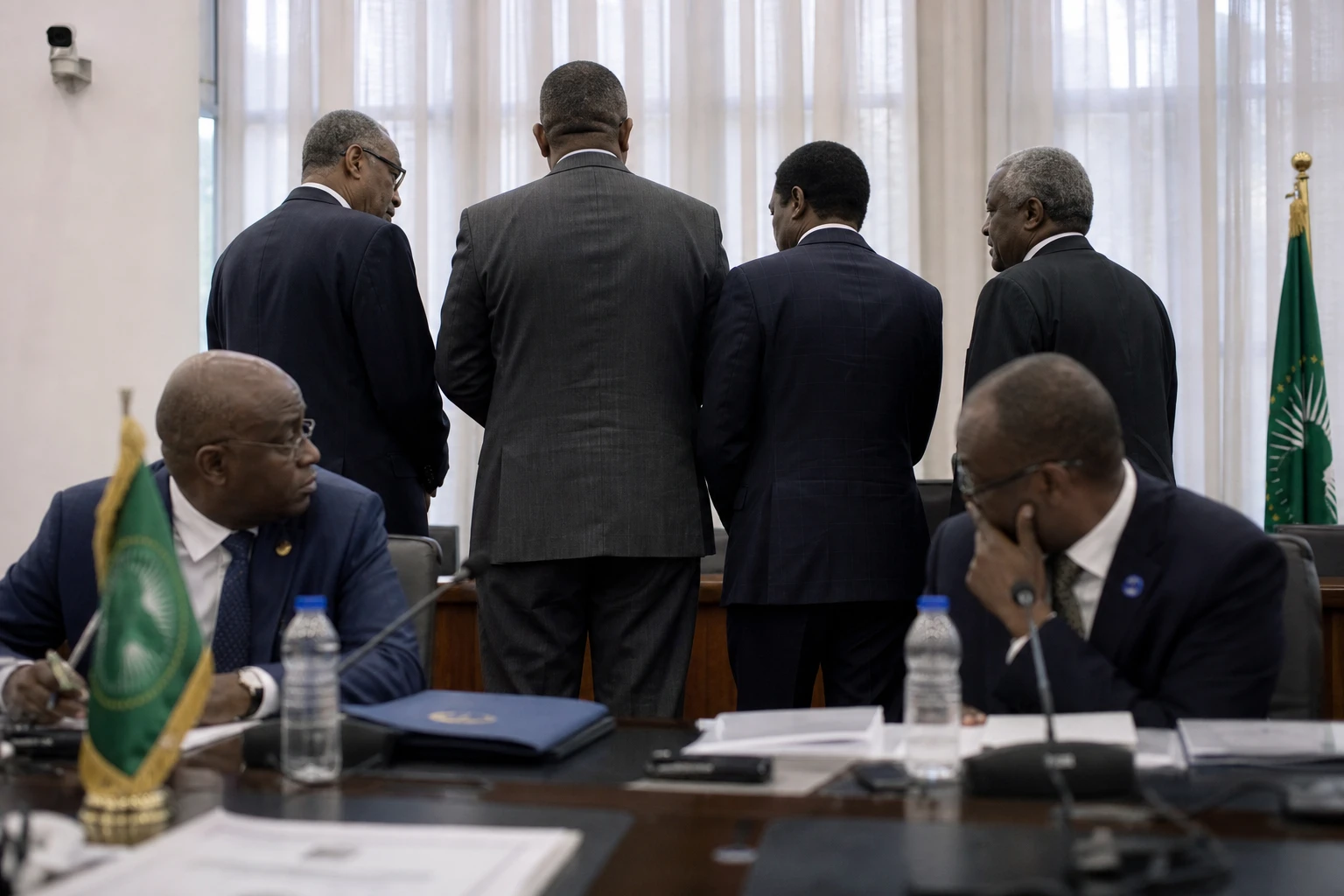
In Libreville and Malabo alike, the issue was not simply three tiny islets lost in the Gulf of Guinea. It was also about process. After years of proceedings, Gabonese and Equatoguineans now see their dispute enter an implementation phase, at a time when Central African states are seeking to ease tensions inherited from colonial boundaries and secure strategic maritime areas. The agreement signed on 28 July 2026 in Addis Ababa forms part of this effort. It was concluded on the sidelines of the 49th ordinary session of the African Union Executive Council, with the support of the AU Commission.
The case concerned Mbanié, Cocotiers and Conga. These islets are small, but they matter. They lie in a maritime area where fishing and energy interests remain sensitive. The stakes are also political: in a sub-region where ECCAS and CEMAC are seeking to stabilise trade, an unresolved border dispute could continue to fuel mistrust, even between two neighbouring capitals linked by shared economic interests.
What the Addis Ababa agreement provides
The text signed in Addis Ababa commits Gabon and Equatorial Guinea to implement the ruling handed down on 19 May 2025 by the International Court of Justice, the United Nations’ highest court. According to the Court, the legal title applicable to the islands of Mbanié, Cocotiers and Conga derives from Equatorial Guinea’s succession to the title held by Spain at the time of its independence, rather than from the 1974 Bata Convention invoked by Libreville. The AU welcomed a “joint commitment agreement”, describing it as a major step in the peaceful settlement of the dispute.
The signing brought together Equatorial Guinea’s Foreign Minister, Simeón Oyono Esono Angue, and the president of Gabon’s Constitutional Court, Dieudonné Aba’a Owono. African Union Commission Chairperson Mahmoud Ali Youssouf also signed the document. On the Gabonese side, the presidency had confirmed for several weeks that Libreville was working with the AU towards a “lasting, peaceful and agreed” settlement of the dispute over Mbanié.
The timeline also offers a useful indication. In March 2026, the AU appointed a special envoy to support implementation of the ICJ ruling. In July, the envoy continued consultations in Libreville and Malabo. The sequence shows that the settlement was not improvised in Addis Ababa. It was prepared through African mediation, with a clear determination to prevent the dispute from resurfacing in the political or military arena.
Why these islets matter beyond their size
Mbanié, Cocotiers and Conga are almost uninhabited. Yet they have long carried great symbolic weight. The dispute dates back to the early 1970s and is rooted in the colonial texts of 1900 between France and Spain. In cases of this kind, sovereignty over a patch of land quickly becomes a question of maritime space, resources and strategic reach. The ICJ ruling clarified the legal title after years of debate over the scope of historical agreements.
For Gabon, the stakes were not merely symbolic. An ill-defined maritime border can complicate coastal security, resource management and investor confidence. For Equatorial Guinea, recognition of the ICJ decision consolidates a sovereign title now confirmed by the international court. For local populations, the stakes are even more tangible: less tension, greater predictability and potentially a better framework for fishing, transport and cross-border cooperation. That is where the agreement derives its value. It turns a legal dispute into a basis for dialogue.
This development also comes at a particular institutional moment for Gabon. Since the transition launched in 2023, Gabonese authorities have sent repeated signals of a return to constitutional order and an affirmation of national sovereignty. Regionally, Libreville remains part of ECCAS, while Equatorial Guinea plays a visible role in Central African cooperation frameworks. In this context, a peaceful border agreement serves both capitals. It removes a diplomatic irritant and creates room for other, more substantial issues, notably the economy, energy and infrastructure.
Significance beyond the Libreville-Malabo relationship
The African Union wants to make this sequence an example. Its Commission Chairperson stressed the peaceful settlement of disputes and respect for international law. That message matters across the continent. Several African borders remain sensitive, sometimes without any direct connection to open conflict, but with latent areas of friction. When two states turn to international justice and then negotiate implementation under African mediation, they send a useful signal to other capitals.
The precedent matters all the more because Central Africa is still seeking its most effective mechanisms for stabilisation. ECCAS, CEMAC and the AU each have a different but complementary role: crisis prevention, political coordination and economic integration. An agreement such as the one reached in Addis Ababa is a reminder that a border dispute need not become a lasting crisis. It can be addressed through law and then resolved through clear, monitored commitments. It is also a lesson for other African cases in which territorial sovereignty, colonial memory and natural resources remain closely intertwined.
The most sensitive phase now remains: implementation. The ICJ ruling dates from 19 May 2025, but translating it into practice requires technical, cartographic and administrative details to be settled. This is often where cases fall apart or become consolidated. If Libreville and Malabo stay the course, the Addis Ababa agreement could become more than a diplomatic episode. It could become an African case study in peaceful settlement, in a region where maritime stability and trust between neighbours remain valuable assets.