Algeria
 Egypt
 Libya
 Morocco
 Sudan
 Tunisia
 Benin
 Burkina Faso
 Cabo Verde
 Côte d'Ivoire
 Ghana
 Guinea
 Guinea-Bissau
 Liberia
 Mali
 Mauritania
 Niger
 Nigeria
 Senegal
 Sierra Leone
 The Gambia
 Togo
 Cameroon
 Central African Republic
 Chad
 DR Congo
 Equatorial Guinea
 Gabon
 Republic of the Congo
 São Tomé and Príncipe
 Burundi
 Comoros
 Djibouti
 Eritrea
 Kenya
 Madagascar
 Malawi
 Mauritius
 Mozambique
 Rwanda
 Seychelles
 Somalia
 South Sudan
 Tanzania
 Uganda
 Angola
 Botswana
 Eswatini
 Lesotho
 Namibia
 South Africa
 Zambia
 Zimbabwe
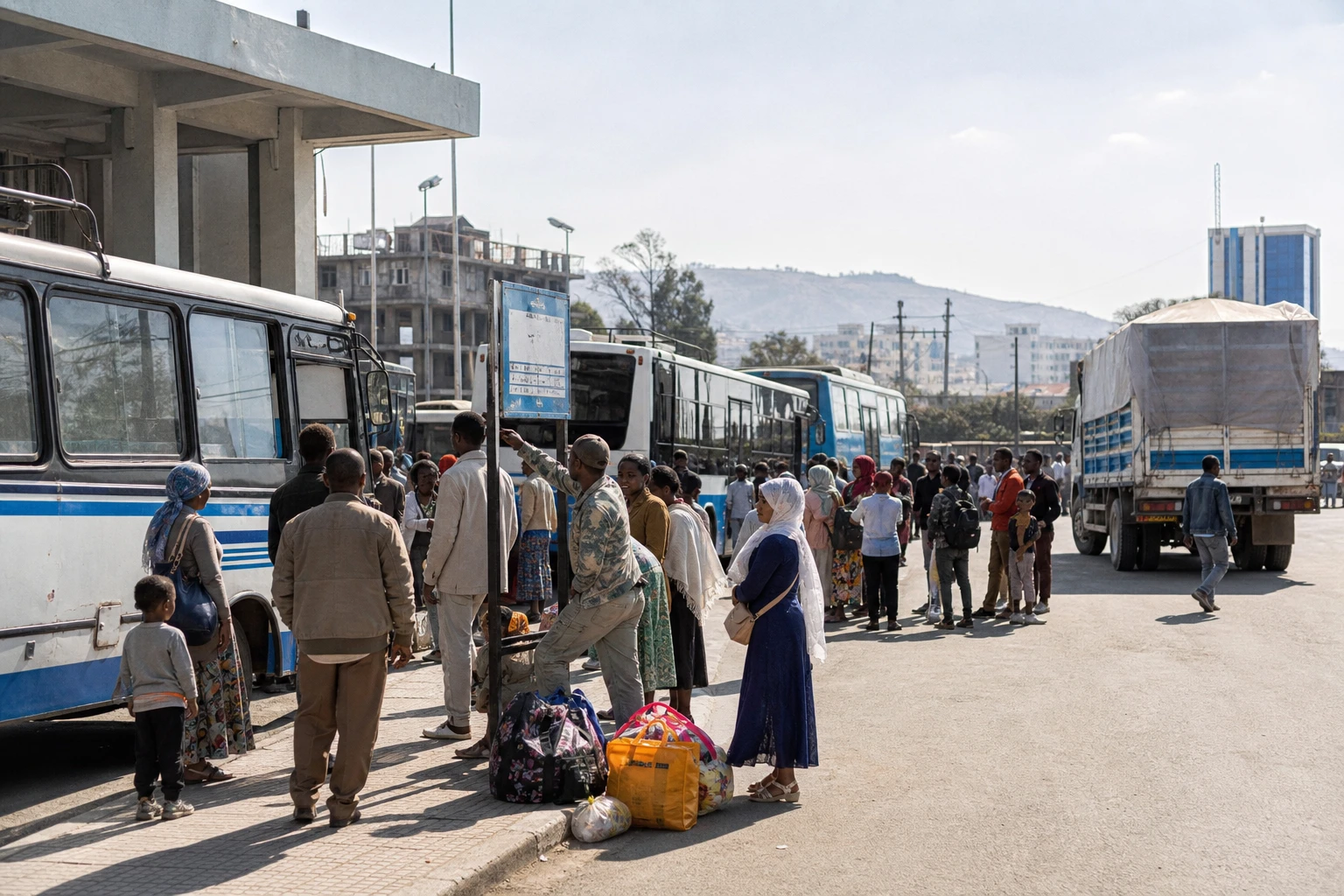
In northern Ethiopia, the return of fighting is already evident in very tangible ways: closed airports, uncertain roads and residents fearing a fresh disruption to supplies. The seizure of strategic positions by Tigrayan forces has raised fears that the crisis could quickly spread beyond Tigray.
Escalation on Tigray’s borders
Fighting broke out on Tuesday 22 September 2026 in the localities of Abala and Erebti, in the Afar region, between forces linked to the Tigray People’s Liberation Front (TPLF) and Ethiopian federal forces. Humanitarian workers in the area reported overnight clashes. Their accounts were carried by Agence France-Presse, but no death toll could be established.
A source specialising in security in Ethiopia confirmed the fighting and said Tigrayan forces controlled Abala. A former TPLF official, for his part, claimed control of several localities in Afar, including Berhale, Erebti, Abala, Megale, Dalul and Konoba. These claims remain difficult to verify independently.
The regional government of Tigray says it responded to intense bombardments carried out, it says, by federal forces. It alleges the use of aircraft, drones and artillery. This account has not yet been confirmed by independent sources. Federal authorities in Addis Ababa had not issued a detailed response at the time of writing.
The situation has also affected air links. Tigrayan forces took control of the airports in Mekele and Shire. They reportedly also seized the one in Axum. Ethiopian Airlines suspended flights to the three cities, citing the security situation in the region. Ethiopia’s national carrier did not provide an immediate timetable for resuming its services.
The African Union Commission called for restraint and immediate de-escalation. Its chairperson, Mahmoud Ali Youssouf, expressed concern over the resumption of hostilities in northern Ethiopia, the disruption of civilian air services and the formation of new political and military alliances.
The fragile legacy of the Pretoria agreement
This latest flare-up comes less than four years after the cessation of hostilities agreement signed in Pretoria, South Africa, on 2 November 2022. The deal ended a two-year war between the federal government and the TPLF. The conflict devastated Tigray and spilled over into Afar and Amhara.
Estimates of the death toll vary widely. The African Union has cited about 600,000 deaths linked to the war, a figure that includes direct victims of fighting and violence, as well as the humanitarian consequences. However, the lack of regular access to several areas has made it impossible to establish a definitive toll.
The Pretoria agreement enabled the gradual resumption of public services and humanitarian aid. It did not, however, resolve the main political and territorial issues. The return of displaced people, the disarmament of fighters and the status of territories disputed between Tigray and Amhara remain sensitive matters.
The crisis is also fuelled by internal rivalries in Tigray. The TPLF remains an influential political and military force, but its leaders do not all share the same strategy. Getachew Reda, a former leader of the movement who became head of Tigray’s interim administration before breaking with his former allies, called the resumption of fighting “heartbreaking”. He accuses the TPLF leadership of launching an offensive against government positions in Afar and Amhara. This accusation could not be independently verified.
Immediate consequences for the population
The airport closures are making travel between Tigray and Addis Ababa more difficult. They affect families, students, traders and humanitarian organisations. In a region where road journeys are long and vulnerable to disruption, air travel is often the fastest way to transport people and some essential goods.
The first effects may also be felt in markets. Urban residents depend on regular deliveries of fuel, medicines and food. In rural areas, transport difficulties risk affecting herders, farmers and displaced people even more severely.
A humanitarian source said a truck carrying food had just been sent to support displaced people. The journey illustrates one of the main risks of escalation: every new frontline can interrupt aid corridors and force more families to leave their homes.
The people of Tigray remain particularly exposed. Years of war have destroyed infrastructure, disrupted healthcare and weakened the local economy. Renewed tensions also threaten commercial activity in Mekele, the regional capital, as well as trade between Tigray, Afar and Amhara.
A risk to the balance of the Horn of Africa
The TPLF recently announced that it had joined a new alliance bringing together several Ethiopian armed groups and opposition forces. The coalition is emerging in a country where insurgencies persist, notably in Oromia and Amhara, two regions of major demographic and political importance.
The federal government retains significant military resources. It has strengthened its capacity to produce and use drones since the Tigray war. The TPLF, however, has considerable military experience and deep political roots in its region. This combination makes a swift resolution through military means alone unlikely.
The regional dimension is just as important. Ethiopia occupies a central position in the Horn of Africa and plays a major role in the Intergovernmental Authority on Development (IGAD), which brings together several East African countries. Any new war in Tigray could affect trade routes to Djibouti, refugee movements and already strained relations with Eritrea.
The immediate priority is therefore to protect the population and restore humanitarian access. The African Union will also need to preserve the channels opened by the Pretoria agreement. What happens next will depend on the ability of federal authorities, Tigrayan leaders and regional actors to prevent the clashes in Afar from becoming a wider conflict.