Algeria
 Egypt
 Libya
 Morocco
 Sudan
 Tunisia
 Benin
 Burkina Faso
 Cabo Verde
 Côte d'Ivoire
 Ghana
 Guinea
 Guinea-Bissau
 Liberia
 Mali
 Mauritania
 Niger
 Nigeria
 Senegal
 Sierra Leone
 The Gambia
 Togo
 Cameroon
 Central African Republic
 Chad
 DR Congo
 Equatorial Guinea
 Gabon
 Republic of the Congo
 São Tomé and Príncipe
 Burundi
 Comoros
 Djibouti
 Eritrea
 Kenya
 Madagascar
 Malawi
 Mauritius
 Mozambique
 Rwanda
 Seychelles
 Somalia
 South Sudan
 Tanzania
 Uganda
 Angola
 Botswana
 Eswatini
 Lesotho
 Namibia
 South Africa
 Zambia
 Zimbabwe
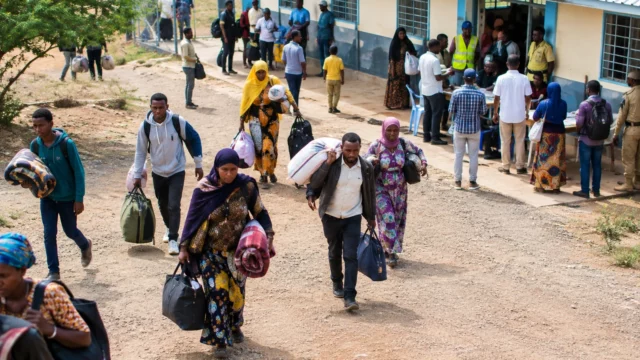
In northern Ethiopia, the front line is no longer confined to Tigray. Fighting is now affecting several routes linking the region with Afar and Amhara. For residents, the immediate risks are twofold: fleeing the clashes and losing access to roads, healthcare and communications.
A front moving west of Tigray
On 25 September 2026, heavy clashes were reported near the Tekeze River, in the Western Tigray zone. Fighting was reported in particular around May Gaba and Tselimo, according to monitoring published by Armed Conflict Location & Event Data, an organisation that documents political violence.
The same area was hit by drone strikes around Sheraro, a town near the border with Eritrea. The attack reportedly targeted Hayelom Tabia, close to the Adi Abay displacement centre. The precise circumstances and casualty toll remain difficult to establish because of telecommunications blackouts and limited access to the areas concerned.
The clashes pit the Tigray Defence Forces, often referred to by the acronym TDF, against Ethiopian federal forces. They are part of a resumption of hostilities after the cessation-of-hostilities agreement signed in November 2022, which ended the open war in Tigray without resolving all territorial and political issues.
Afar becomes a second flashpoint
Fighting has also intensified in Afar, a strategically important region between Tigray, Djibouti and the Red Sea. Clashes have been reported in Abala and Erebti, two towns on routes linking the north of the country to the eastern trade corridors.
Several corroborating sources have reported movements of fighters and civilian displacement in the area. A humanitarian source quoted by media outlets in the region described residents trapped between several front lines. Access for aid organisations has become more difficult, while evacuations have been considered around Abala.
Afar is not merely a peripheral area. The region is home to vital routes to the port of Djibouti, through which a large share of Ethiopia’s imports pass. A prolonged deterioration in security could therefore affect supplies to northern cities as well as trade between Addis Ababa and Red Sea markets.
Lalibela remains under pressure in Amhara
The Amhara region is also seeing fresh clashes. Fighting has been reported around Lalibela, a city known for its rock-hewn churches and listed as a UNESCO World Heritage Site. Flights to its airport have been suspended, according to ACLED monitoring.
The situation around Lalibela illustrates the intertwined nature of Ethiopia’s conflicts. In Amhara, federal forces have been fighting the Fano militias, an armed movement based in the region, since 2023. Tigray and Amhara also remain linked by territorial disputes dating back to the 2020–2022 war.
The fighting is affecting rural areas, but its impact is also being felt in urban centres. Roads are becoming less safe. Air links are being disrupted. Businesses are cutting back and families are seeking to reach areas considered more stable. In Lalibela, this pressure also threatens a local economy heavily dependent on visitors and heritage-related services.
Military tolls impossible to verify
Federal authorities have said that more than 700 rebel fighters have been killed and about 500 wounded since hostilities resumed. This toll could not be independently verified. No comparable figures have been released for government forces.
In a conflict marked by network blackouts and rival accounts, these figures should therefore be presented as claims by a party to the conflict. The information available does not yet make it possible to establish the true scale of the losses or who has lasting control of disputed towns.
UN High Commissioner for Human Rights Volker Türk said he was deeply alarmed by the escalation. He called on all parties to de-escalate tensions swiftly and avoid a resumption of large-scale hostilities.
According to the UN human rights office, air strikes, some reportedly carried out using drones, hit five schools in Tigray on 22 September. Deaths and injuries were reportedly recorded. These reports still need to be documented case by case, but they underline the risks posed by the use of long-range weapons in populated areas.
Civilians caught between bombardment and recruitment
The United Nations has also reported allegations of forced recruitment by Tigrayan forces, including of minors. Volker Türk has also cited troubling reports of arbitrary conscription attributed to government forces. These allegations, which concern opposing sides, require independent investigations.
The population is already bearing the concrete consequences of the escalation. Internet and telephone blackouts are hampering emergency calls, preventing families from checking on their loved ones and making it harder to confirm casualty figures. They are also disrupting aid distribution and the functioning of healthcare facilities.
Displaced people are particularly exposed. In western Tigray, some strikes reportedly took place near sites sheltering civilians who had fled earlier violence. In Afar, displacement can quickly become impossible when roads are controlled by armed groups or humanitarian organisations suspend their movements.
A warning for the Horn of Africa
The crisis now extends beyond Tigray’s administrative borders. It affects Afar, Amhara and the routes linking Ethiopia with Djibouti and Eritrea. It is therefore part of the wider Horn of Africa, a region where territorial rivalries, population displacement and tensions between states reinforce one another.
The Intergovernmental Authority on Development, IGAD, the regional organisation for the Horn of Africa, will need to monitor the fighting and the risk of it spilling over closely. The African Union, headquartered in Addis Ababa, also has a stake in preserving the 2022 agreement and protecting civilians.
The next phase will depend on several factors: the federal forces’ ability to retake disputed routes, the stance of Tigrayan leaders, developments on the Amhara front and whether channels for dialogue are opened. As long as communications remain cut and parties publish conflicting casualty figures, the priority will be to verify the facts, secure humanitarian corridors and prevent another full-scale war in northern Ethiopia.