Algeria
 Egypt
 Libya
 Morocco
 Sudan
 Tunisia
 Benin
 Burkina Faso
 Cabo Verde
 Côte d'Ivoire
 Ghana
 Guinea
 Guinea-Bissau
 Liberia
 Mali
 Mauritania
 Niger
 Nigeria
 Senegal
 Sierra Leone
 The Gambia
 Togo
 Cameroon
 Central African Republic
 Chad
 DR Congo
 Equatorial Guinea
 Gabon
 Republic of the Congo
 São Tomé and Príncipe
 Burundi
 Comoros
 Djibouti
 Eritrea
 Kenya
 Madagascar
 Malawi
 Mauritius
 Mozambique
 Rwanda
 Seychelles
 Somalia
 South Sudan
 Tanzania
 Uganda
 Angola
 Botswana
 Eswatini
 Lesotho
 Namibia
 South Africa
 Zambia
 Zimbabwe
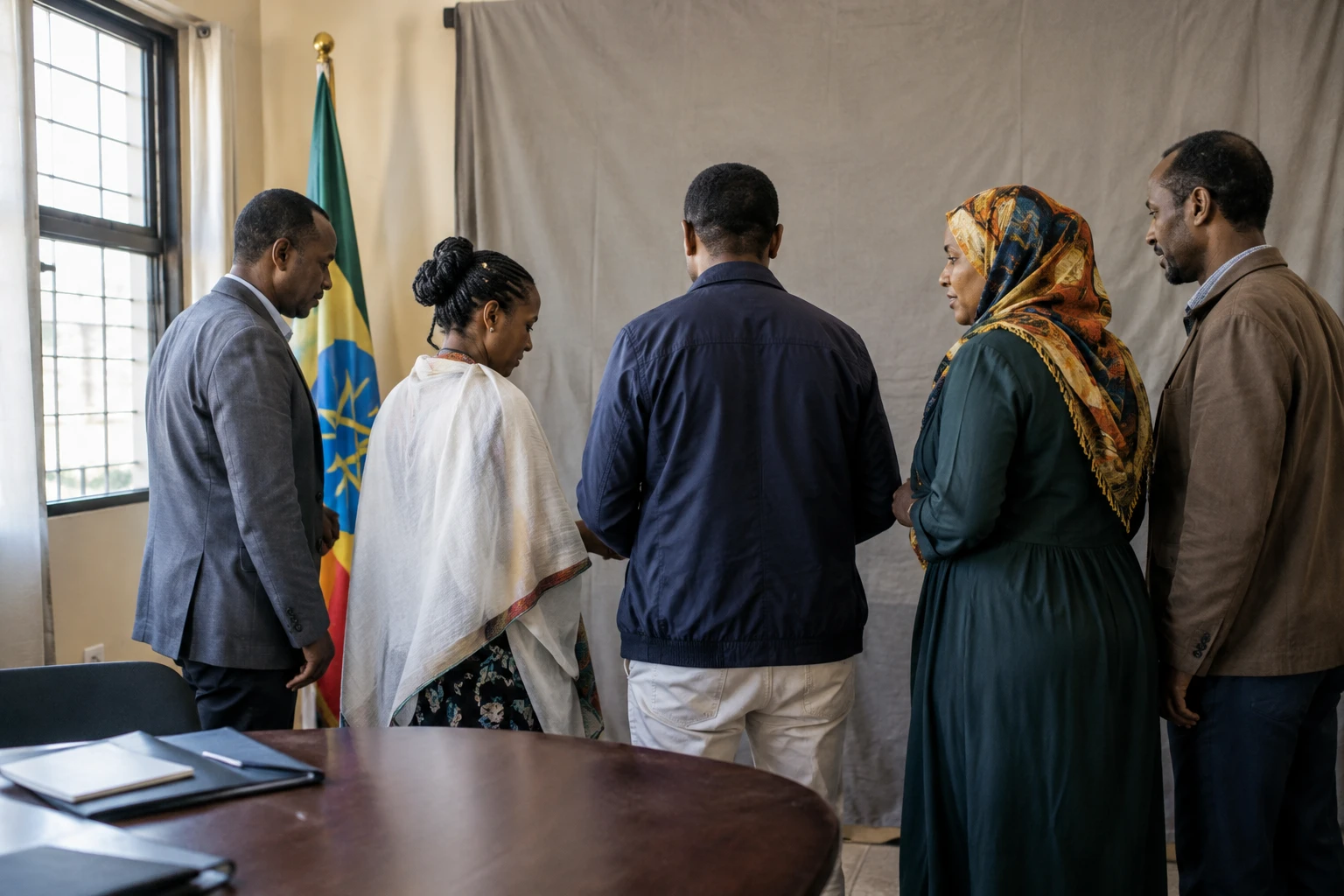
In Dalati, western Ethiopia, the death toll remains disputed. Behind these competing figures, one immediate question remains for residents: who can ensure their safety, and who will establish the facts? Available accounts confirm a deadly attack, but not yet its final toll or the identity of those responsible.
A toll that varies between accounts
The attack hit Dalati in the early hours of Thursday 5 November, in Buldiglu district, Assosa zone, in the Benishangul-Gumuz regional state. The locality is close to the administrative border with Oromia. The region lies in the west of the country, near Sudan.
Regional police commissioner Mohammed Idriss reported 52 deaths: 21 civilians, 18 riot police officers and 13 members of local militias. He attributed the assault to the Oromo Liberation Army (OLA), which Ethiopian authorities refer to as “OLF-Shene”. This attribution remains that of the police official: it has not been independently confirmed.
Residents gave a higher toll to Addis Standard, as reported by regional media: more than 65 dead, including at least 27 civilians. Some accounts describe violence that allegedly continued until Friday 6 November. On 10 November, the African Press Agency (APA) reported that residents were claiming more than 100 victims, while highlighting the discrepancy with the figure given by police.
These figures are therefore not interchangeable. The toll of 52 deaths is the one reported by regional police. The higher counts are attributed to residents and have not been independently verified. At this stage, the exact number of victims and the proportion who were civilians remain uncertain.
Another account must also be reported with caution. The Oromo Liberation Front (OLF), a distinct legal political party, claims that regional police killed more than 43 Oromo civilians after the attack. This allegation has not been verified, and it is not clear whether it overlaps with the police toll. The OLA, meanwhile, had not publicly responded to the authorities’ accusation in the reports consulted.
A region facing multiple tensions
Benishangul-Gumuz is a federal state in western Ethiopia, bordering Sudan and Oromia. This local attack should not be confused with the Sudanese conflict on the other side of the border. The two contexts may nevertheless affect border dynamics and relations between states.
The region has seen repeated episodes of armed violence and civilian displacement. Its security landscape includes federal and regional forces, local militias and armed groups whose affiliations are sometimes disputed. APA cites several political movements and factions present in the region, without establishing their role in the Dalati attack. In Assosa, this complexity makes an investigation capable of distinguishing facts from accusations all the more important.
The incident also comes amid national tensions. Ethiopia remains marked by the consequences of the Tigray war and ongoing clashes in several regions. The Pretoria ceasefire, concluded in November 2022 between the federal government and the Tigray authorities, ended large-scale fighting in the north but did not resolve all the country’s tensions. Security issues vary from region to region: a local crisis should not be presented as a uniform conflict across the country.
In Dalati, regional officials have pointed to security failures. According to Ethiopian outlet The Abay Times, a member of the regional council said his committee would examine the shortcomings and report back to the council. If this process goes ahead, it could shed light on the circumstances of the attack and the response of public forces. It would not, however, replace an independent investigation into the deaths and responsibility for them.
Civilian protection at the heart of the issue
Accounts also differ over the duration of the attack and the response of the forces. The police commissioner said the attackers had left after their assault and that regional and federal forces had been deployed. Residents, by contrast, described violence lasting nearly two days and the absence of federal intervention during that period. These conflicting accounts require verification, including through interviews with displaced people, the injured and medical facilities.
For families, the gap between the tolls has tangible consequences: it complicates the identification of victims, mourning arrangements and access to reliable information. Residents are also concerned about the safety of travel, the operation of markets and whether they can return to their locality without risk. The information available does not yet make it possible to assess the scale of these effects.
The cross-border context warrants separate attention. In early November, Ethiopia ordered the closure of the Sudanese consulate in Assosa and the expulsion of six of its staff, amid Sudanese allegations that drones had been launched from Ethiopian territory. Addis Ababa has rejected similar allegations in the past. No information consulted links these diplomatic tensions to the Dalati attack. They nevertheless show how unverified information in this area can fuel suspicions beyond the border.
An investigation awaited at regional level
Ethiopia is a member of the Intergovernmental Authority on Development (IGAD), a regional organisation in the Horn of Africa that works on cooperation and peace, among other issues. The situation in Benishangul-Gumuz is primarily a matter for Ethiopian authorities and local communities. But the region’s proximity to Sudan gives border stability a regional dimension, at a time when relations between the two countries are strained.
The next developments to watch are clear: the publication of a consolidated toll, a statement from regional or federal authorities, a response from the OLA and independent verification of the OLF’s allegation. Without reliable access to the area and witnesses, no account yet settles all the questions. The journalistic priority remains to distinguish clearly between what is established, what is attributed and what remains disputed.
The facts and accounts were cross-checked against reports by the African Press Agency on the conflicting tolls in Dalati, The Abay Times on the regional police account and the Associated Press on diplomatic tensions between Ethiopia and Sudan.