Algeria
 Egypt
 Libya
 Morocco
 Sudan
 Tunisia
 Benin
 Burkina Faso
 Cabo Verde
 Côte d'Ivoire
 Ghana
 Guinea
 Guinea-Bissau
 Liberia
 Mali
 Mauritania
 Niger
 Nigeria
 Senegal
 Sierra Leone
 The Gambia
 Togo
 Cameroon
 Central African Republic
 Chad
 DR Congo
 Equatorial Guinea
 Gabon
 Republic of the Congo
 São Tomé and Príncipe
 Burundi
 Comoros
 Djibouti
 Eritrea
 Kenya
 Madagascar
 Malawi
 Mauritius
 Mozambique
 Rwanda
 Seychelles
 Somalia
 South Sudan
 Tanzania
 Uganda
 Angola
 Botswana
 Eswatini
 Lesotho
 Namibia
 South Africa
 Zambia
 Zimbabwe
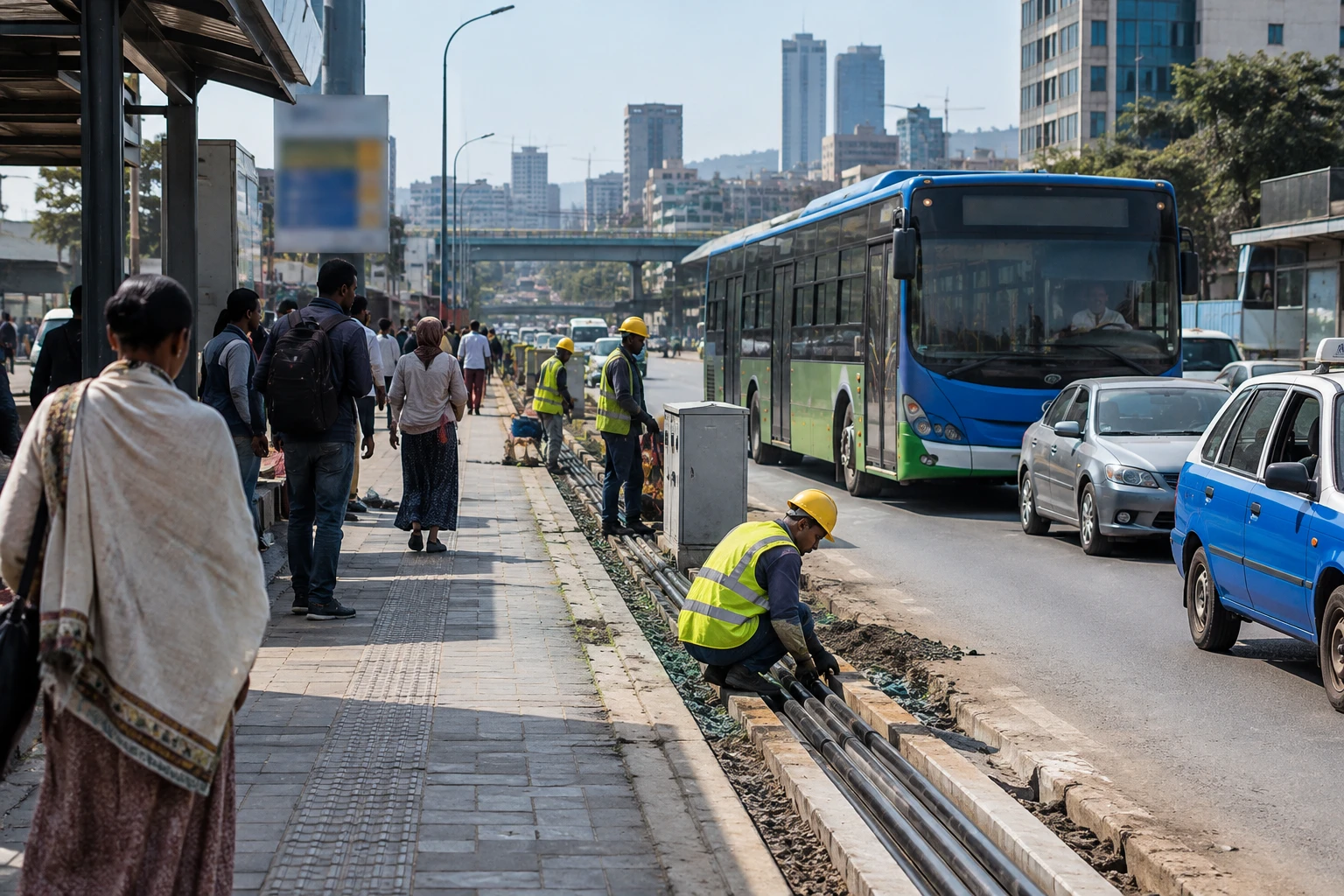
An increase in production is not enough to guarantee that electricity reaches neighbourhoods, shops and businesses without interruption. In Addis Ababa, Ethiopia wants to strengthen the parts of the grid that transmit and distribute power as the capital prepares to host a global climate gathering in 2027.
The capital at the centre of the work
On 13 October 2026, Ethiopia’s parliament approved $145.8 million in concessional financing from the International Development Association (IDA), the World Bank Group’s lending and grant facility for low-income countries. The decision concerns the first phase of the electricity sector reform and modernisation project. Details of the vote and the amount were reported by the Ethiopian News Agency (ENA); public World Bank data confirm the existence of a national programme to modernise the sector, but do not allow this specific parliamentary approval to be verified separately.
The announced work focuses mainly on transmission and distribution: grid expansion, the construction of substations, the refurbishment of existing facilities and the laying of underground lines. These are less visible infrastructure projects than a dam, but they are essential to carrying electricity from power plants to users. The loan terms announced are a six-year grace period and repayment over 31 years, according to information presented to parliament and reported by ENA.
The project is also part of preparations for COP32, the United Nations climate conference that Ethiopia is due to host in Addis Ababa in 2027. The UN and the African Union have confirmed Ethiopia’s role as host country. For the authorities, reliable electricity is necessary for an event bringing together delegations, organisations and media. But the same infrastructure must also meet the everyday needs of a growing capital beyond the summit.
Producing more does not solve everything
Ethiopia is investing in new generation capacity. The Assela wind farm, inaugurated on 16 April 2026, adds 100 megawatts to the national grid, according to ENA. Prime Minister Abiy Ahmed has also said the country’s installed capacity has reached 10,000 MW. The agency reported this announcement, but the sources consulted do not provide a detailed independent assessment to verify the overall figure.
Growth in electricity supply makes the modernisation of lines and substations all the more necessary. A power plant can generate electricity, but an undersized, poorly maintained or outage-prone grid limits the amount of energy actually delivered. In its documents on electricity in Ethiopia, the World Bank notes that service reliability and grid resilience remain challenges to be addressed alongside access and generation.
Access figures also need to be read carefully. The World Bank estimates that 56.6% of the population had access to electricity in 2024. Another indicator, based on its multi-tier framework for measuring access to electricity, puts the share of the population with access to at least a basic level of service at 44%, according to preliminary results from the 2025 survey. These measures do not describe exactly the same thing: being connected or living in an area served by the grid does not guarantee a regular supply or sufficient power.
The gap affects residents and economic activity in different ways. In the capital, outages can affect shops, workshops, digital services and public facilities. Businesses able to invest in generators or backup solutions have a degree of protection that smaller businesses and households do not always have. Across the country, rural areas continue to face more limited access to the grid, making complementary solutions, particularly off-grid systems, necessary.
An Ethiopian challenge, with regional connections
Ethiopia’s electricity trajectory extends beyond its national borders. The country is a member of the Intergovernmental Authority on Development (IGAD), a regional organisation in the Horn of Africa, and the East African Community (EAC). Grid reliability matters for domestic industrial activity, as well as for electricity trading and interconnection projects with neighbouring countries. The ability to transmit energy, not just produce it, will therefore shape Ethiopia’s place in a developing regional system.
At continental level, the work forms part of a broader challenge: expanding access while improving service quality, and doing so with grids able to integrate more renewable sources. The African Union has welcomed Ethiopia’s selection to host COP32. The state of its energy infrastructure will give concrete weight to discussions on the transition and climate investment, although hosting the summit alone cannot measure the progress made.
The next step will be implementation: the construction schedule, site selection, disbursement of funding and observable improvements in service continuity. The approved loan sets a financial framework; it is not yet proof that residents and businesses will experience fewer outages. In Addis Ababa and other regions, the outcome will depend on the ability to turn grid investment into electricity that is available, reliable and accessible.