
 Algeria
 Egypt
 Libya
 Morocco
 Sudan
 Tunisia
 Benin
 Burkina Faso
 Cabo Verde
 Côte d'Ivoire
 Ghana
 Guinea
 Guinea-Bissau
 Liberia
 Mali
 Mauritania
 Niger
 Nigeria
 Senegal
 Sierra Leone
 The Gambia
 Togo
 Central African Republic
 Chad
 DR Congo
 Equatorial Guinea
 Gabon
 Republic of the Congo
 São Tomé and Príncipe
 Burundi
 Comoros
 Djibouti
 Eritrea
 Ethiopia
 Kenya
 Madagascar
 Malawi
 Mauritius
 Mozambique
 Rwanda
 Seychelles
 Somalia
 South Sudan
 Tanzania
 Uganda
 Angola
 Botswana
 Eswatini
 Lesotho
 Namibia
 South Africa
 Zambia
 Zimbabwe
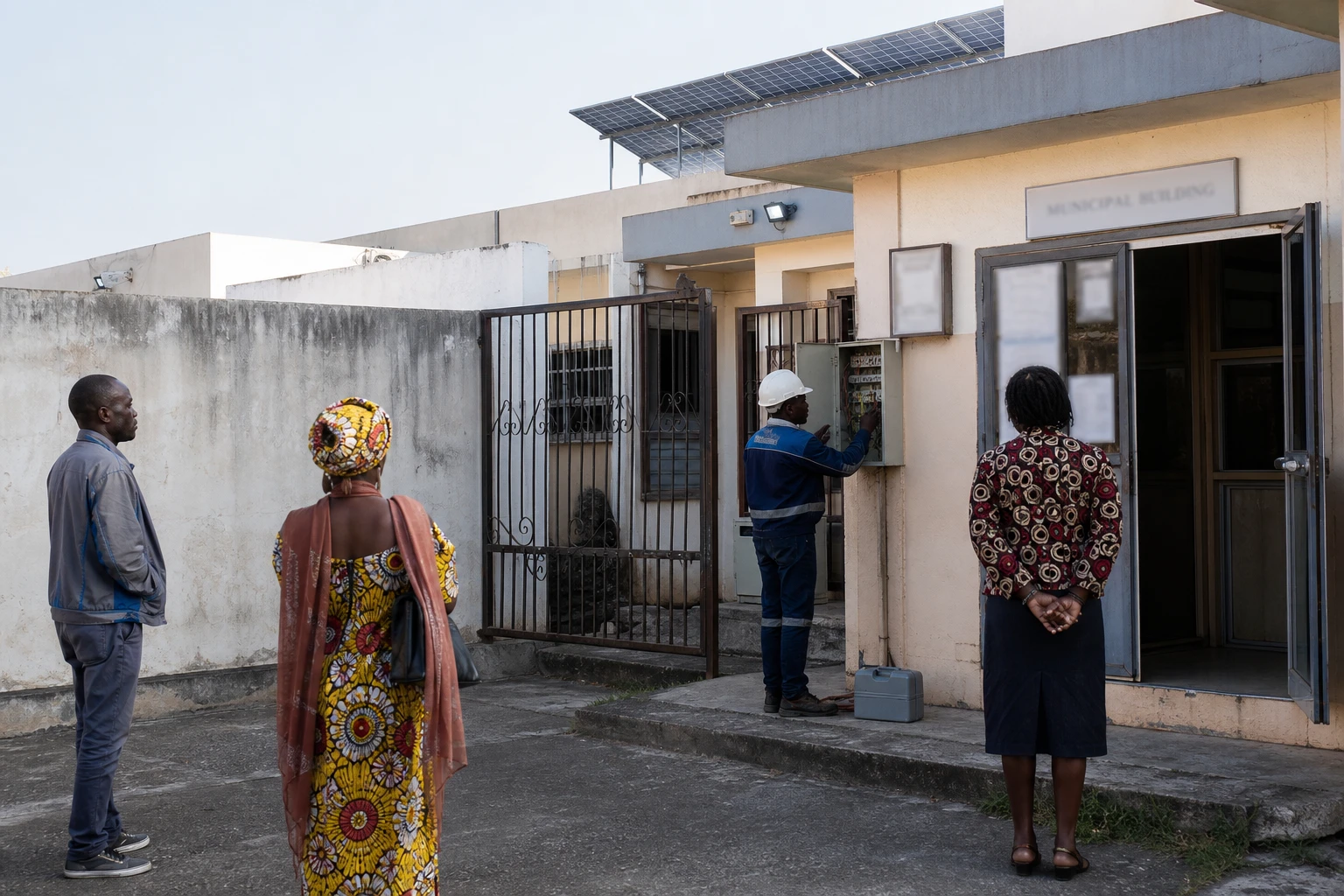
In Esse, the night sometimes tells a better story than speeches
In this municipality in Cameroon’s Centre Region, around 60 kilometres from Yaoundé, electricity is about more than comfort. It powers radio, small businesses, food preservation and essential services. When a locality is without power for a long time, even the simplest activities become difficult, from charging a phone to keeping a health centre running. National data also show that access to electricity remains unequal in Cameroon, with wide disparities between urban and rural areas.
Esse is in the Mefou-et-Afamba department, in a region where the state, municipalities and public operators often share responsibility for energy infrastructure that remains vulnerable. The Ministry of Water and Energy is responsible for public policy in the sector, but the maintenance of local facilities also depends on coordination with local authorities and maintenance budgets. Projects are often won or lost there.
Equipment built to last, then caught out by maintenance
The solar plant installed in Esse in 2018 was intended to provide a practical solution to a power cut that had already lasted for years. The project, funded by the Ministry of Water and Energy, cost 200 million CFA francs, or around €305,000 at the time, according to information gathered locally. For several years, the town centre and several neighbourhoods were indeed supplied with electricity, before the installation gradually deteriorated. This timeline is consistent with local accounts and with the administrative logic of decentralised electrification projects, which require regular monitoring to remain operational.
The site then began to tell its own story. Weeds encroached on the area around the plant. Panels disappeared. Cables were cut. The municipality, meanwhile, changed its administration in 2020. The former mayor, who initiated the project, says he ensured its maintenance during his term. The current administration says the municipality was not involved in the system’s day-to-day management and promises to include it in monitoring from now on. This disagreement illustrates a wider problem in Cameroon: when responsibilities are not clearly shared among the many parties involved, local infrastructure is often left vulnerable.
The municipality of Esse has itself acknowledged on its website that access to reliable electricity remains limited in several neighbourhoods and that power cuts are holding back economic activity. It also says a centralised solar park is being considered to supply schools, health centres and small businesses. The announcements show that energy has never left the local agenda. In practical terms, they confirm above all that needs extend beyond the town centre alone.
What Esse’s case reveals about Cameroon’s electricity sector
The issue extends far beyond the municipality. Cameroon still has significant unmet needs in access to electricity, despite progress in recent years. The World Bank estimated in 2023 that the national access rate was about 65%, with 94% in urban areas compared with 25% in rural areas. In another assessment published in 2025, the institution noted that 75% of the rural population remained without electricity, even when some communities were close to the grid. The contrast between Yaoundé, Douala and outlying municipalities therefore remains stark.
This situation is not due solely to a lack of infrastructure. It also stems from maintenance, payment collection, project governance and the ability to replace equipment. The World Bank’s report on Cameroon’s electricity sector highlights weaknesses in planning, delays in implementation and poor maintenance of the distribution network. It also notes that public subsidies, unpaid bills and the sector’s financial fragility weigh on its sustainability. In other words, a solar plant can be installed, funded and inaugurated; without maintenance, it can quickly lose its usefulness.
Esse also highlights a point that is often underestimated: energy is not only about large power stations or dams. It also comes from local solutions, which are smaller and often quicker to implement, but demanding to manage. In 2022, the municipality had already revived plans for two mini solar plants in other parts of its territory, at Nsimi-Yetoulou and Ebodoumou, costing 20 million CFA francs per site. This shows that rural electrification is built in layers, at the pace of public budgets and local partnerships.
A local lesson within a broader national strategy
Esse’s case comes at a time when Cameroon is seeking to expand access to more reliable and affordable energy. The gradual commissioning of the Nachtigal hydroelectric complex, with 360 MW fed into the grid in mid-January 2025, according to the World Bank, is already changing the picture for part of the interconnected grid. But this increase in capacity does not, on its own, solve the problems of communities far from the grid or poorly served by it. Solar mini-grids, line extensions and rural electrification projects therefore remain essential.
For residents, the stakes are immediate. Without reliable power, informal businesses slow down, households spend more on backup solutions and public services become less effective. For municipalities, the challenge is both budgetary and political: they must prove they can maintain what they ask the state or partners to build. For the state, the challenge is to turn visible investments into lasting services. This is where some of the credibility of public policy is at stake.
Across Central Africa, Esse is a reminder of a simple truth that is often forgotten: the energy transition is measured not only in megawatts, but also in continuity of service. In CEMAC, where states are seeking to modernise infrastructure while supporting growth, small municipalities are becoming real-world tests. If they succeed in maintaining modest installations, they show that more distributed electrification is possible. If they fail, they are a reminder that the problem is not only how to produce electricity, but how to keep it flowing to the last household.



