Algeria
 Egypt
 Libya
 Morocco
 Sudan
 Tunisia
 Benin
 Burkina Faso
 Cabo Verde
 Côte d'Ivoire
 Ghana
 Guinea
 Guinea-Bissau
 Liberia
 Mali
 Mauritania
 Niger
 Nigeria
 Senegal
 Sierra Leone
 The Gambia
 Togo
 Cameroon
 Central African Republic
 Chad
 DR Congo
 Equatorial Guinea
 Gabon
 Republic of the Congo
 São Tomé and Príncipe
 Burundi
 Comoros
 Djibouti
 Ethiopia
 Kenya
 Madagascar
 Malawi
 Mauritius
 Mozambique
 Rwanda
 Seychelles
 Somalia
 South Sudan
 Tanzania
 Uganda
 Angola
 Botswana
 Eswatini
 Lesotho
 Namibia
 South Africa
 Zambia
 Zimbabwe
Asmara returns to multilateral corridors without abandoning its hard line
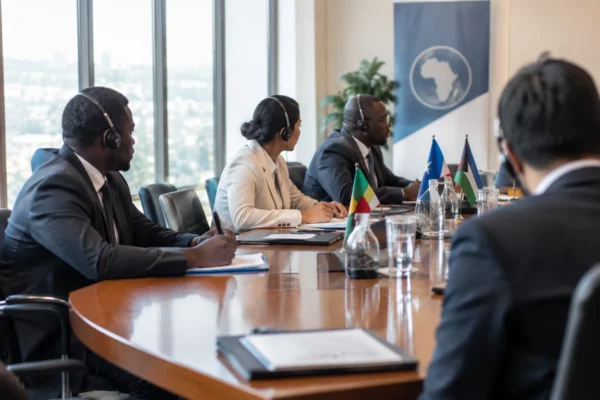
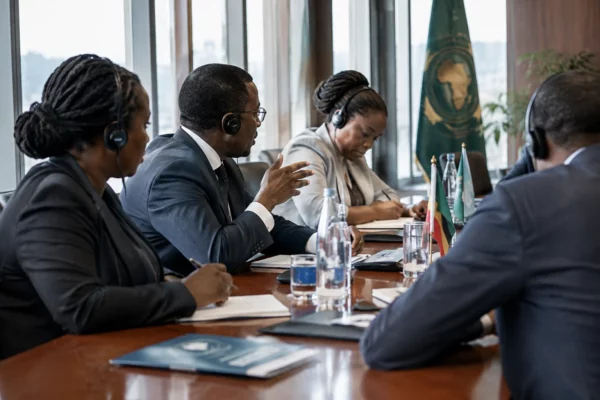
In Asmara, the calculation is simple: gaining a stronger presence at the UN does not necessarily mean loosening its grip at home. For Eritrea, a country in the Horn of Africa often described as politically closed, every seat, every session presidency and every speech counts as a means of raising its profile. That visibility becomes even more useful as the Red Sea once again becomes a focus of global tension.
The country is not starting from scratch. For several years, the UN has maintained a monitoring mechanism on the human rights situation in Eritrea, and the Human Rights Council renewed the mandate of the Special Rapporteur on 4 July 2025. The resolution was adopted by 23 votes to four, with 20 abstentions. The vote shows that the issue remains politically sensitive, but also that the UN system continues to treat Eritrea as a matter of its own.
UN positions, but a dispute that remains unresolved
The heart of the matter lies in a contradiction. On the one hand, Eritrea is taking on greater responsibilities within international bodies. The 2025-2026 UN cycle confirmed the role of regional groups in the allocation of positions, and Asmara continues to seek room for influence there. On the other, criticism of fundamental rights has not eased. The latest report by the Special Rapporteur on Eritrea, published in 2025, points to the continued existence of national service with no clearly defined end date, arbitrary detention and severe restrictions on public freedoms.
This tension is not new. The US State Department still describes Eritrea as a highly centralised regime, where the press, political parties and freedoms of assembly remain tightly controlled. The same US diplomatic apparatus also maintains specific restrictions, notably on exports of defence equipment. Washington is therefore not pursuing full normalisation, but cautious dialogue, used when the regional environment requires it.
In practice, Asmara is seeking to shift the focus. The government wants to show that it can play by the rules of multilateralism, while refusing to let human rights criticism become the sole lens through which the country is viewed. This is a familiar strategy among states facing criticism: it does not erase the allegations, but broadens the agenda. It also makes it possible to discuss security, development, sovereignty and the Red Sea, four topics more comfortable for the Eritrean authorities than public freedoms.
The Red Sea changes the equation, as does the Horn of Africa
The renewed interest in Eritrea is chiefly a matter of geography. The country borders a maritime corridor that has become strategic amid Houthi attacks in the Red Sea and disruption around Bab el-Mandeb, the strait linking the Red Sea to the Gulf of Aden. In 2024, the US Department of Defense itself reiterated the importance of stabilising the area to protect commercial traffic. For a state such as Eritrea, situated opposite one of the world’s most sensitive maritime routes, the effect is immediate: it is once again useful in the eyes of several capitals.
This usefulness is not limited to the sea. It also reflects the changing dynamics of the Horn of Africa. IGAD, the Intergovernmental Authority on Development, brings together Djibouti, Eritrea, Ethiopia, Kenya, Somalia, Sudan, South Sudan and Uganda. The region remains beset by wars, institutional fragility and rivalries between neighbours. In December 2025, IGAD also took note of Eritrea’s withdrawal, a sign that sub-regional dialogue remains unstable. This decision says something important: Asmara wants to be consulted, but without being confined to a framework it considers hostile or ineffective.
In the Horn of Africa, this stance has tangible effects. For neighbouring governments, Eritrea remains a military and diplomatic actor to watch, particularly in the Ethiopia-Somalia-Eritrea triangle and against the backdrop of the conflict in Tigray, which has profoundly shaped regional balances. For populations, however, the consequences are more prosaic: the closure of civic space, prolonged military mobilisation, the movement of young people and families, and uncertainty over the prospects for opening up. When diplomacy gathers pace, everyday life does not automatically change.
What this episode says about the continent
The Eritrean case goes beyond the national context. It illustrates a broader trend in Africa: states criticised for their governance are seeking to turn their geostrategic weight into diplomatic capital. This applies to the Red Sea, but also to other African regions where maritime security, trade routes and border stability now matter as much as institutional rhetoric. The African Union and regional organisations cannot ignore this reality, because they are directly affected by it.
For Asmara, what happens next will depend on several levels. On the one hand, the country’s ability to occupy positions where regional allocation gives it a voice. On the other, the continuing pressure exerted by UN human rights mechanisms. In New York as in Geneva, Eritrea is seeking to show that it can be an acceptable interlocutor without abandoning its domestic political logic. This tension defines its diplomatic return today: a partial, opportunistic and still contested rehabilitation.
Finally, this episode is a reminder of an often overlooked fact: in the Horn of Africa, diplomacy is never read in isolation. It must be read alongside ports, straits, armies, UN mandates and regional affiliations. Eritrea, with Asmara as its political centre, offers a clear illustration. The country is becoming visible again because circumstances demand it. The question remains whether this visibility will ever serve anything beyond strengthening its position in power struggles.