Algeria
 Egypt
 Libya
 Morocco
 Sudan
 Tunisia
 Benin
 Burkina Faso
 Cabo Verde
 Côte d'Ivoire
 Ghana
 Guinea
 Guinea-Bissau
 Liberia
 Mali
 Mauritania
 Niger
 Nigeria
 Senegal
 Sierra Leone
 The Gambia
 Togo
 Cameroon
 Central African Republic
 Chad
 DR Congo
 Equatorial Guinea
 Gabon
 São Tomé and Príncipe
 Burundi
 Comoros
 Djibouti
 Eritrea
 Ethiopia
 Kenya
 Madagascar
 Malawi
 Mauritius
 Mozambique
 Rwanda
 Seychelles
 Somalia
 South Sudan
 Tanzania
 Uganda
 Angola
 Botswana
 Eswatini
 Lesotho
 Namibia
 South Africa
 Zambia
 Zimbabwe

An epidemic weighing on families, health centres and roads in the east
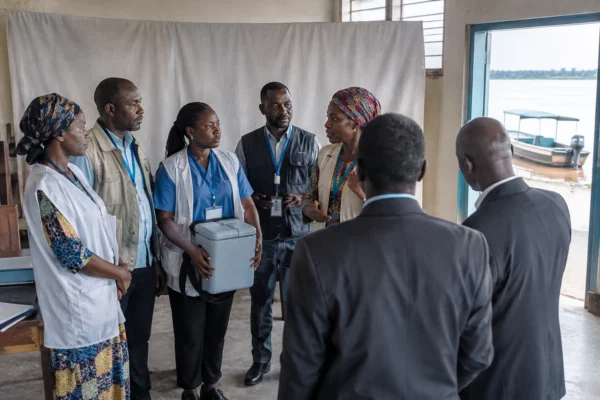
In the Democratic Republic of the Congo, Ebola is not just a health alert. It is also a logistical, social and economic ordeal that intrudes on daily life, from the markets of Bunia to the roads linking Ituri, North Kivu, Tshopo and South Kivu. When an outbreak spreads, routine consultations, patient transfers and trust in health facilities are all shaken.
The latest official tally, published in early September 2026, gives a measure of the shock: 6,186 confirmed cases, 3,007 deaths and 1,409 recoveries. The case fatality rate stands at 48.6%, a level that underscores the severity of the disease when diagnosis comes late or access to care remains inconsistent.
Ituri at the centre, six provinces under surveillance
The epidemic first took hold in Ituri, in the north-east of the country, before spreading to other health zones. The Congolese health ministry and the Congolese Press Agency said the response remained active in six provinces and 60 health zones, with Ituri as the main epicentre, followed by North Kivu and Tshopo. In this geography, the administrative capital, Kinshasa, leads national coordination, while the provinces bear the burden of cases and field surveillance.
This spread is far from insignificant. In the DRC, scattered outbreaks complicate the work of response teams, particularly when roads are long, borders porous and affected areas sometimes far from major hospitals. Africa CDC has also confirmed that the risk of regional spread has remained a major concern since the outbreak began.
In Ituri, 28 of 36 health zones were affected in mid-August, according to a response source cited by the ACP. In Kisangani, in Tshopo, the health zones of Makiso, Mangobo and Lubunga have also been identified as areas requiring vigilance. This spread towards urban centres and transport hubs changes the nature of the challenge: it is no longer just a matter of isolating cases, but of containing the virus as it moves through highly dense mobility networks.
Signs of a lull, but no guarantee of a turning point
Despite the severity of the toll, African health authorities say they are seeing more encouraging signs. Africa CDC has observed a slowdown in transmission after several weeks of intensified response efforts. The African public health agency cited health zones with no new cases for nearly 21 days, including Adja, Kambala, Logo and Mahagi in Ituri, as well as Goma and Lubero in North Kivu, and Lubunga in Tshopo. South Kivu has reportedly recorded no new cases for 92 days.
The same organisation said the national reproduction rate had fallen to 0.97, from about 4 when the epidemic began in May 2026. In public health terms, a rate below 1 means that, theoretically, each infected person infects fewer than one other person on average. It is a useful indicator, but no guarantee of victory. An outbreak can rebound if surveillance declines, transmission chains escape detection or mistrust hinders the isolation of cases.
The Congolese authorities, for their part, have strengthened administrative and security coordination with the governors of the affected provinces. The government has also stressed the need to protect health teams, ambulances and supplies, a useful reminder in a context where the medical response depends as much on supply as on community support.
What this crisis says about the DRC and the region
This epidemic first shows the DRC’s ability to document and monitor complex public health situations almost in real time. The country has built up rare experience in responding to Ebola, and that institutional memory matters. It can be seen in the rapid reporting of figures, the deployment of treatment centres and cooperation between Kinshasa, the provinces and African technical partners.
But this experience is not enough on its own. The outbreak is putting pressure on services already stretched by other public health emergencies. It is affecting families who postpone care, health workers exposed on the front line and small businesses that depend on daily movement within cities and between provinces. In eastern Congo, where security and health vulnerabilities sometimes compound one another, every delay in detection can worsen the toll.
At continental level, the crisis highlights the importance of African health solidarity. Africa CDC has played a coordinating and early-warning role, supporting the Congolese request for access to the ERVEBO vaccine and calling for decisive action. For the African Union and regional communities, the case of the DRC confirms that an epidemic originating in one province can quickly become a cross-border health security issue, particularly when traffic to Uganda, Rwanda or South Sudan is heavy.
What happens next will depend on a few very practical factors: maintaining surveillance in areas that have stopped reporting cases, rapidly isolating patients, targeted vaccination of contacts and the authorities’ ability to retain the trust of communities. If these measures hold, the curve may continue to flatten. Otherwise, Ituri and neighbouring provinces could once again become the starting point for a new surge.