Algeria
 Egypt
 Libya
 Morocco
 Sudan
 Tunisia
 Benin
 Burkina Faso
 Cabo Verde
 Côte d'Ivoire
 Ghana
 Guinea
 Guinea-Bissau
 Liberia
 Mali
 Mauritania
 Niger
 Nigeria
 Senegal
 Sierra Leone
 The Gambia
 Togo
 Cameroon
 Central African Republic
 Chad
 DR Congo
 Equatorial Guinea
 Gabon
 Republic of the Congo
 São Tomé and Príncipe
 Comoros
 Djibouti
 Eritrea
 Ethiopia
 Kenya
 Madagascar
 Malawi
 Mauritius
 Mozambique
 Rwanda
 Seychelles
 Somalia
 South Sudan
 Tanzania
 Uganda
 Angola
 Botswana
 Eswatini
 Lesotho
 Namibia
 South Africa
 Zambia
 Zimbabwe
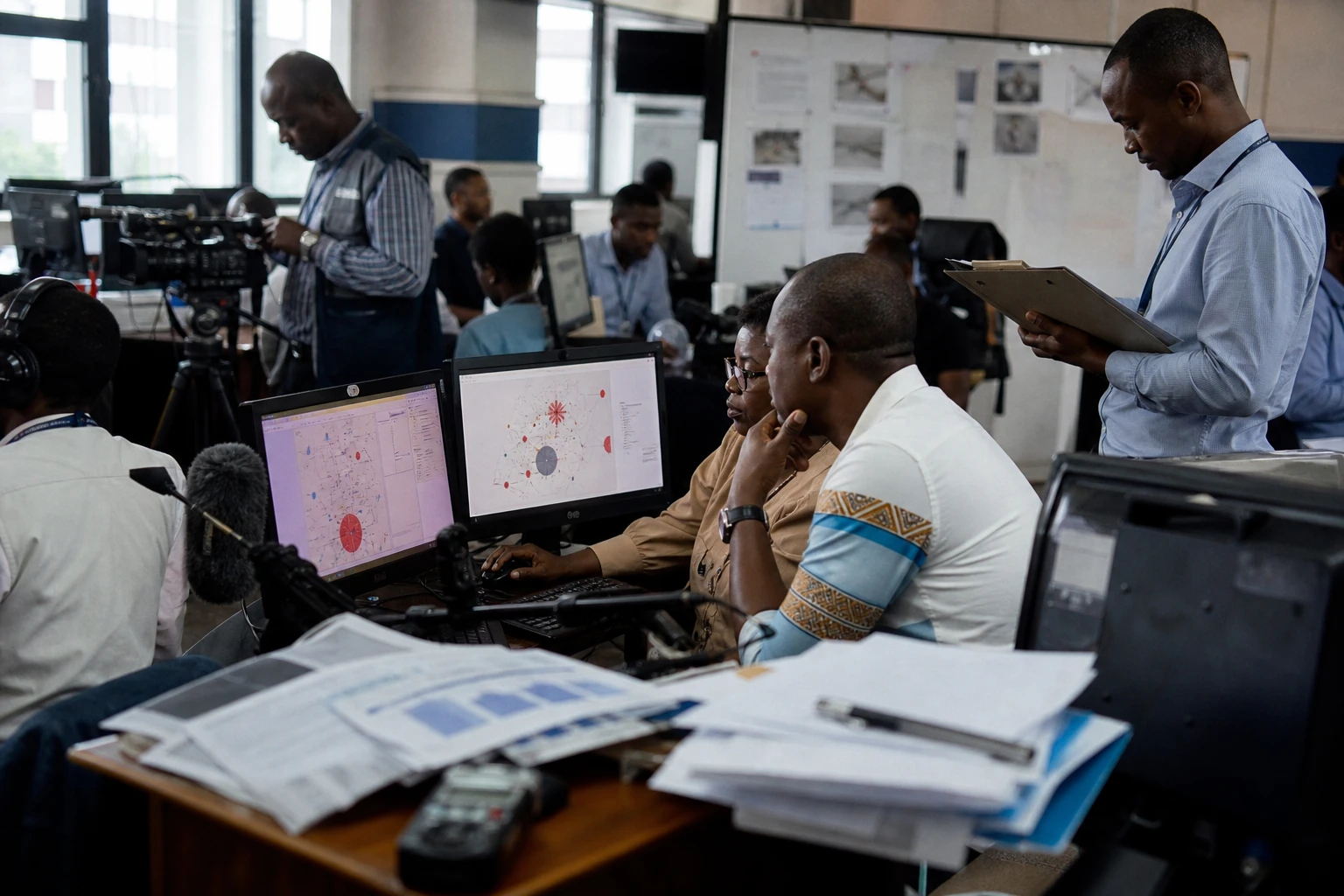
When a health alert crosses borders, the speed of funding matters as much as the speed of the virus
In Central Africa and the Great Lakes region, an epidemic does not stop at border posts. It follows trade routes, pirogues, markets, travelling families and under-resourced health zones. In this context, the Ebola response in the Democratic Republic of the Congo (DRC) raises more than a medical question. It also raises a question of governance: who decides, who funds the response, and how quickly does aid reach the places where cases are reported?
This is precisely the issue being highlighted by the Congolese authorities and their African partners. In Kinshasa, the stated priority is now clear: provide funding quickly, make it transparent, and avoid allowing a proliferation of channels to cloud the field response. This position aligns with the framework advocated by Africa CDC, the African Union’s health agency, which calls for stronger national systems and more robust regional coordination.
DRC on the front line, but facing a regional health threat
The DRC is facing its 17th Ebola outbreak. The Ministry of Health declared the alert on 15 May 2026. Since then, the crisis has initially affected Ituri and North Kivu, before being closely monitored in other eastern provinces. Official figures published on 22 August show 5,514 confirmed cases, 2,642 deaths and six provinces affected: Ituri, North Kivu, Haut-Uélé, Tshopo, South Kivu and Bas-Uélé. These figures point to an epidemic embedded across the country, not an isolated outbreak.
The risk is also regional. The outbreak crossed the border into Uganda in its early days, prompting WHO to declare it a public health emergency of international concern on 17 May 2026. In the region, the health ministries of the DRC, Uganda and South Sudan subsequently strengthened their coordination in Kampala, alongside Africa CDC and WHO. The logic is simple: population movements do not stop at administrative boundaries, and neither do viruses.
What Tshisekedi, Museveni, Touadéra, Ndayishimiye and Africa CDC are calling for
At the heart of their position is a very practical idea: a budget pledge is worthless if it remains stuck for too long between announcement and disbursement. Heads of state Félix Tshisekedi, Yoweri Museveni, Faustin-Archange Touadéra and Évariste Ndayishimiye, alongside Jean Kaseya, director-general of Africa CDC, are therefore calling on partners to speed up funding and align it with national priorities. This call comes as WHO and Africa CDC have launched a continental preparedness and response plan worth $518 million to support African countries at risk from the outbreak.
The second message concerns traceability. The signatories want to know where every sum is going, when it arrives, what activity it is funding, and what results it produces. This is no cosmetic demand. In an Ebola response, funding must cover community teams, surveillance, laboratories, care, dignified burials, points of entry and logistics. If funds pass through too many intermediaries, the decision-making chain lengthens, visibility declines and the most exposed areas are left waiting. The Congolese Ministry of Health has also publicly stressed the need to centralise funding data within a single coordination mechanism.
The third message is regional. The presidents and Africa CDC are calling for funding for the national response, as well as cross-border surveillance, laboratories and regional emergency teams. This choice reflects an often-underestimated African reality: a province may contain cases, but it is often the border area that determines how quickly the virus spreads. This is particularly true in eastern DRC, where movement converges across urban areas, markets, road networks and lakes.
More targeted health measures, without an abrupt halt to trade
On the ground, WHO has tightened its recommendations without going as far as the most restrictive measures. The organisation advises strengthening health checks on roads leading to at-risk areas, setting up surveillance of boats linking affected areas to major cities, and improving traveller monitoring. It also recommends risk-reduction measures in social venues, including restaurants and nightclubs, as well as increased vigilance around schools. WHO does not, however, recommend suspending flights, closing river routes outright or denying travellers entry.
This matters for the DRC, where part of the economy depends on informal travel, local trade and river links. An overly heavy-handed system would come at a high cost to households, transport operators and small businesses. Conversely, a system that is too lax would allow the virus to circulate. The balance sought by the authorities and WHO is therefore to maintain essential exchanges while reducing opportunities for transmission. This is a public health trade-off, but also a social and economic one.
What this episode says about Africa’s health systems
This issue goes far beyond the Congolese case alone. It revives a long-standing but unresolved debate: can Africa build funding mechanisms that are faster, more transparent and less dependent on external pledges? Africa CDC’s answer is a health sovereignty strategy based on stronger African resources, better-funded health systems and continental instruments capable of acting quickly in a crisis. Since 2025, the agency has also highlighted the need to put African resources at the centre of the continent’s health security.
For the DRC, the stakes are immediate. An effective response builds community trust, protects health workers and limits the spread to other provinces. For neighbouring countries, it reduces the risk of the virus being reintroduced. For the Great Lakes region, it is also a test of whether states can speak with one voice in the face of a threat that travels faster than budgetary procedures. What happens next will depend on the ability to turn pledges into visible resources, and resources into safe conditions on the ground. That is where the credibility of Africa’s response to Ebola is measured in concrete terms.