Algeria
 Egypt
 Libya
 Morocco
 Sudan
 Tunisia
 Benin
 Burkina Faso
 Cabo Verde
 Côte d'Ivoire
 Ghana
 Guinea
 Guinea-Bissau
 Liberia
 Mauritania
 Niger
 Nigeria
 Senegal
 Sierra Leone
 The Gambia
 Togo
 Cameroon
 Central African Republic
 Chad
 DR Congo
 Equatorial Guinea
 Gabon
 Republic of the Congo
 São Tomé and Príncipe
 Burundi
 Comoros
 Djibouti
 Eritrea
 Ethiopia
 Kenya
 Madagascar
 Malawi
 Mauritius
 Mozambique
 Rwanda
 Seychelles
 Somalia
 South Sudan
 Tanzania
 Uganda
 Angola
 Botswana
 Eswatini
 Lesotho
 Namibia
 South Africa
 Zambia
 Zimbabwe
At Dioura, the war is now measured by Bamako’s silences
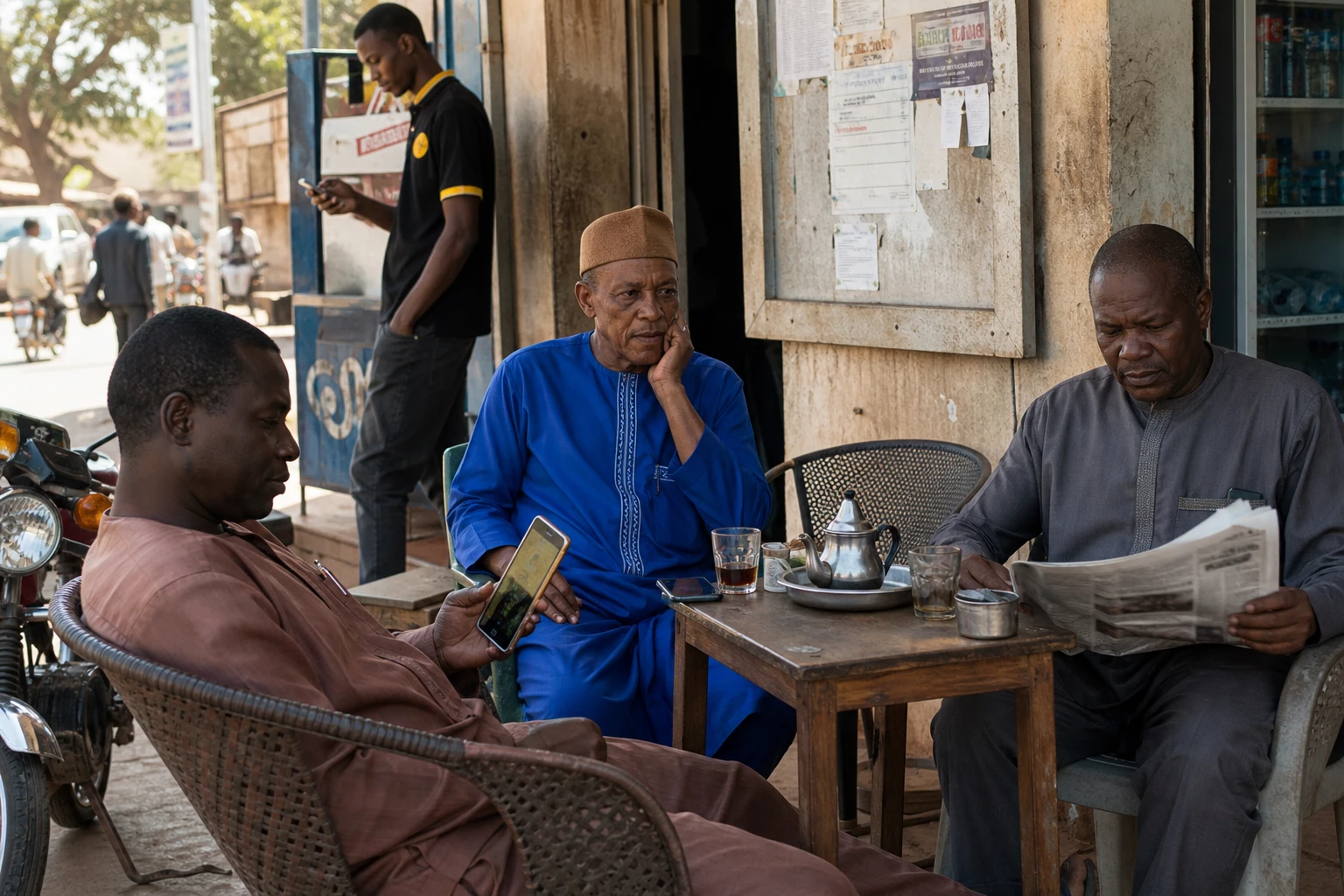
In central Mali, an attack is measured not only by the sound of gunfire. It is also measured by what is missing afterwards: official confirmation, bodies returned to families, settled figures. At Dioura, in the Mopti region, the Malian army acknowledged losses after several days of fighting, while local and security sources reported a far higher toll, a sign of a battle in which information is also a front line.
Dioura is not an isolated point on the map. It lies in a zone of transit and pressure between the country’s centre and north, at the heart of a Sahelian area where armed groups move quickly and garrisons remain exposed. In recent months, Bamako has recast its security doctrine within the framework of the Confederation of Sahel States, comprising Mali, Burkina Faso and Niger, while military leaders have spoken of operations to monitor, control and secure the territory.
What is known about the battle at Dioura
The attack was reported on Thursday 10 September 2026 in the Dioura area of the Mopti region. The African Press Agency said at the time that a statement attributed to the Malian Armed Forces reported that a response was under way, with no immediate casualty figures. At the same time, JNIM, the Group for the Support of Islam and Muslims, claimed the assault and said it had taken control of a barracks.
A few days later, accounts diverged further. Africanews, citing security and local sources quoted by AFP, reported that at least 50 Malian soldiers had been killed, along with five Russian Africa Corps paramilitaries, and that dozens of people had been taken prisoner. Other sources cited in the same dispatch put the toll at between 60 and 80 military personnel killed. On 20 September, the Malian army acknowledged losses in its ranks but gave no figure, while announcing that operations around the garrison were continuing and that two companies had been evacuated.
The most sensitive issue therefore remains the human toll. The new figure of “more than 100 soldiers killed”, repeated in several public statements, was not detailed by the army when it acknowledged losses. Caution is necessary in such cases: the exact number of dead, wounded and captives still depends on available cross-checks, and the Malian authorities do not always provide a full count immediately.
A military battle, but also a political one
In Bamako, the stakes go beyond the defence of a single base. A camp attacked and contested for several days undermines the credibility of the chain of command, particularly in a context where the transitional authorities have made restoring state authority a central argument. The army highlights retaliatory strikes and losses inflicted on the attackers. But repeated attacks in the country’s centre are a reminder that armed groups retain considerable capacity to cause damage, including far from major cities.
Central Mali remains particularly vulnerable. Mopti and neighbouring districts are criss-crossed by roads, rural markets, livestock movements and informal trade flows. When a garrison there falters, civilians are the first to bear the secondary effects: disrupted movement, fear of reprisals, temporary closure of tracks and higher costs for transport operators. The impact is therefore twofold. It affects soldiers on the front line. It also affects the people living around the routes under control, often far from the official account.
This episode also recalls another reality of the conflict in Mali: the circulation of propaganda images, competing claims and contradictory casualty figures blur perceptions of events on the ground. JNIM exploits every seizure, video and abandoned position to promote a narrative of strength. The army, for its part, stresses that it is holding the ground and carrying out clearance operations. Between the two, the population is above all seeking to know who really controls the roads, villages and corridors used for movement.
What Dioura says about the Sahel today
Dioura resonates far beyond Mali. The crisis shows that front lines in the Sahel are no longer fixed. Armed groups adapt, strike, withdraw, return, then turn combat zones into media stages. Within the Confederation of Sahel States, the capitals of Bamako, Ouagadougou and Niamey are seeking to project a united response. But realities on the ground are a reminder that political co-operation, even when strengthened, cannot on its own replace effective control of territory.
For Mali’s partners, neighbouring countries and regional institutions such as the BCEAO, the stakes are also economic. Every surge in violence in central Mali weighs on logistics routes, local revenues, neighbourhood trade and business confidence. On a continental scale, the Dioura affair is a reminder of an obvious truth: security in the Sahel cannot be reduced either to military operations or to public relations announcements. It depends on a lasting territorial network, a credible administrative presence and trust between the authorities and rural communities.
What happens next will depend on two factors. First, the FAMa’s ability to stabilise the Dioura area without allowing the ground to close in behind them. Second, clarification of the human toll, which will show whether this attack remains one heavy blow among others or becomes one of the costliest episodes for the Malian army since the current phase of the conflict began. In either case, Mopti remains a barometer of the central Sahel: when Dioura falters, the entire security balance in Mali is weakened.