Algeria
 Egypt
 Libya
 Morocco
 Sudan
 Tunisia
 Benin
 Burkina Faso
 Cabo Verde
 Côte d'Ivoire
 Ghana
 Guinea
 Guinea-Bissau
 Liberia
 Mali
 Mauritania
 Niger
 Senegal
 Sierra Leone
 The Gambia
 Togo
 Cameroon
 Central African Republic
 Chad
 DR Congo
 Equatorial Guinea
 Gabon
 Republic of the Congo
 São Tomé and Príncipe
 Burundi
 Comoros
 Djibouti
 Eritrea
 Ethiopia
 Kenya
 Madagascar
 Malawi
 Mauritius
 Mozambique
 Rwanda
 Seychelles
 Somalia
 South Sudan
 Tanzania
 Uganda
 Angola
 Botswana
 Eswatini
 Lesotho
 Namibia
 South Africa
 Zambia
 Zimbabwe
In Lagos, an industrial asset becomes a full-scale test
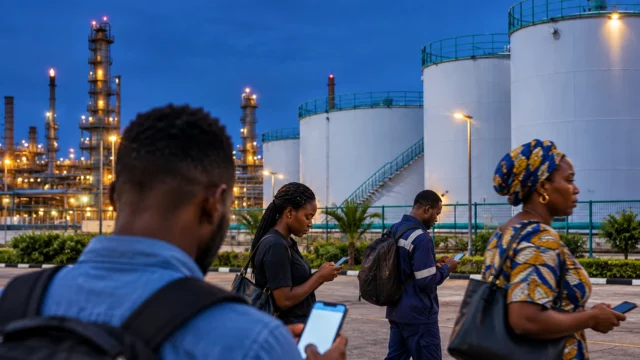
In a country where fuel costs weigh on households, transport operators and small businesses, the Dangote refinery has moved beyond the status of an industrial gamble to become a strategic asset. Located in Ibeju-Lekki, in Lagos State, it is no longer merely promising to reduce imports. It is beginning to post figures that are attracting investors and Nigerian policymakers alike.
The oil complex, billed as Africa’s largest single-train refinery, was designed to process 700,000 barrels a day and is ultimately targeting 1.4 million barrels a day. Its significance therefore extends well beyond the company itself. It affects Nigeria’s energy security and external balance, and more broadly the supply of refined products to West Africa.
Results that change the nature of the debate
In the first six months of 2026, the refinery generated a net profit of $1.82 billion, on revenue of $13.91 billion and Ebitda of $2.6 billion. These figures mark a sharp turnaround from the loss of $476 million recorded over the whole of 2025. They also show that the industrial unit’s ramp-up is now visible in the accounts, not just in statements.
The recovery was driven first and foremost by production. The average utilisation rate reportedly reached 83.6% in the first half, following a slower start-up phase. The group says it improved the operation of key units, particularly catalytic cracking, boosting output of petrol, diesel and kerosene. In a tight global market, these products remain among the most remunerative for a refinery.
But the performance is not based on volumes alone. It also depends on high refining margins. International conditions played a decisive role here. Geopolitical tensions and supply disruptions supported the price spreads between the crude bought and the products sold. That is good news for the site’s cash flow. It is also a less stable variable for future shareholders.
IPO highly anticipated, but not without questions
The turnaround comes as the group prepares a listing on the Lagos Stock Exchange. The plan discussed in market reports targets around 2,150 billion naira, or $1.63 billion, through the sale of 4.1 billion ordinary shares at 525 naira apiece. The transaction is presented as one of the largest ever considered on an African stock exchange.
The timing is particularly sensitive because Nigeria’s financial markets regulator warned on 23 June 2026 against premature solicitations relating to a purported share offering by the refinery. Nigeria’s SEC said at the time that no IPO registration application had been filed or approved as of that date. The warning illustrates an essential point: in Nigeria, the credibility of a major market transaction depends as much on the accounts as on regulatory discipline. Nigerian SEC: warning over solicitations relating to the refinery.
The group, for its part, is highlighting a $1 billion financial backing programme announced on 18 August 2026, presented as a milestone ahead of the sale of shares. It is a useful signal for investors, but no guarantee of the stock’s future performance. The eventual valuation will depend on how long high margins last, the cost of crude, operational stability and Nigeria’s ability to secure supplies for the site. Official announcement on pre-IPO financing.
What this means for Nigeria and the region
For Abuja, the challenge is clear: to turn a private megaproject into a macroeconomic lever. The International Monetary Organisation estimates that a domestic refinery of this size can reduce imports of refined products, support foreign-exchange reserves and improve the country’s current account. In other words, the refinery can act as an external buffer in an economy long exposed to the cost of imported fuel.
For Nigerians, the effect is more immediate and uneven. Cities, transport operators and small informal businesses feel changes in the price of petrol, diesel and jet fuel first. If local production stabilises, the country gains greater security of supply. If margins remain high without a visible impact on retail prices, the social benefits will take longer to be felt. The gap between financial capital and the real economy may remain significant.
The impact also extends beyond Nigeria’s borders. The refinery is already envisaged as a regional supplier. In the ECOWAS sub-region, where refined petroleum product supplies remain heavily dependent on imports, a player capable of delivering on a large scale from Lagos could reshape commercial dynamics. The question is no longer simply whether Nigeria can refine for itself. It is how far it can become a net exporter of higher value-added products to West Africa.
An industrial asset already shaping the continental narrative
The refinery’s management is now openly expressing continental ambitions. The site says it wants to serve African markets and bring more local and pan-African capital into its development. This direction aligns with a broader movement towards industrialisation financed and valued in Africa, rather than conceived solely from outside the continent. In this context, the project is being closely watched by financial centres, oil companies and governments across the region.
One major unknown remains: how robust this model will be once the market returns to less favourable margins. The strong results for the first half of 2026 lend credibility to the project. They do not yet show whether profitability will remain at the same level when international tensions ease. That is what the next stage will be judged against, far more than the headline profit figure alone.