Algeria
 Egypt
 Libya
 Morocco
 Sudan
 Tunisia
 Benin
 Burkina Faso
 Cabo Verde
 Côte d'Ivoire
 Ghana
 Guinea
 Guinea-Bissau
 Liberia
 Mali
 Mauritania
 Niger
 Senegal
 Sierra Leone
 The Gambia
 Togo
 Cameroon
 Central African Republic
 Chad
 DR Congo
 Equatorial Guinea
 Gabon
 Republic of the Congo
 São Tomé and Príncipe
 Burundi
 Comoros
 Djibouti
 Eritrea
 Ethiopia
 Kenya
 Madagascar
 Malawi
 Mauritius
 Mozambique
 Rwanda
 Seychelles
 Somalia
 South Sudan
 Tanzania
 Uganda
 Angola
 Botswana
 Eswatini
 Lesotho
 Namibia
 South Africa
 Zambia
 Zimbabwe
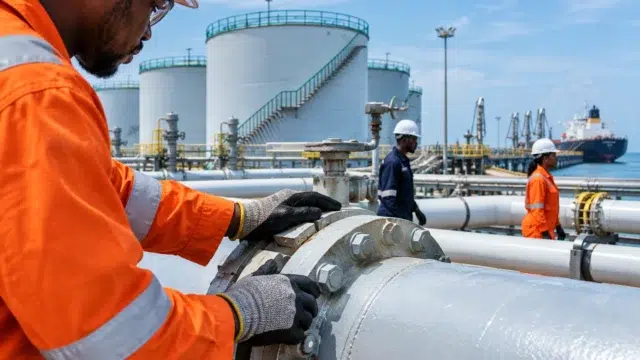
A refinery built in Nigeria is now seeking shareholders beyond its borders. But between the ambition of pan-African financing and the national rules governing investments, investors do not all have the same access to the offer.
A Nigerian offer with regional reach
In Nigeria, the transaction concerns Dangote Petroleum Refinery and Petrochemicals, owner of the Lekki complex near Lagos. The country, West Africa’s largest economy, is a member of ECOWAS, a regional organisation that promotes, among other things, trade between its member states. Yet investing in a company listed in a neighbouring country remains subject to the rules and intermediaries of each market.
The refinery, which began production in 2024, plays a major role in Nigeria’s industrial strategy. It aims to process some of the country’s crude oil locally and supply refined products to the domestic market and for export. Its financing and operations therefore have implications beyond its shareholders alone: they also affect energy supplies, imports and regional trade.
The context has changed since Nigeria ended fuel subsidies in 2023, contributing to a sharp rise in pump prices. Local production can reduce dependence on imports, but it does not, on its own, guarantee stable prices or equal access to fuel in all regions.
Two extra weeks to subscribe
The subscription period for the initial public offering (IPO), the sale of shares to the public before they may be traded on a stock exchange, was due to end on Tuesday 13 October. The company extended it to 27 October, with the approval of Nigeria’s Securities and Exchange Commission, the financial markets regulator. The announcement was reported by Channels Television, and the offer timetable is confirmed by the Nigerian SEC.
The offer comprises 4.1 billion shares priced at 525 naira each. It could raise about $1.6 billion, according to information provided at its launch. The price and volume appear in announcements by the company and the regulator. However, Aliko Dangote’s claim that applications already exceed the amount sought by three to four times has not been confirmed by an independent public tally. It should therefore be treated as a statement by the promoter, rather than an established result.
David Bird, the company’s managing director, said the additional time was intended to make it easier for investors in other African countries to participate. The company cites, in particular, the time needed to establish local subscription channels, open accounts and carry out regulatory checks. An offer presented as continental does not automatically become accessible everywhere: each financial authority must determine the terms on which it can be marketed.
Access varies by country
In Kenya, depositary receipts are intended to allow investors to subscribe in local currency for securities linked to the Nigerian offer. A depositary receipt represents shares held by an intermediary and may be traded on a local market, subject to the relevant approvals. BusinessDay Nigeria reported approval for a scheme aimed at Kenyan investors. The precise terms and completion of the necessary steps must nevertheless be distinguished from the mere announcement of a mechanism.
In Uganda, reported access is limited to professional investors and people with substantial financial means. The general public is therefore not on an equal footing with these groups. This illustrates a practical issue: cross-border access can broaden the shareholder base while, in some markets, reserving participation for wealthier investors.
In southern Africa, work is also said to be under way to enable depositary receipts to circulate between markets, including Botswana. But until agreements, approvals and settlement arrangements are finalised, these plans do not amount to guaranteed access. Extending the timetable gives intermediaries more time; it does not remove regulatory differences.
An ownership offer that remains regulated
Aliko Dangote has presented the transaction as a way to involve a large number of individuals in the refinery. The minimum offer announced at launch was ten shares, or 5,250 naira. However, buying shares carries the risk of loss: the price may fluctuate, and a high valuation guarantees neither a dividend nor future returns.
The offer also does not mean that control of the company is passing to the public. Dangote is expected to retain a majority stake, while new shareholders will share a fraction of the capital. Investors will therefore need to examine the company’s governance, accounts and prospects, as well as its industrial role. The SEC recommends using only approved intermediaries and channels and consulting the official offer documents.
For Nigerian households, the issue is therefore twofold: gaining access to an important industrial asset while weighing that investment against day-to-day needs and financial risks. For institutional investors and individuals in neighbouring countries, the obstacles are more administrative and regulatory. Finally, the refinery may strengthen Nigeria’s processing capacity without resolving questions of competition, prices and the distribution of petroleum products.
A test for African markets
The case highlights a gap: capital and companies move across the region more easily than retail investments. ECOWAS provides a framework for West African co-operation, but the offer also concerns investors in East and southern Africa, outside the bloc. Agreements are therefore needed between regulators, banks, depositaries and stock exchanges across several regions.
The next step will be to establish how many investors have actually subscribed, in which countries and under what arrangements. The timetable published by the company and regulators’ decisions will help distinguish intentions from results. More broadly, the transaction will show whether an African company can mobilise savings across several markets without national differences restricting access to investors who are already well equipped.