
 Algeria
 Egypt
 Libya
 Morocco
 Sudan
 Tunisia
 Benin
 Burkina Faso
 Cabo Verde
 Côte d'Ivoire
 Ghana
 Guinea
 Guinea-Bissau
 Liberia
 Mali
 Mauritania
 Niger
 Nigeria
 Sierra Leone
 The Gambia
 Togo
 Cameroon
 Central African Republic
 Chad
 DR Congo
 Equatorial Guinea
 Gabon
 Republic of the Congo
 São Tomé and Príncipe
 Burundi
 Comoros
 Djibouti
 Eritrea
 Ethiopia
 Kenya
 Madagascar
 Malawi
 Mauritius
 Mozambique
 Rwanda
 Seychelles
 Somalia
 South Sudan
 Tanzania
 Uganda
 Angola
 Botswana
 Eswatini
 Lesotho
 Namibia
 South Africa
 Zambia
 Zimbabwe
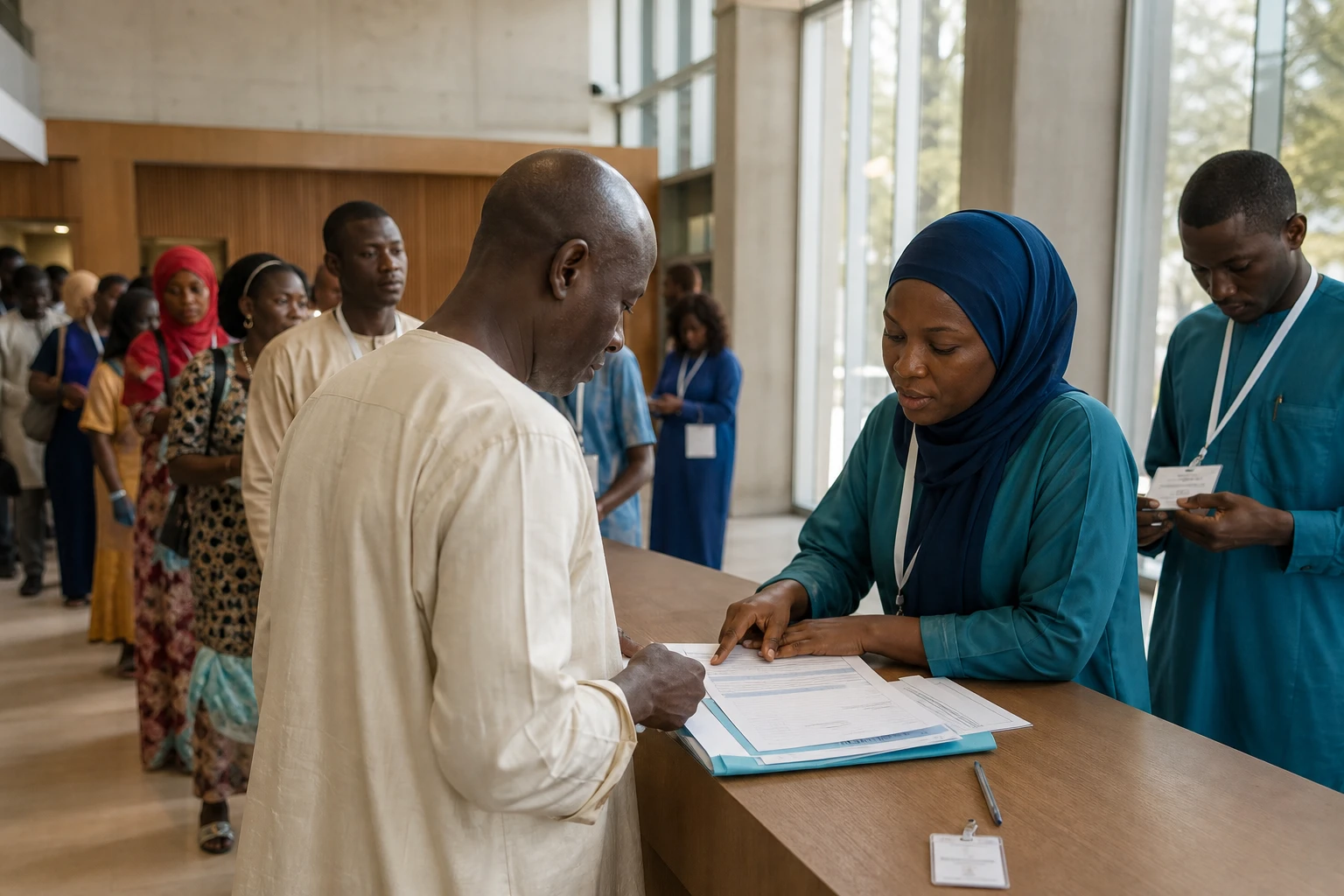
In Dakar, the success of the Youth Olympic Games will not be decided solely in sports venues. It will also depend on thousands of everyday actions: guiding a delegation, keeping people moving, securing an entrance or welcoming a visitor. With the event just weeks away, volunteers are becoming one of Senegal’s most visible faces.
Local mobilisation before delegations arrive
Dakar City Hall brought together nearly 300 volunteers on 22 September 2026 at a ceremony dedicated to their role in organising the Youth Olympic Games. The event included the symbolic handover of the volunteers’ flag to the organising committee.
Dakar Mayor Abass Fall urged participants to show commitment, resilience and professionalism. Their role will go beyond protocol and ceremony. It will cover reception, accommodation, urban mobility, guidance, access controls and site monitoring.
These tasks will be particularly sensitive in a metropolis where getting around can quickly become an organisational challenge. Volunteers will therefore need to provide a direct link between athletes, delegations, spectators, residents and the various services involved.
The organising committee plans to recruit a total of 6,000 volunteers through the Jambaar26 programme. The initiative is to cover the sites in Dakar, Diamniadio and Saly, three hubs set to host competitions and activities related to the Games. The official Dakar 2026 volunteer training portal says participants will follow courses tailored to their roles.
Practical roles at the heart of the Games experience
Volunteering will not be limited to a symbolic presence. Participants will be assigned specific roles, including accreditation, Olympic Village services, welcoming the public and assisting delegations.
Training is to combine general preparation, instruction related to each person’s role and practical training at the site itself. The aim is to reduce mistakes during competition days, when the flow of people will be at its heaviest.
The programme also has a civic dimension. A campaign conducted across Senegal’s 14 regions had already attracted more than 6,000 young people by the end of 2025, according to the Senegalese National Olympic and Sports Committee. This mobilisation shows that the event is not solely about Dakar. It is part of a nationwide drive.
For young Senegalese, the experience could provide a first immersion in sports events, logistics, international reception or crowd management. It could also strengthen skills that will be useful beyond the Olympic fortnight. The organising committee presents the programme as a pathway to prepare participants for operational responsibilities.
Dakar 2026, a national and continental event
The Youth Olympic Games will take place in Senegal from 31 October to 13 November 2026. They will be the first Olympic event held on the African continent. The programme includes 2,700 athletes, 25 sports in competition and several disciplines designed to encourage discovery and participation among young people.
Dakar’s selection in 2018 was already a significant milestone for the African Olympic movement. Eight years on, the challenge is now operational. Senegal must demonstrate its ability to organise a global event while maintaining strong involvement from local authorities and stakeholders.
The International Olympic Committee says the Games will use several sites, from Dakar to Diamniadio and as far as Saly. This distribution extends the event’s reach across the country. It also requires close co-ordination between transport, accommodation, security, public services and organisers.
Dakar City Hall has a particular role in this arrangement. The capital accounts for a large share of the reception, travel and international visibility. It must therefore reconcile the demands of the Games with residents’ daily lives, particularly in neighbourhoods near the sites and main traffic routes.
A test of urban organisation and the Games’ legacy
The mobilisation of volunteers will provide an opportunity to assess Dakar’s ability to manage large flows of people without isolating the local population. International visitors will not be the only people affected. Workers, students, traders, transport operators and families will need to continue getting around a city that remains active.
The impact will also vary between locations. Dakar will receive the greatest media exposure. Diamniadio will host some of the infrastructure and delegations. Saly, for its part, will have to balance tourism, accommodation and sports organisation. Co-ordination between these areas will be crucial to ensure that the event is not confined to the capital.
The Jambaar26 programme will therefore be judged on the quality of its welcome, but also on its ability to leave behind lasting skills and networks. Effective training, better command of event organisation and greater youth participation could provide a tangible legacy for Senegalese sport.
The official Dakar 2026 slogan, “Africa welcomes, Dakar celebrates”, sets this ambition at a continental level. Senegal will welcome delegations from around the world, but the event must also speak to Africa’s young people. The volunteers’ performance will be one of the first measures of whether that promise is fulfilled.
The final countdown to the opening
From 31 October, teams will have to move from preparation to implementation. Volunteers will then face the realities on the ground: schedule changes, urgent requests, mobility constraints and diverse audiences.
The 22 September ceremony therefore marks a change of pace rather than a conclusion. Dakar’s volunteers are entering the phase in which every detail matters. Their presence will put a human face on an organisation that must now prove, day after day, that Senegal can host the first Olympic event in the history of the African continent.



