Algeria
 Egypt
 Libya
 Morocco
 Sudan
 Tunisia
 Benin
 Burkina Faso
 Cabo Verde
 Côte d'Ivoire
 Ghana
 Guinea
 Guinea-Bissau
 Liberia
 Mali
 Mauritania
 Niger
 Nigeria
 Senegal
 Sierra Leone
 The Gambia
 Togo
 Cameroon
 Central African Republic
 Chad
 DR Congo
 Equatorial Guinea
 Gabon
 São Tomé and Príncipe
 Burundi
 Comoros
 Djibouti
 Eritrea
 Ethiopia
 Kenya
 Madagascar
 Malawi
 Mauritius
 Mozambique
 Rwanda
 Seychelles
 Somalia
 South Sudan
 Tanzania
 Uganda
 Angola
 Botswana
 Eswatini
 Lesotho
 Namibia
 South Africa
 Zambia
 Zimbabwe
Social protection must prove its value beyond training rooms
In Brazzaville and Pointe-Noire, the question is no longer just whether young people are being trained. It is what remains after certificates, workshops and coaching sessions: an income, a stable activity, or simply another administrative process. That is the central challenge facing the Youth Social Protection and Productive Inclusion Project, or PSIPJ, which is reaching a decisive stage as the World Bank monitors its implementation on the ground. The programme is funded to the tune of $133 million and aims to shift social protection in the Republic of the Congo from assistance towards economic self-reliance.
In a country where decisions are made in Brazzaville and Pointe-Noire carries considerable economic weight, the issue goes beyond the Ministry of Social Affairs. It also concerns the Ministry of Planning, coordination with technical education, the unified social registry and, more broadly, the Congolese state’s ability to target public spending more effectively. In Central Africa, this is a strategic issue. CEMAC, the Republic of the Congo’s regional bloc, is pressing states to strengthen their social safety nets without putting further strain on public finances that are already under pressure.
From the Lisungi programme to the PSIPJ: continuing social policy work
The PSIPJ builds on the legacy of Lisungi, launched in 2014 with support from the World Bank. Lisungi combined conditional cash transfers, grants for small businesses and support for poor households. According to the World Bank, about 76,000 people received transfers between 2015 and 2023, while more than 95,000 others received grants to start a small business. The project officially ended on 29 February 2024, but its tools have continued to shape social policy in the Republic of the Congo.
The increase in funding and institutional scale is significant. In June 2020, the World Bank approved $50 million for the emergency response to Covid-19. An additional $83 million in funding was then added, bringing the total to $133 million. The Congolese Ministry of Planning now describes the PSIPJ as a World Bank-funded social protection and productive inclusion project, scheduled to close on 30 June 2027. The government website also lists two financing agreements, signed in 2020 and 2022.
This structure explains the support mission held in Brazzaville and Pointe-Noire from 21 September to 2 October. World Bank teams are due to meet officials responsible for planning, solidarity and social affairs, as well as visit sites where the next stages are to be rolled out, including locations under consideration for future community childcare centres. The project is therefore not limited to young adults. It also seeks to connect early childhood protection and productive inclusion within a single social support system.
Numbers matter, but the system must work
The PSIPJ targets several groups. According to official programme documents, it is to support more than 45,000 young people into employment and self-employment, while also providing cash transfers to vulnerable households. The 2026 plan, approved in late December, provides for 40,000 young people to enter self-employment and another 5,000 to train for in-demand trades. It also sets an annual budget of about 44.12 billion CFA francs for 58 activities.
The interim figures show that the programme has already begun to produce sizeable cohorts. In Brazzaville on 29 July, the Minister of Social Affairs, Solidarity and Humanitarian Action, Marie-France Lydie Hélène Pongault, presented certificates to 2,256 young people from Brazzaville, Pointe-Noire, Dolisie and Ouesso. They had completed six to nine months of training in 22 trades, from agriculture and construction to services and industry. A few weeks earlier, ACI’s field mission had already reported that 2,162 young people were in training in Brazzaville and Pointe-Noire. The figures do not describe precisely the same snapshot, but they confirm the scale of the rollout and the project’s acceleration.
The real test lies elsewhere: in the transition from learning to earning. In an economy where informal work remains dominant, moving from trainee to micro-entrepreneur depends on the quality of coaching, access to basic equipment, administrative support and the ability to find local markets. This is where the World Bank mission becomes crucial. It must assess the smoothness of payments, transparency in targeting, women’s participation, the expansion of the unified social registry and the reliability of training providers.
The unified social registry, a cornerstone of credibility
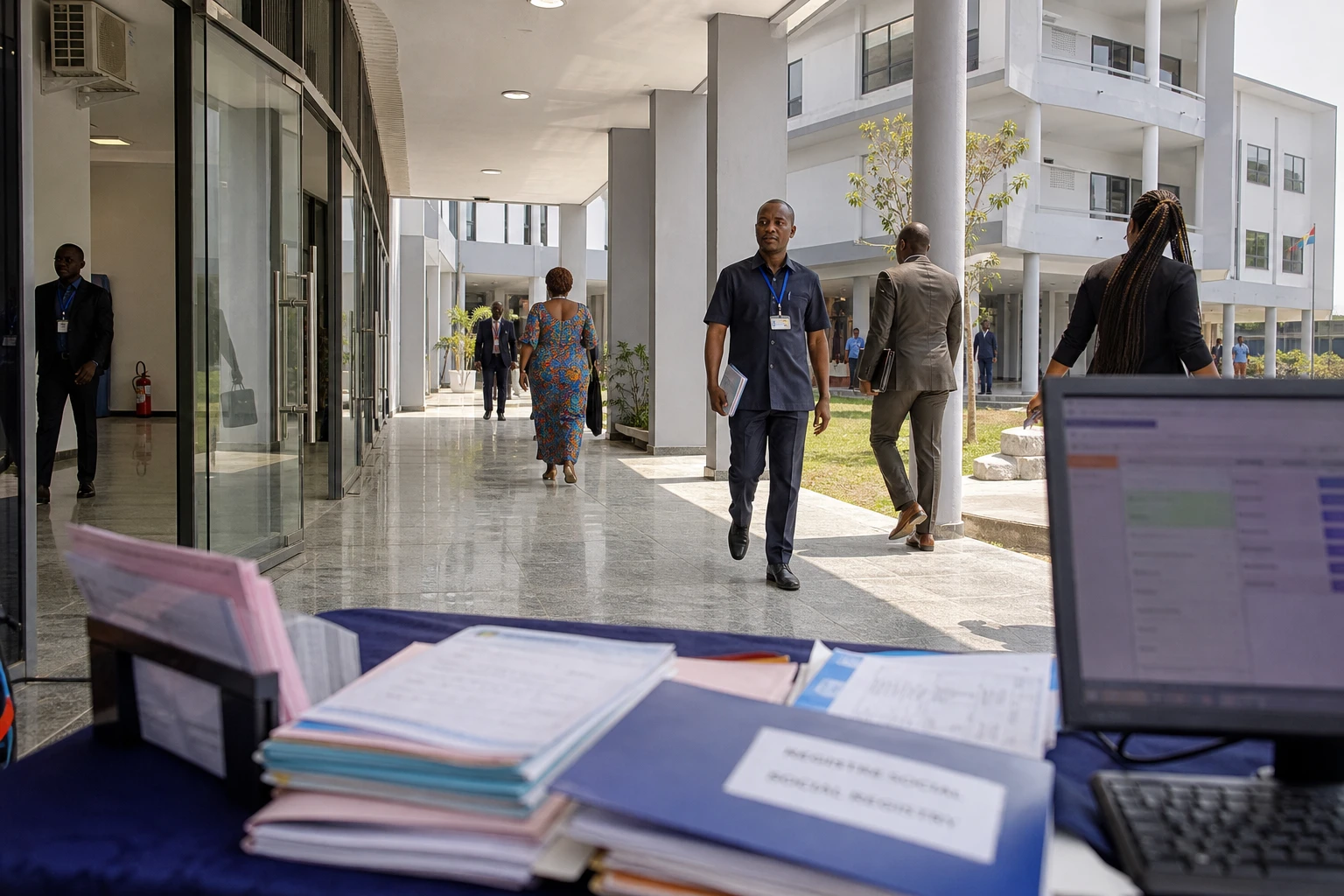
The unified social registry has become one of the PSIPJ’s technical cornerstones. It is used to identify poor households and avoid duplication between programmes. The World Bank recently said the database contained information on 852,149 households, a substantial number in a country of 6.1 million people. The Congolese Ministry of Planning, for its part, stresses that the registry’s software has been fully deployed, considering it essential for targeting and monitoring.
For the authorities, the challenge is twofold. First, the system must be made easier for local administrations and social service providers to understand. Second, they must demonstrate that payments, beneficiary lists and training follow verifiable rules. With payment delays reported in 2025, the World Bank’s support mission must also assess the project’s ability to address bottlenecks without disrupting the momentum already established.
The implications extend beyond the Republic of the Congo. Across Central Africa, the PSIPJ illustrates a broader trend: states are seeking to build social safety nets that are more targeted, more digital and more focused on productivity. This trend is of interest to CEMAC and to the African Union, which for several years has urged governments to better link social protection, youth employment and household resilience. In the Republic of the Congo, the next phase will show whether the country can turn a well-funded programme into a lasting tool for social mobility. That is where the model’s credibility will be tested, far more than in a mission report.