Algeria
 Egypt
 Libya
 Morocco
 Sudan
 Tunisia
 Benin
 Burkina Faso
 Cabo Verde
 Côte d'Ivoire
 Ghana
 Guinea
 Guinea-Bissau
 Liberia
 Mali
 Mauritania
 Niger
 Nigeria
 Senegal
 Sierra Leone
 The Gambia
 Togo
 Cameroon
 Central African Republic
 Chad
 DR Congo
 Equatorial Guinea
 Gabon
 São Tomé and Príncipe
 Burundi
 Comoros
 Djibouti
 Eritrea
 Ethiopia
 Kenya
 Madagascar
 Malawi
 Mauritius
 Mozambique
 Rwanda
 Seychelles
 Somalia
 South Sudan
 Tanzania
 Uganda
 Angola
 Botswana
 Eswatini
 Lesotho
 Namibia
 South Africa
 Zambia
 Zimbabwe
A public response to increasingly visible urban violence
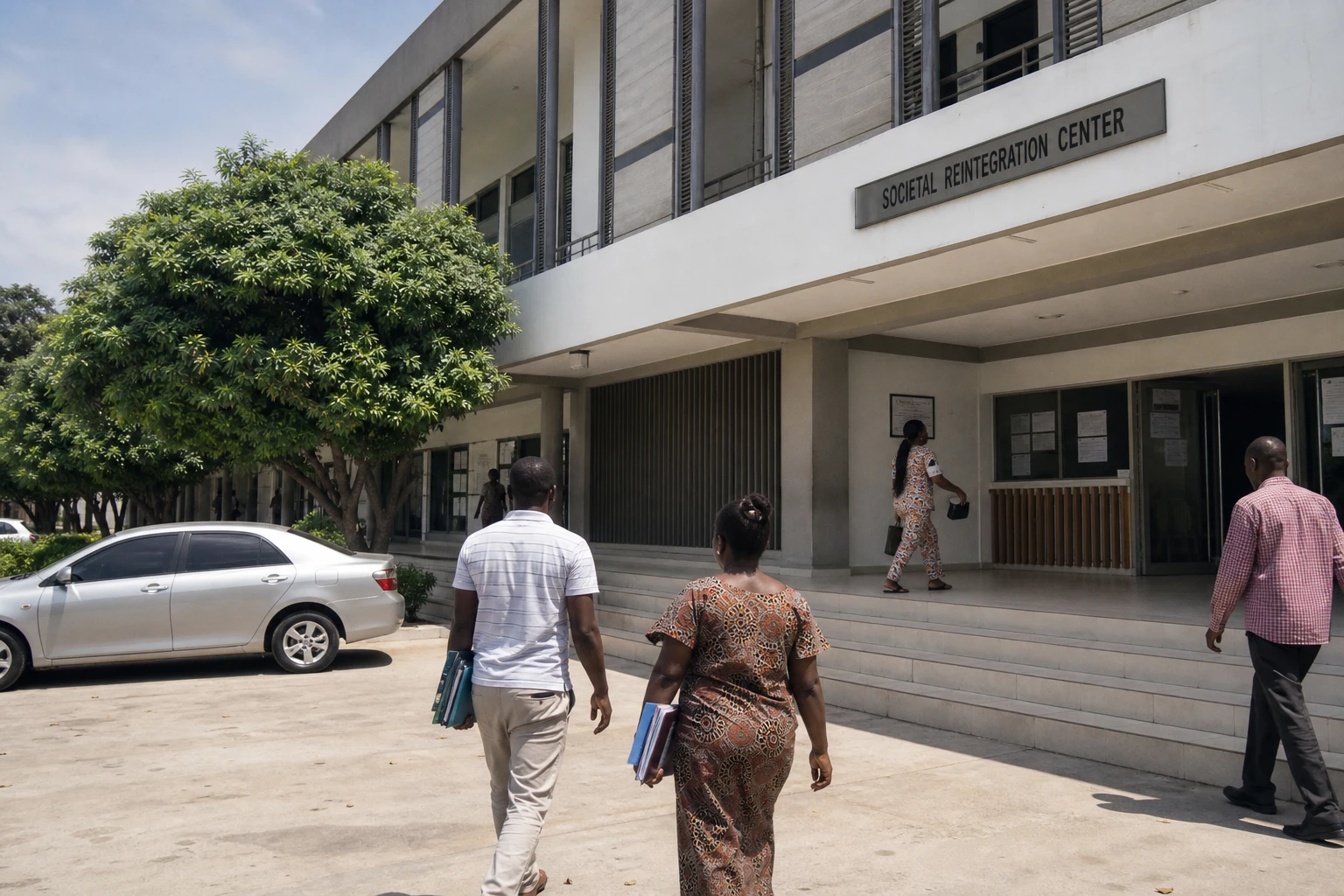
In Congo, the question is no longer just one of arrests. It is also what happens afterwards. At Aubeville, in Bouenza, the authorities are now banking on a facility to support young people in conflict with the law, in a country where juvenile delinquency has become a fixture of public debate as a social, security and educational problem all at once. The youth integration and reintegration centre is part of the search for a way forward through work, supervision and vocational training.
The move is as political as it is social. It signals that the Congolese state no longer wants to deal with these young people’s life trajectories solely through repression. It also wants to take them in hand, after repeated acknowledgement that urban youth are being made vulnerable by unemployment, dropping out of school and drugs, particularly in major centres such as Brazzaville and Pointe-Noire. In its messages on the state of the nation, the presidency had already referred to young people in conflict with the law awaiting transfer to Aubeville, described as one link in a chain of rehabilitation and reintegration.
Aubeville, a construction project turned public policy tool
The site is not just an administrative building. By the time work reported in early 2026 was complete, the Aubeville complex covered 13 hectares and had 40 new buildings, as well as nine other structures, according to the Congolese press. The centre is described as ready to receive its first residents after several months of development. Its expansion was accompanied by training for managers and staff, held in Brazzaville with technical support from the United Nations Development Programme, to make the scheme operational.
The authorities have also laid the administrative groundwork. In autumn 2025, the ministry responsible for youth brought together police, gendarmerie and centre managers to organise the screening of young people who fall under the justice system and those deemed eligible for resocialisation. This detail matters. It shows that the challenge is not simply to open the doors. It is also necessary to decide who gets admitted, for how long and with what follow-up.
In official announcements, Aubeville is intended to combine educational supervision, psychological care and vocational training. The fields cited range from baking and pastry-making to carpentry, agro-pastoral work and welding. The government has also referred to support for young people’s projects after they leave, making the centre more like an instrument of economic integration than simply a place to stay.
What this approach means for young people, families and the state
For the young people concerned, the change is tangible. The centre promises support that lasts longer than a police stop, with a structured pathway towards a trade. For families, it offers a way out of the cycle of street violence, school disruption and repeated exclusion from society. For the state, it is a test of credibility. A centre can be inaugurated in a day. Successful reintegration, by contrast, is measured over several years.
The issue also touches on how Congo treats its young people. In official statements, “youth priority” is now presented as a pillar of the 2022-2026 National Development Plan, with a promise of integration, training and civic service. Aubeville is therefore becoming a symbol: of a state trying to move from a policy of catching up to one of social investment.
But success will depend on overcoming several obstacles. First, the centre must not become merely a disciplinary holding facility. Funding, the quality of supervision and follow-up after release will also have to be maintained. Without that, young people risk returning to Brazzaville, Pointe-Noire or other cities with the same vulnerabilities, but no new points of reference. The Congolese government has already acknowledged that the issue of young people in conflict with the law requires a sustained response, not a one-off operation.
A significance that extends beyond Bouenza
The issue goes beyond the borders of Bouenza and even those of Congo. Across Central Africa, capitals face comparable pressures from urban youth, addiction, unemployment and petty crime. In the CEMAC region, where social policies are unevenly resourced, a centre such as Aubeville raises a simple question: how can a security response be turned into a lasting pathway out?
Its significance is also continental. The African Union and regional institutions have for several years emphasised youth employment, violence prevention and integration through training. Aubeville is part of this broader set of responses, provided the trades taught lead to real opportunities and the project does not remain a publicity exercise. That is where the difference between a showcase site and a useful public tool will be decided.
For Congo, the stakes are clear. The political capital, Brazzaville, accounts for a visible share of social tensions. Bouenza, in turn, is where the state is attempting a different response. If Aubeville delivers on its promises, it could become a model for other countries in the region. Otherwise, it will join the long list of projects conceived to address a crisis but lacking real transformative power.