
 Algeria
 Egypt
 Libya
 Morocco
 Sudan
 Tunisia
 Benin
 Burkina Faso
 Cabo Verde
 Côte d'Ivoire
 Ghana
 Guinea
 Guinea-Bissau
 Liberia
 Mali
 Mauritania
 Niger
 Nigeria
 Senegal
 Sierra Leone
 The Gambia
 Togo
 Central African Republic
 Chad
 DR Congo
 Equatorial Guinea
 Gabon
 Republic of the Congo
 São Tomé and Príncipe
 Burundi
 Comoros
 Djibouti
 Eritrea
 Ethiopia
 Kenya
 Madagascar
 Malawi
 Mauritius
 Mozambique
 Rwanda
 Seychelles
 Somalia
 South Sudan
 Tanzania
 Uganda
 Angola
 Botswana
 Eswatini
 Lesotho
 Namibia
 South Africa
 Zambia
 Zimbabwe
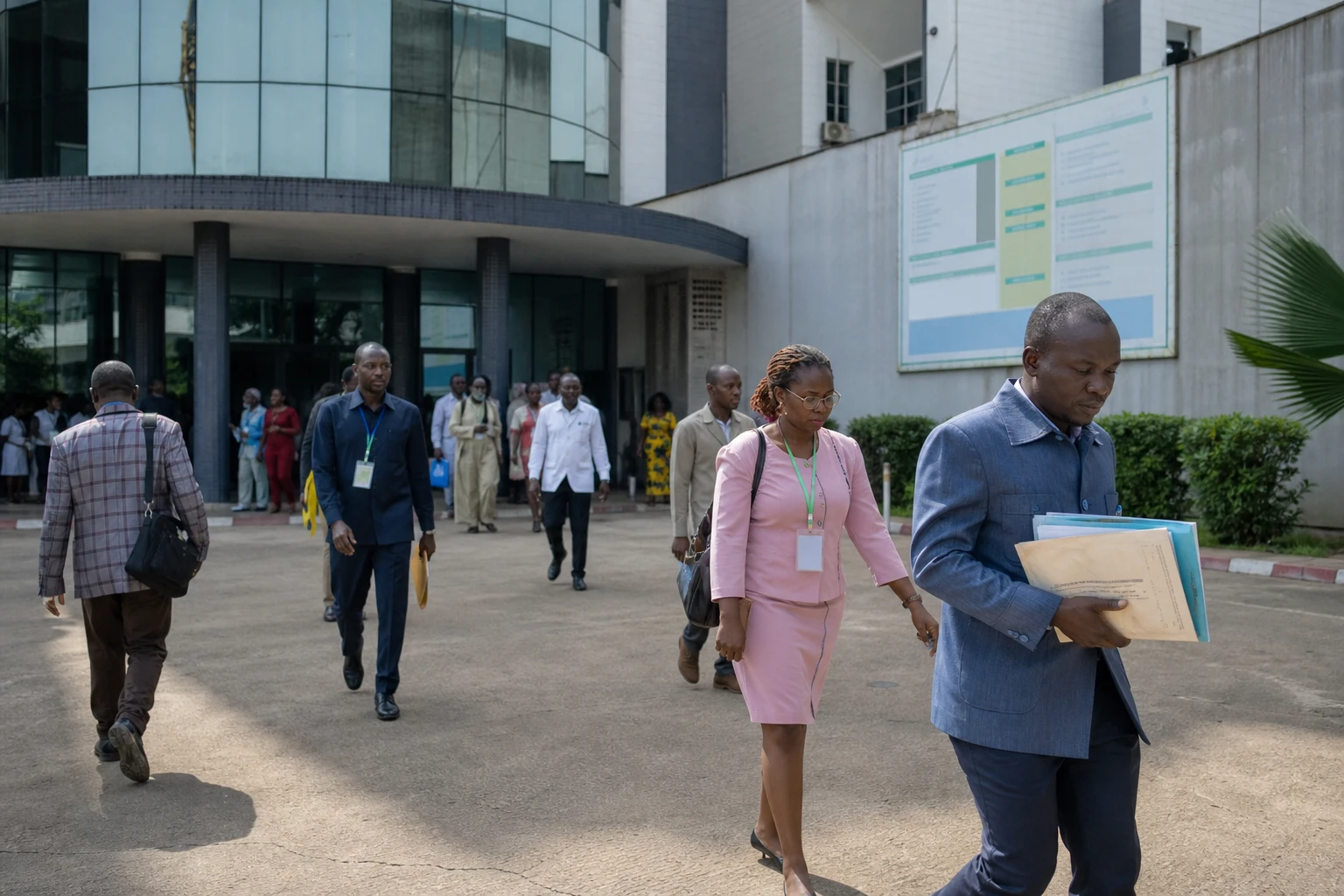
In Douala, a minority party seeks to influence the national debate
In a Cameroon marked by a presidential election held on 12 October 2025 and an institutional agenda already focused on the next legislative and municipal elections, some parties are seeking to make their presence felt in ways other than through ballot-box figures alone. The New Popular Movement, or NMP, chose Douala to showcase this ambition and give its political organisation a new form.
Banda Kani’s party held phase II of its third national congress in Douala on 25 and 26 July 2026. On the occasion, it announced the creation of a “Pan-Africanist People’s Parliament”, an internal structure presented as a space for reflection, direction and activist mobilisation. The movement says it wants to address the country in the name of a Pan-Africanism of government, while also offering a highly critical reading of Cameroon’s political balance of power.
A political congress set against a tense and tightly controlled Cameroonian backdrop
Cameroon remains a state dominated by a strong centralisation of power, even though decentralisation has featured in public debate for years. The national Parliament sits in Yaoundé, the political capital, while Douala remains the country’s main economic centre. In this landscape, political parties that control neither the state apparatus nor a large electoral machine often seek to make their mark through rhetoric, activist networks and ideological battles.
The electoral timetable also weighs on strategies. ELECAM had set the presidential election for 12 October 2025, and the authorities later confirmed that the Constitutional Council would proclaim the results on 27 October 2025. Meanwhile, the Inter-Parliamentary Union’s platform indicates that new legislative elections are expected between 29 January and 19 April 2027. The NMP’s political message must therefore be read in light of this institutional sequence.
The movement is also operating in a particular regional environment. Cameroon belongs to CEMAC, a sub-region where debates on economic sovereignty, currency and integration regularly return to the public sphere. This is precisely the terrain on which the NMP places part of its discourse, linking national politics to the balance of power across the continent.
What Banda Kani says, and what it reveals about the political moment
In Douala, Banda Kani presented his congress as a step towards consolidation. He stressed the training of young people and women, the passing on of activist experience and the need, in his view, to prepare new generations to take part in the country’s political and institutional struggles. This line reprises a theme already present in his previous public statements, in which the NMP defines itself as a Pan-Africanist and sovereigntist party.
The NMP leader also returned to the language of rupture. In his view, the Pan-Africanist struggle is not limited to identity-based rhetoric; it must, he says, transform economic, political and geopolitical relations. This framing gives the party a distinctive place in Cameroon’s political landscape, as it seeks to link opposition to the neo-colonial framework with a stated commitment to the national institutional order. It is therefore not simply a party of witness, but an actor seeking to present itself as a doctrinal force.
This position also sheds light on its distancing from the traditional opposition. The NMP says it rejects anti-Biyaism as its sole horizon and instead presents itself as a systemic opposition, meaning one opposed to the model it considers a legacy of political and intellectual dependence. In the Cameroonian debate, this stance may appeal to some activists seeking a more structured discourse. It may also isolate the party, placing it at a distance from the usual electoral coalitions.
What this episode means for Cameroon and Central Africa
Domestically, the main issue is not merely the holding of a congress, but the NMP’s ability to turn a dense discourse into a lasting political force. In Cameroon, the parties that endure are those able to move beyond ideological statements and build local networks, social alliances and a presence across the country. Douala offers a showcase, but the real test lies in establishing a foothold in the regions, municipalities and working-class communities.
For the population, especially the young urban residents and women whom the party says it wants to train, the promise is of more active participation in public affairs. But this ambition will have to be measured against tangible results: recruitment, organisation, the development of ideas and the ability to address prices, employment, local governance and public services. Without that, Pan-Africanist rhetoric risks remaining confined to grand statements.
At regional level, the NMP’s message joins a broader conversation on sovereignty in Central and West Africa. The organisation of a “Pan-Africanist voice” in Douala is a reminder that debates on reforming regional institutions, currency, historical reparations and the continent’s place in the world order are no longer reserved for state summits. They now run through political parties, the media and activist spaces.
One central question remains: can this kind of initiative shift the balance at a time when Cameroon is entering a new electoral and institutional phase? The answer will depend less on the force of the speeches than on the NMP’s ability to turn its Douala congress into an organisation, a local presence and real influence in the politics of Central Africa.



