Algeria
 Egypt
 Libya
 Morocco
 Sudan
 Tunisia
 Benin
 Burkina Faso
 Cabo Verde
 Côte d'Ivoire
 Ghana
 Guinea
 Guinea-Bissau
 Liberia
 Mali
 Mauritania
 Niger
 Nigeria
 Senegal
 Sierra Leone
 The Gambia
 Togo
 Cameroon
 Central African Republic
 Chad
 DR Congo
 Equatorial Guinea
 Gabon
 Republic of the Congo
 São Tomé and Príncipe
 Comoros
 Djibouti
 Eritrea
 Ethiopia
 Kenya
 Madagascar
 Malawi
 Mauritius
 Mozambique
 Rwanda
 Seychelles
 Somalia
 South Sudan
 Tanzania
 Uganda
 Angola
 Botswana
 Eswatini
 Lesotho
 Namibia
 South Africa
 Zambia
 Zimbabwe
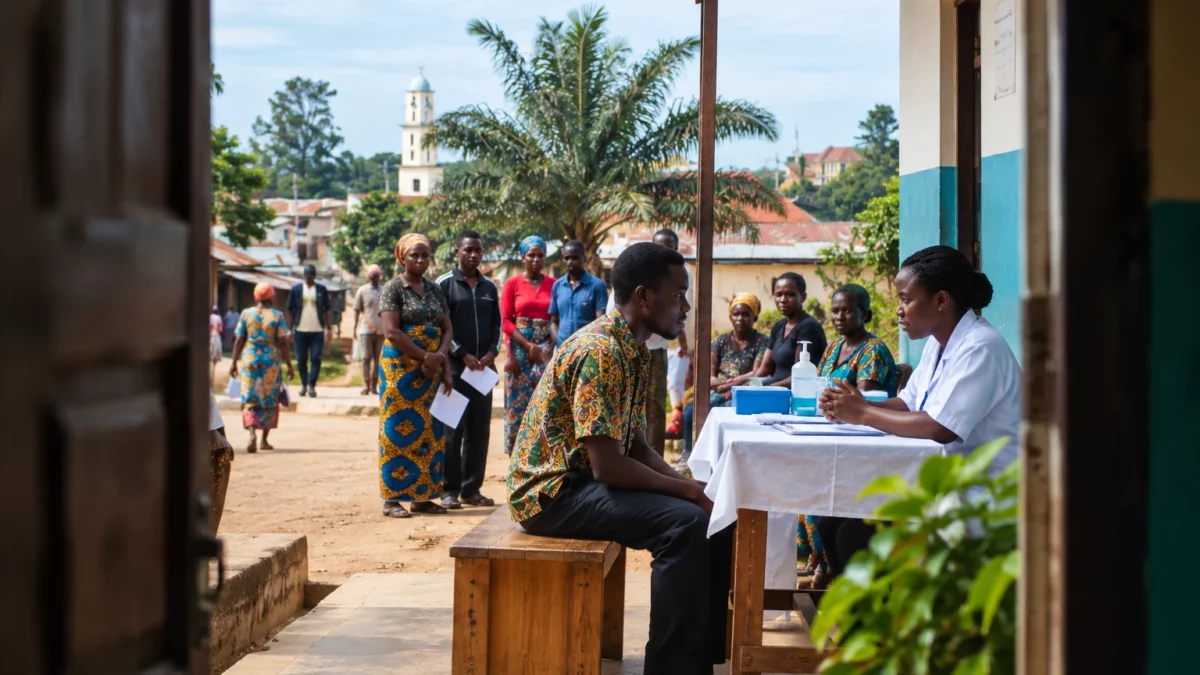
An HIV test does not treat the virus on its own. But it can quickly open the way to treatment, prevention advice and medical follow-up. In Burundi, this first step also depends on very practical conditions: being able to reach a centre, maintain confidentiality and avoid the fear of rejection or violence.
The seventh International Testing Week takes place from 23 to 29 November 2026. Coordinated by Coalition PLUS, it brings together organisations in several dozen countries. This year, the campaign highlights the violence that keeps people away from prevention, testing and care services. In Burundi, the issue takes on added significance as funding for the HIV response has contracted.
Access to care also depends on trust
Burundi is a member of the East African Community (EAC), a regional organisation bringing together several neighbouring countries. In this context, health issues transcend borders: prevention, continuity of treatment and the sharing of information require accessible and robust services in every country.
Burundi’s response relies on public services, international partners and local associations. Among them, the National Association for the Support of People Living with HIV and AIDS, now known as ANSS-Santé PLUS, supports people living with HIV and runs testing activities. Its president, Jeanne Gapiya Niyonzima, also sits on the board of Coalition PLUS.
Testing makes it possible to learn one’s HIV status — that is, whether one is living with the virus. A positive result can lead to antiretroviral treatment, which slows the virus’s multiplication and protects health. A negative result allows people, depending on their individual circumstances, to discuss the prevention options available.
But medical services are not enough if someone fears their result will be disclosed, faces discrimination or cannot travel without risk. Violence and stigma can delay testing. Women, young people and those exposed to discrimination may face particular barriers, although their circumstances are not identical.
Progress to protect despite financial pressure
Burundi has made progress in HIV care. According to the World Health Organization’s 2024 annual report on Burundi, the rate of mother-to-child transmission of the virus fell from 19.4% in 2023 to 8.5% in 2024. This encouraging development does not erase the need for prevention, testing and follow-up for those affected.
Reliance on external aid is an additional vulnerability. In April 2025, UNAIDS reported an immediate funding gap of $6.4 million to cover needs including antiretroviral drugs, rapid tests, medicines for opportunistic infections and transport costs. The organisation also said that a US-funded partner supported prevention and care services in 349 facilities across 18 provinces.
These figures describe a national funding need; they do not prove that every service has been interrupted. They nevertheless show why associations and authorities are monitoring continuity of care. If resources fall, the consequences may vary by area: an urban centre may have several service points, while someone living far from a facility may depend on transport or a community team.
Funding cuts also affect local organisations. They refer people to care, support treatment and help build trust. When these links weaken, the cost is not measured only in the number of tests available: it can also mean delays in diagnosis or more difficult follow-up.
Violence does not stop at the health centre door
Focusing on violence means examining what actually prevents someone from seeking a test. This may include physical or sexual violence, but also threats, rejection by family, discrimination or a lack of confidentiality. These experiences are not interchangeable. They can nevertheless make access to services riskier or more difficult.
The response therefore requires more than a one-off campaign. It calls for places where testing respects consent and confidentiality, staff trained to welcome people without judgement, and referral mechanisms for care. Community organisations can complement public action, but they cannot replace stable funding or the responsibility of national services.
For their part, Burundi’s authorities updated the national HIV prevention and treatment guidelines in 2024. The challenge now is to put those guidelines into practice in facilities and communities, while protecting access to tests and treatment as partner funding declines.
A regional signal on the future of the response
Testing Week highlights an issue that extends beyond Burundi: how to maintain health gains when external resources fluctuate. For EAC countries and the African Union alike, continuity of services depends on regional co-operation, national budgets and partnerships capable of supporting local organisations.
The event from 23 to 29 November will not, on its own, measure changes in access to testing. Indicators to monitor include the availability of tests, referral to treatment, continuity of community services and changes in the resources mobilised. For people in Burundi, the immediate issue remains simple: being able to learn their status and access care without fear, violence or distance closing the door.