Algeria
 Egypt
 Libya
 Morocco
 Sudan
 Tunisia
 Benin
 Cabo Verde
 Côte d'Ivoire
 Ghana
 Guinea
 Guinea-Bissau
 Liberia
 Mali
 Mauritania
 Niger
 Nigeria
 Senegal
 Sierra Leone
 The Gambia
 Togo
 Cameroon
 Central African Republic
 Chad
 DR Congo
 Equatorial Guinea
 Gabon
 Republic of the Congo
 São Tomé and Príncipe
 Burundi
 Comoros
 Djibouti
 Eritrea
 Ethiopia
 Kenya
 Madagascar
 Malawi
 Mauritius
 Mozambique
 Rwanda
 Seychelles
 Somalia
 South Sudan
 Tanzania
 Uganda
 Angola
 Botswana
 Eswatini
 Lesotho
 Namibia
 South Africa
 Zambia
 Zimbabwe
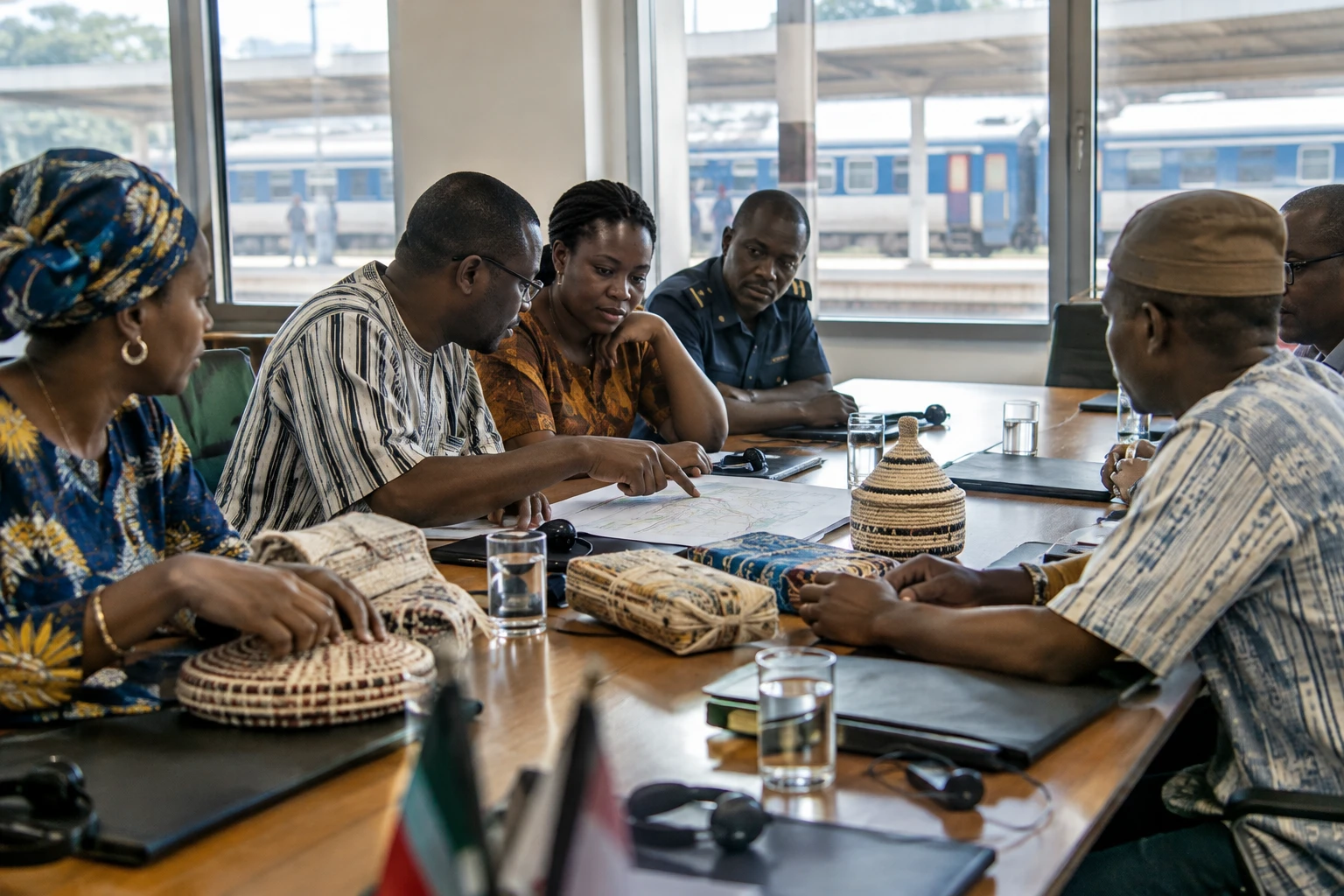
For an artisan, taking part in a fair far from their workshop involves more than finding a seat on a train. They must also transport their work, protect it and absorb the costs of the journey. As the Ouagadougou International Arts and Crafts Fair approaches, a rail operation between Bobo-Dioulasso and the Burkinabè capital aims to ease that burden.
From Guiriko to Ouagadougou, transport covered
On Wednesday 28 October 2026, SITARAIL launched a free shuttle in Bobo-Dioulasso for artisans from the Guiriko region and their goods. The departure comes ahead of the opening of the 18th edition of the Ouagadougou International Arts and Crafts Fair (SIAO), scheduled to run from 30 October to 8 November in the capital.
According to information provided by the company and corroborated by Burkinabè media, the service comprises six freight wagons, each with a stated capacity of 47 tonnes, as well as a passenger train with 320 seats. The theoretical freight capacity is therefore 282 tonnes. Local reports say around 100 artisans boarded in Bobo-Dioulasso. This available capacity does not mean that all the wagons were full.
Passengers and the transport of their work are provided free of charge to beneficiaries. For exhibitors, the advantage is both financial and practical: their pieces can travel with them, without the need to arrange separate transport by road. Artisans interviewed by the Burkinabè press describe transport costs and logistics as recurring barriers to participation.
SIAO, a showcase and market for creators
Established in 1988, SIAO is a biennial event dedicated to exhibiting and marketing craft products. Its 18th edition focuses on the links between African crafts and industrialisation. For creators, the fair is more than a showcase: it can open up opportunities with the public and professional buyers, while highlighting a range of skills.
But access to this showcase requires resources. Travel costs weigh particularly heavily on small workshops and artisans who have to transport bulky or fragile items. Rail assistance can reduce some of these expenses and make it easier for exhibitors to arrive on time. On its own, however, it does not resolve the other challenges of participation: accommodation, set-up, sales and lasting access to markets.
The service links two important centres of Burkina Faso’s economy. Bobo-Dioulasso, the main city in the west, is home to craft and commercial activity; Ouagadougou is where national institutions and the fair are concentrated. The train thus moves people and goods along a domestic route, on a line that also connects Burkina Faso to Côte d’Ivoire.
A one-off initiative on a strategic regional route
SITARAIL, the rail operator on this line under a public-private partnership between the two states, presents the operation as a continuation of previous initiatives supporting cultural and tourism events. The company usually carries freight and passengers; in this instance, it is temporarily deploying a train for an economic and cultural event.
This distinction matters: a special free train organised for a fair does not constitute a regular service or a permanent improvement in access to rail. Its immediate value depends on how the journey is organised and on exhibitors’ needs. Its longer-term impact will depend instead on whether this kind of support can be repeated and links between production centres and markets strengthened.
The Abidjan–Ouagadougou line also has regional significance. It serves freight trade between Côte d’Ivoire and Burkina Faso, two countries whose economic activity is connected by the rail corridor. Since 29 January 2025, Burkina Faso has no longer been a member of ECOWAS, the Economic Community of West African States. Movement and trade along regional routes therefore remain a practical concern, beyond institutional changes.
What the operation cannot yet measure
For artisans, the most immediate benefit is lower transport costs and the ability to travel with their work. For the fair, the presence of creators from Bobo-Dioulasso enriches the range on offer in Ouagadougou. For the operator, the initiative links its rail activity to an event that champions creativity and local economies.
It remains to be seen whether this arrangement can be repeated and whether it will meet the needs of other regions, beyond the participants transported this time. The available information describes the departure and the capacity deployed, but does not yet provide a full assessment of occupancy rates, exhibitors’ sales or the economic impact of the journey.
In the short term, attention is focused on SIAO, running from 30 October to 8 November 2026, and on the opportunities secured by artisans. In the longer term, the question is whether rail can play a regular role in access to major markets and the movement of Burkinabè products, while maintaining trade links with neighbouring countries.
Sources cross-checked: report on the launch in Bobo-Dioulasso, information on beneficiaries and capacity deployed, official SIAO 2026 website and ECOWAS statement on Burkina Faso’s withdrawal.