Algeria
 Egypt
 Libya
 Morocco
 Sudan
 Tunisia
 Benin
 Burkina Faso
 Cabo Verde
 Côte d'Ivoire
 Ghana
 Guinea
 Guinea-Bissau
 Liberia
 Mali
 Mauritania
 Niger
 Nigeria
 Senegal
 Sierra Leone
 The Gambia
 Togo
 Cameroon
 Central African Republic
 Chad
 DR Congo
 Equatorial Guinea
 Gabon
 Republic of the Congo
 São Tomé and Príncipe
 Burundi
 Comoros
 Djibouti
 Eritrea
 Ethiopia
 Kenya
 Madagascar
 Malawi
 Mauritius
 Mozambique
 Rwanda
 Seychelles
 Somalia
 South Sudan
 Tanzania
 Uganda
 Angola
 Eswatini
 Lesotho
 Namibia
 South Africa
 Zambia
 Zimbabwe

Botswana seeks African partners to scale up
In Gaborone, Botswana’s government is looking for more than investment promises. It wants players capable of building quickly, investing heavily and taking a long-term view. That is the focus of recent talks with Aliko Dangote and Mohammed Dewji, two leading African business figures whose groups have already expanded beyond their home markets.
The choice says much about the moment Botswana is going through. The country remains one of Southern Africa’s most stable economies, but its model is still too dependent on diamonds. The World Bank notes that diamonds still account for more than 90% of export earnings, while growth has fallen over the past two years as the global market has weakened.
Against this backdrop, attracting African groups is no symbolic gesture. It is a way of testing Gaborone’s ability to turn its political stability, regional position and announced reforms into concrete projects. Botswana is a member of SADC, the Southern African Development Community, whose headquarters are in Gaborone. This membership matters because Botswana can serve as a platform to reach a regional market larger than its own domestic market.
Close talks with two groups betting on Africa
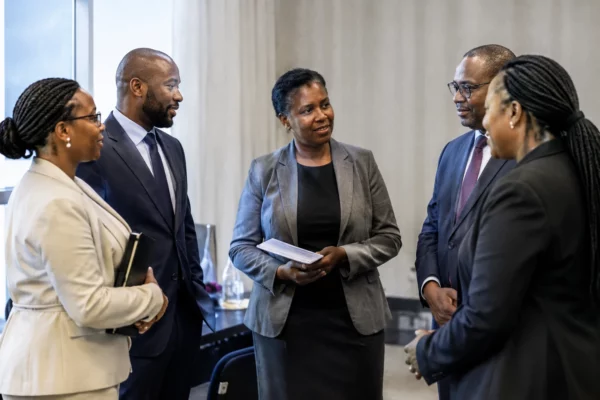
On Thursday 3 September, President Duma Boko received Aliko Dangote in Gaborone. Botswana’s presidency said the meeting focused on investment opportunities and the possible participation of the Dangote Group in major national projects. The authorities’ message is clear: Botswana wants partners that bring capital, but also the ability to deliver.
A few days earlier, on Tuesday 26 August, Duma Boko had received Mohammed Dewji, head of the Tanzanian conglomerate MeTL Group. Here too, the talks focused on possible investment in Botswana, including through the Botswana Stock Exchange and in several productive sectors. According to Botswana’s public broadcaster, Mohammed Dewji described the country as a strategic base for accessing Southern Africa.
The two businessmen’s profiles help explain this interest. Dangote Industries operates in cement, energy, refining, petrochemicals and fertilisers. In May 2026, the group confirmed that it was increasing its planned investment in a fertiliser complex in Ethiopia to more than $4bn, signalling an assertive African strategy.
MeTL, meanwhile, has grown from its Tanzanian base across agribusiness, textiles, consumer goods, logistics, energy and distribution. The group also announced a beverage factory in Mombasa, Kenya, this year, followed by a $250m commitment in Mozambique. These announcements point to a clear regional expansion strategy.
Botswana’s economy under pressure, but still bankable
The core issue is economic. Botswana wants to move away from its long-standing dependence on diamonds, as the sector has lost momentum. The World Bank estimates that Botswana’s economy contracted by 2.8% in 2024 and by 0.7% in 2025. It adds that public debt almost doubled as a share of GDP between 2023 and 2025, reducing the government’s fiscal room for manoeuvre.
The government is aware of this turning point. The Botswana Economic Transformation Programme, or BETP, presented as a framework for economic transformation, aims to attract private finance, speed up reforms and support a more diversified economy. The authorities are now talking about a direction based on services, industry, infrastructure and local value chains.
This shift addresses a tangible need. When diamond revenues fall, public finances, employment and local investment all slow. Cities such as Gaborone feel the impact of frozen projects sooner, while less connected areas remain dependent on the administration, informal markets and public-sector employment. Diversification is therefore no slogan. It is a condition for social stability.
Turning to African capital is also significant. It allows Botswana to engage on equal terms with investors from the continent, without waiting for an outside player’s approval. This is an important perspective in a region where states are increasingly seeking to retain added value on the continent. Botswana is part of a broader trend in Southern Africa: attracting regional entrepreneurs able to finance factories, logistics services and distribution platforms.
What the meetings say about new regional competition
For Duma Boko, the challenge is twofold. He must reassure investors that the state can act quickly, while proving that promises of diversification will not remain theoretical. The presidency has stressed that bureaucratic obstacles should not hold up agreed projects. Botswana’s private sector, often wary of administrative delays, will be watching this promise closely.
For Dangote and Dewji, Botswana represents more than another market. It could be a gateway to SADC, with a stable political base, an institutional framework familiar to investors and a reputation for relatively sound governance. But the country will only attract this kind of capital if it offers guarantees on project delivery, access to land, tax rules and project oversight. Botswana’s message is simple: the door is open, but proposals will be judged on results.
At the continental level, the case reflects a broader trend. Africa does not lack capital alone; it often lacks bridges between African wealth, regional markets and public industrial strategies. Botswana is taking a pragmatic approach: mobilising African champions to accelerate its own transformation while strengthening its foothold in Southern Africa. What happens next will come down to one specific point: the announcement of measurable projects, with clearly identified amounts, timelines and sectors.