Algeria
 Egypt
 Libya
 Morocco
 Sudan
 Tunisia
 Benin
 Cabo Verde
 Côte d'Ivoire
 Ghana
 Guinea
 Guinea-Bissau
 Liberia
 Mali
 Mauritania
 Niger
 Nigeria
 Senegal
 Sierra Leone
 The Gambia
 Togo
 Cameroon
 Central African Republic
 Chad
 DR Congo
 Equatorial Guinea
 Gabon
 Republic of the Congo
 São Tomé and Príncipe
 Burundi
 Comoros
 Djibouti
 Eritrea
 Ethiopia
 Kenya
 Madagascar
 Malawi
 Mauritius
 Mozambique
 Rwanda
 Seychelles
 Somalia
 South Sudan
 Tanzania
 Uganda
 Angola
 Botswana
 Eswatini
 Lesotho
 Namibia
 South Africa
 Zambia
 Zimbabwe
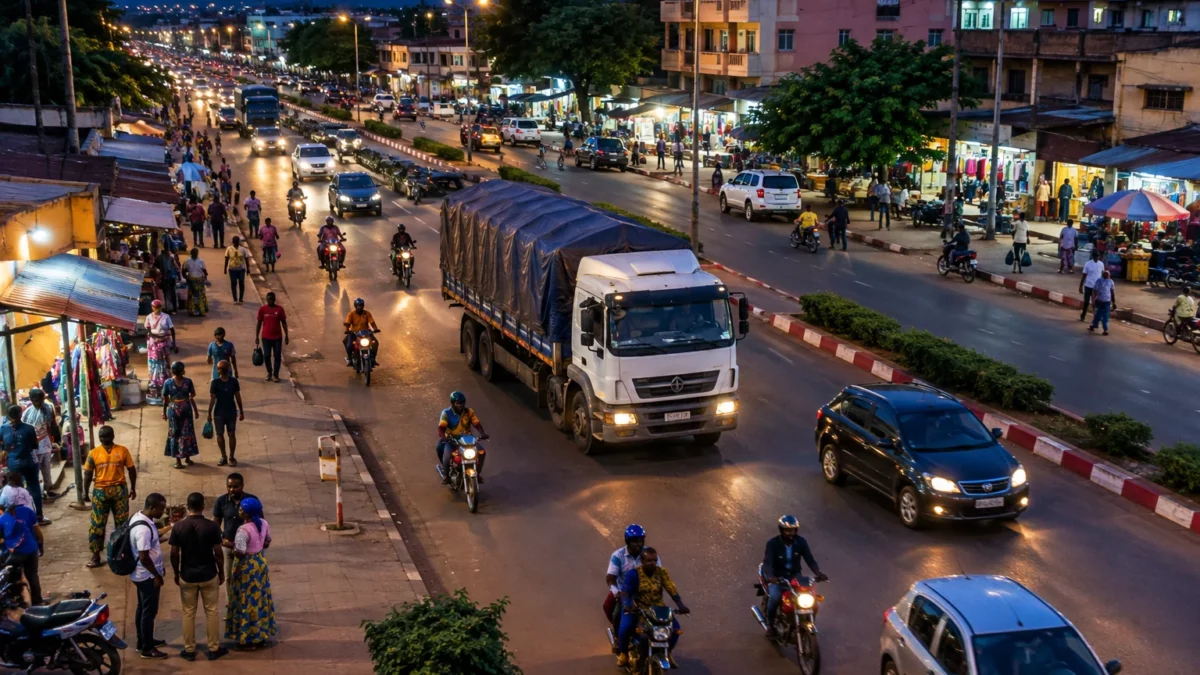
In Bobo-Dioulasso, diverting heavy goods vehicles from the city centre is about more than easing traffic. It is also a question of access to the dry port, safety on urban roads and time lost by residents and hauliers alike.
The official launch of the south-eastern ring road is announced for Monday 30 November 2026. But public documents do not all give the same length: some refer to around 12 kilometres, while tender notices and recent project documents put it at about 10 kilometres. This difference needs to be clarified before the route is presented as definitively settled.
A link designed around the dry port
Bobo-Dioulasso is Burkina Faso’s second-largest city and an important hub for trade between the country’s economic capital in the west, other regions and neighbouring borders. The ring road is intended to link national roads RN1, RN7 and RN8, serving the dry port, a platform where goods can be handled, stored and dispatched.
The project is part of the Secondary Cities Urban Mobility and Development Project (PMDUVS). Funded by a credit from the International Development Association, the World Bank’s arm for low-income countries, the initiative also covers Kaya and Ouahigouya. Its overall budget is estimated at $200 million. The programme plans investment in mobility, urban services and cities’ management capacity.
The Burkinabè government launched the PMDUVS in Bobo-Dioulasso in February 2024. At that stage, the authorities described a ring road of around 11 kilometres. Consultation documents published later set out a route of about 12 kilometres between RN1, RN7 and RN8. In 2026, available procurement documents instead describe around 10 kilometres. These figures may refer to different stages or scopes; the sources consulted do not make it possible to determine which.
The announced launch date of 30 November 2026 was reported by a Burkinabè news outlet. The World Bank has documented the road project and its route, while the PMDUVS official website publishes procurement and study documents on the ring road. However, the material found does not independently confirm the ceremony on 30 November. The date should therefore be treated as an announcement, not as a launch that has already taken place.
A matter of traffic, but also of access
If the link is completed and properly connected, lorries will be able to bypass part of the city centre to reach the dry port or national roads. Hauliers could save time. Neighbourhoods crossed by heavy goods vehicles could face less disruption and fewer conflicts between heavy traffic, motorbikes, cars and pedestrians.
But the benefits will be neither automatic nor the same for everyone. Businesses and dry-port operators will depend on smooth access. Residents will need safe crossings, signs, drainage and measures to control dust during construction. For traders along the roads, a change in traffic flows could also shift customers elsewhere rather than simply boost business.
The PMDUVS also aims to improve access to services and economic opportunities for people in the cities concerned, including displaced people. This gives the project a broader dimension than that of a simple bypass. But the ring road will not replace local access streets, public transport or pedestrian infrastructure, all of which underpin daily travel within Bobo-Dioulasso.
The project’s funding is substantial, but it does not by itself resolve the question of maintenance. A deteriorating road surface, inadequate drainage structures or incomplete connections can quickly reduce the usefulness of a new route. Contracts, the construction timetable, road-safety measures and maintenance responsibilities will therefore matter just as much as the launch ceremony.
An urban strategy to follow beyond Bobo
The ring road is part of a broader effort to modernise transport infrastructure in Burkina Faso. Nationwide, needs span roads between cities, urban streets and rural tracks. For producers and traders, network quality affects the cost and reliability of deliveries; for residents, it determines access to work, healthcare and services.
The regional dimension is also tangible. Bobo-Dioulasso connects domestic trade with West African corridors. In an area where goods move between several countries and operators have to contend with sometimes lengthy routes, better local access can facilitate transit. It does not, however, resolve problems at borders or constraints on intercity roads.
Burkina Faso is a member of the Alliance of Sahel States alongside Mali and Niger, having withdrawn from the Economic Community of West African States. This context is reshaping regional cooperation, but the ring road is primarily a national project backed by the World Bank; its funding should not therefore be confused with an initiative of the AES or ECOWAS.
The next step will be to verify the announced launch, then follow the final route, construction duration, any compensation arrangements and the connections to the dry port. PMDUVS and World Bank documents set out the mobility objective and planned features, but the published discrepancies over the road’s length still need to be clarified. For Bobo-Dioulasso residents, success will be measured less by the announcement than by the new road’s ability to reduce disruption without isolating the neighbourhoods it crosses.
Documentary references: official PMDUVS overview, World Bank consultation on the route, Burkinabè public notice relating to the works.